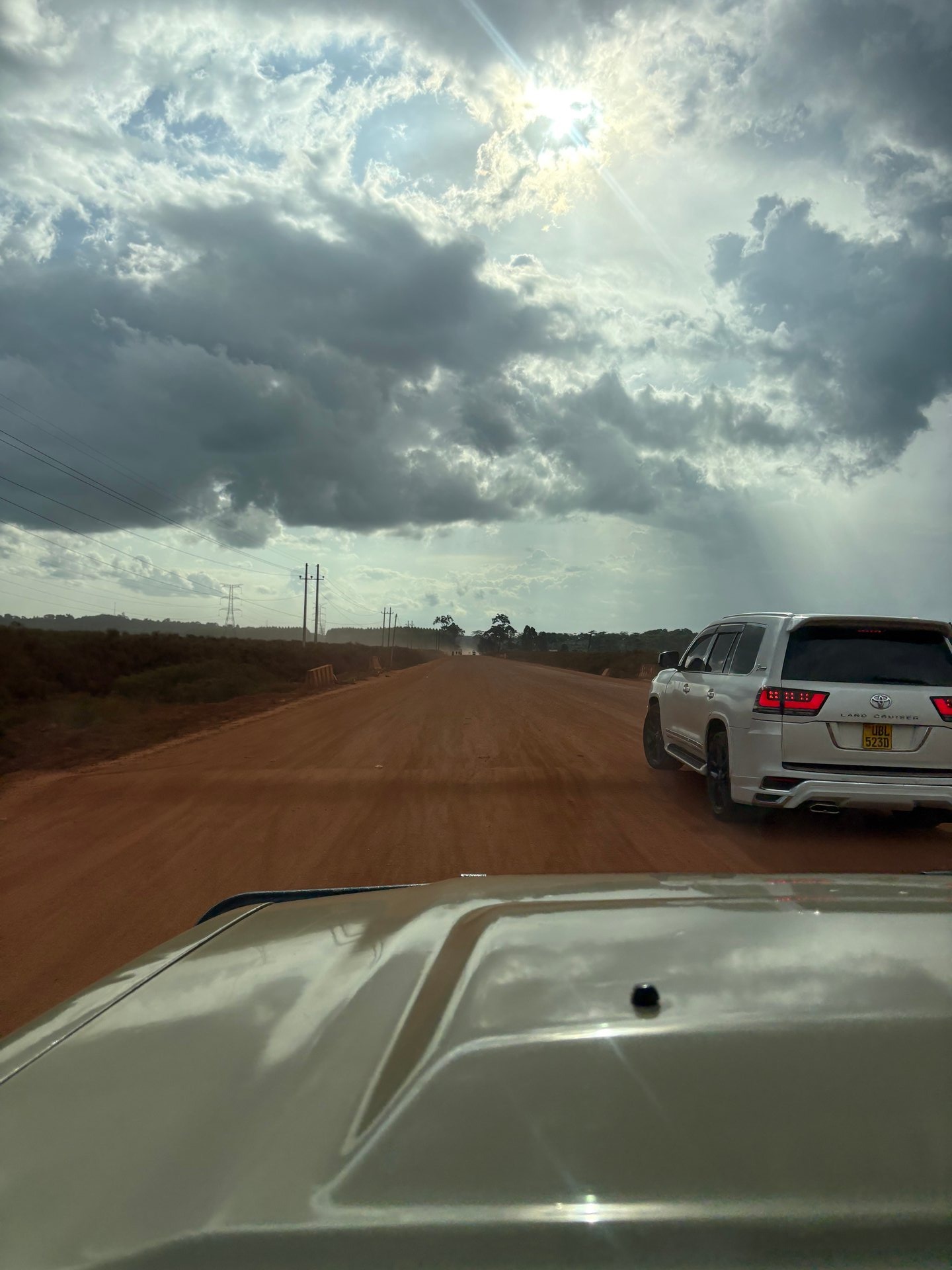
We were making our way along the Masaka Highway with our driver, a long red-dust corridor that cuts straight through the flat, green landscape of central Uganda. The road is rough in the way long-neglected roads always are — corrugated in places, loose at the edges, the kind of surface that makes conversation difficult. Renovation work is planned for 2026, but until then the dust rises in pale columns behind every vehicle. Above us, the sky was doing something spectacular: the sun pressing through thick cloud cover in wide diagonal shafts, the kind of light you only notice when you have nothing to do but look out the window and wait.
We were not yet close to Bwindi. The journey to Buhoma demands patience before it delivers its rewards. During my visit in October 2024, and again in January 2026, I drove versions of this same route, watching the landscape shift from equatorial flatlands to the steep tea-covered hills of southwestern Uganda. By the time the road begins to climb toward Bwindi Impenetrable National Park, you understand why the people who live and work at the end of it carry a particular kind of self-reliance.
Norman is one of those people. He has built his working life around a motorcycle and a deep knowledge of the terrain surrounding Buhoma. He is not a wildlife ranger or a licensed gorilla trekking guide in the formal Uganda Wildlife Authority sense — his domain is the space between the official tourism infrastructure and the actual texture of life in the community. He knows which villages sit beyond the reach of the main track, which families produce the best local honey, where the best viewpoint over the Bwindi forest canopy can be reached in under an hour on a motorcycle, and which community projects are genuinely worth a visitor's time and money.
Buhoma: The Village at the Gate of the Forest
Buhoma is the northernmost entry point into Bwindi Impenetrable National Park and the most visited. It sits at roughly 1,600 metres above sea level on the edge of the ancient montane forest, a small collection of lodges, guesthouses, community projects, and the Uganda Wildlife Authority ranger station where gorilla trekking groups assemble every morning. The village did not always look this way. Before gorilla trekking permits became the economic cornerstone of the region, Buhoma was a subsistence farming community, its residents growing sorghum, beans, and sweet potatoes on the steep surrounding hillsides. The arrival of international tourism transformed the village incrementally but decisively.
Today, Buhoma exists at the intersection of two worlds that do not always fit together easily: the global appetite for close-range wildlife encounters, and the daily economic reality of a rural Ugandan community. Lodges range from basic bandas to luxury tented camps. Local women sell craft items near the park gate. Community cultural performances have been formalized into ticketed experiences. And men like Norman have built livelihoods around the movement of visitors — not as trackers or porters, though those roles also exist — but as motorcycle guides who combine local transport with knowledge of the landscape, the people, and the routes that do not appear on any map.
The broader context matters. Uganda's Uganda Wildlife Authority managed twelve national parks and three active game reserves, offering products from gorilla tracking to nature walks and bird watching. Between 2009 and 2013, visitor numbers to Uganda's national parks grew by 41 percent, reaching more than 213,000 annual visits. Of those, 47 percent were foreign non-residents — the international tourists whose permit fees ultimately finance both conservation and the community revenue-sharing programs that benefit villages like Buhoma. Norman's work exists because those visitors arrive, and because Buhoma is too layered and too alive to be fully experienced from inside a lodge or at the end of a trekking trail.
A Portrait of Norman: Motorcycle Guide and Local Entrepreneur
Norman has built his working life around a motorcycle and a deep knowledge of the terrain surrounding Buhoma. He is not a wildlife ranger or a licensed gorilla trekking guide in the formal UWA sense — his domain is the space between the official tourism infrastructure and the actual texture of life in the community. He knows which villages sit beyond the reach of the main track, which families produce the best local honey, where the best viewpoint over the Bwindi forest canopy can be reached in under an hour on a motorcycle, and which community projects are genuinely worth a visitor's time and money.
The work of a motorcycle tour guide in a place like Buhoma requires more than riding skill. Norman must navigate the expectations of international visitors, many of whom arrive with strong pre-formed ideas about what an “authentic” community experience should look like. He operates in a tourism economy where the gorilla trekking permit — priced for international conservation finance — represents a sum that most of his neighbors will never hold in their hands at once. His role is partly logistical and partly interpretive: he is a bridge between the park gate and the community beyond it.
Norman's challenges are structural as well as personal. The roads around Buhoma are difficult by any measure — steep, seasonally muddy, and in the wet season genuinely dangerous on two wheels. Vehicle maintenance in a remote location is costly. Competition among boda boda operators and informal guides is real. And the seasonal nature of gorilla trekking tourism means that income is concentrated into certain months of the year, with dry seasons bringing full lodges and high activity, and the wettest weeks bringing quiet. Managing that irregularity while keeping a motorcycle roadworthy and building a reputation among returning visitors and tour operators requires a particular combination of patience and entrepreneurial thinking.
What keeps Norman working in tourism despite the challenges of the roads and the competition is a combination of deep local knowledge and the relationships he has built with visitors over years of consistent, trustworthy work. His value cannot be replicated by a booking platform.
What is certain is that Norman represents a model of community participation in tourism that is less visible than the lodge staff or the park rangers but equally important to the quality of a visitor's experience. The people who find him — through a lodge recommendation, a word-of-mouth referral, or simply by asking at the right guesthouse — tend to come away with a version of Buhoma that the brochures do not contain.
Tourism as an Economic Force in the Buhoma Community
Tourism is not simply an industry in Buhoma — it is the primary economic organizer of the community's relationship to the outside world. The gorilla trekking permit system, managed by Uganda Wildlife Authority, channels a portion of permit revenues back to communities surrounding the park. This revenue-sharing mechanism is designed to give local residents a material interest in the continued existence of the gorillas and the forest, replacing the economic logic of encroachment with the economic logic of conservation. In practice, the relationship is more complex, with communities negotiating their share of benefits while managing the social changes that come with sustained international tourism.
Norman's work fits into this economy at the informal entrepreneurial layer — the layer that formal statistics do not always capture but that visitors experience directly. Beyond the lodges and the licensed trackers, there is a whole ecosystem of guides, craft sellers, transport operators, cooks, launders, and fixers whose livelihoods depend on visitor numbers and visitor behaviour. When Uganda's national park visits grew by 41 percent between 2009 and 2013, the effect was felt not just in park revenues but in this informal layer as well. More visitors meant more demand for the services Norman and his counterparts provide.
The challenge for community members who work at this informal layer is that their economic security tracks global events as much as local ones. The COVID-19 pandemic in 2020 shut gorilla trekking entirely for months. Political instability in neighbouring countries affects visitor numbers from regional markets. The proportion of visitors from within the East African Community — running at around 24 percent of national park visitors, second only to foreign non-residents — shifts with economic conditions and exchange rates. Norman has no control over any of these variables. What he controls is his reputation, his reliability, and his knowledge of a landscape that changes with every season.
Community-based tourism initiatives in the Buhoma area have worked to provide more stable economic channels: the Buhoma Community Rest Camp, cultural dance performances, craft cooperatives. These formalizations help, but they also change the nature of the exchange. The most vivid encounters visitors describe tend to be the unscripted ones — an unplanned conversation at a roadside, a detour on a motorcycle to somewhere not on any itinerary, a meal at a family home that no booking platform lists. Norman operates primarily in this unscripted space.
Motorcycles and Mobility: The Boda Boda Economy of Rural Uganda
The boda boda — motorcycle taxi — is one of the most consequential innovations in Ugandan transport over the past two decades. In urban areas like Kampala, boda bodas move enormous numbers of people through traffic that would otherwise be gridlocked, at a cost accessible to almost any income level. In rural areas, they reach communities and terrain that no minibus or car service can serve. The motorcycle is, in much of Uganda, the only form of motorized transport that can reliably navigate the steep, unpaved tracks that connect villages to market towns and town centres to national park gates.
The safety profile of motorcycle transport in Uganda is serious and well-documented. Data from Kampala in 2023 showed that motorcycles accounted for 50 percent of traffic fatalities and 61 percent of serious injuries in the city — a stark figure that reflects both the volume of motorcycle use and the road conditions under which riders operate. In rural areas, where roads are rougher, lighting is absent, and emergency medical care is distant, the risks compound further. This is the working environment Norman navigates daily, on roads that are only beginning to receive the infrastructure investment they need.
For Norman, the motorcycle is not just a tool — it is the fixed capital investment around which his entire livelihood is organized. A reliable motorcycle in good mechanical condition is the difference between being able to work and not being able to work. Maintenance costs, fuel prices, and the unpredictable timing of mechanical failures are permanent variables in his business calculation. The planned renovation of the Masaka Highway, which we drove along on our way toward Bwindi, represents the kind of infrastructure investment that eventually improves conditions across the entire transport network — but the roads in and around Buhoma itself still present the challenges they always have.
What separates a guide like Norman from a purely functional boda boda operator is the accumulated knowledge he brings to every ride. He knows which viewpoints are accessible by motorcycle and which require walking. He knows the road conditions in each season. He knows the community members his visitors might want to meet, the local projects worth supporting, and the distances that can genuinely be covered in an afternoon. That knowledge is the product of years of work, not something replicable by a maps application or a travel blog.
The Forest at the End of the Road: Gorilla Trekking and the Buhoma Experience
The reason most international visitors find themselves in Buhoma is the mountain gorilla. Bwindi Impenetrable National Park shelters more than half of the world's remaining mountain gorilla population — a species that exists nowhere outside of this corner of the Albertine Rift ecosystem. Gorilla trekking permits allow small groups to spend one hour in the presence of a habituated gorilla family, guided by UWA rangers through forest that can be dense, steep, and genuinely demanding.
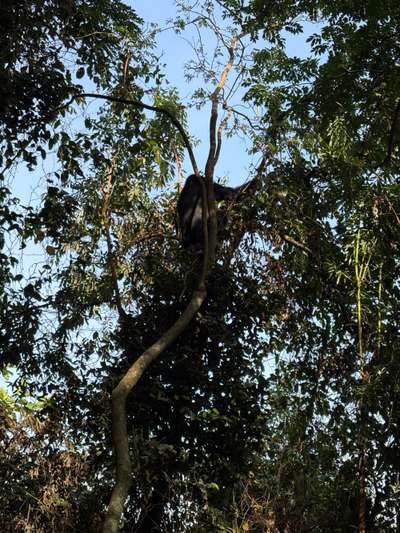
During our gorilla trekking in January 2026, our group encountered the first gorilla family within about an hour of setting out from the Buhoma trailhead. The first individual we saw was sitting up in the branches of a large tree, feeding on leaves with the unhurried calm of an animal that has no natural predators and no particular interest in the watching humans below. The forest canopy filtered the light into something diffuse and green. This is the moment that draws visitors across continents — but it is also, in an important sense, the culmination of everything that happens before it: the long road, the early morning briefing, the climb through the undergrowth, and all the logistics that people like Norman help make possible.
The gorillas of Bwindi are not confined to the trekking zones. They move through forest that covers more than 321 square kilometres, crossing the invisible boundaries that separate Uganda from the Democratic Republic of Congo and Rwanda. Their survival depends on the integrity of the forest, which in turn depends on the economic incentive structure that makes conservation more valuable to surrounding communities than conversion to farmland. Gorilla trekking tourism, for all its complexity, is the mechanism that currently sustains that incentive. Norman's livelihood and the gorilla's habitat are, in this sense, connected by the same economic chain.
Buhoma as the northern sector entry point offers something that the other sectors — Rushaga, Nkuringo, Ruhija — do not: proximity to the park gate from the main approach roads, a relatively established tourism infrastructure, and the density of community life that comes with being the oldest and most developed sector. Visitors who arrive in Buhoma for the gorillas and spend only the minimum time often leave having touched only the surface. A day with a guide who knows the community as Norman does can reshape the experience entirely.
What Community Tourism in Buhoma Actually Looks Like
Community tourism is a phrase that gets used across a wide spectrum, from carefully choreographed cultural performances staged for bus-tour groups to genuinely unscripted encounters facilitated by people who live and work in the community they are showing visitors. The quality of the experience depends almost entirely on the quality of the human bridge between visitor and place.
Norman's approach — or at least what can be understood of it from the portrait this page begins to sketch — sits closer to the unscripted end of that spectrum. A motorcycle tour with him is not a packaged product with a fixed itinerary and a standardized presentation. It is a negotiated route through a landscape he knows intimately, shaped by the visitor's questions and his own sense of what is worth seeing on a given day. That unpredictability is the value, not a deficiency.
The Voices of Buhoma project, under which Norman's story is being documented, is an attempt to capture and share exactly this kind of community knowledge before it becomes invisible beneath the smoothed surfaces of packaged tourism. Audio recordings, GPS-tagged photographs, and first-hand accounts from community members constitute a form of documentation that no official tourism publication produces. The result is a portrait of Buhoma that is specific, grounded, and honest about the difficulties of the work alongside its rewards.
For visitors planning time in Bwindi, the practical implication is straightforward: build in time that is not filled with pre-booked activities. The hour spent at the park gate waiting for the morning briefing, the afternoon after the trekking group has returned, the early evening before dinner — these are the windows in which encounters with people like Norman become possible. Buhoma rewards the visitor who arrives with curiosity and a tolerance for improvisation. The gorillas are the reason to come. The community is the reason to stay longer.
The infrastructure picture is improving incrementally. Road renovation projects will eventually reduce the isolation that has historically defined life in southwestern Uganda's highlands. Better road surfaces will reduce Norman's maintenance costs and extend his working season. More reliable transport connections will make it easier for lodges to bring in the goods and staff they need. Whether those improvements will also change the texture of community life in Buhoma — making it more accessible but also more homogeneous — is one of the open questions that anyone working in community tourism in the region is watching carefully.