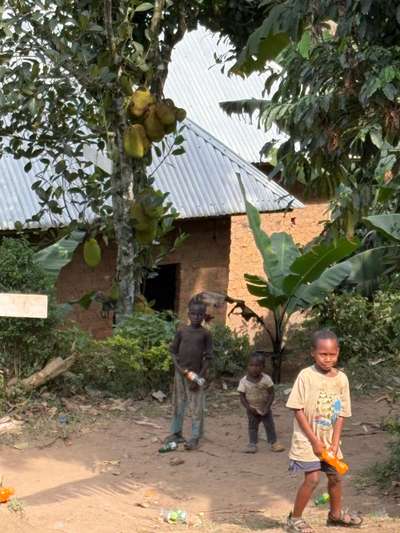
On a June morning in Buhoma, a few hundred metres from the park boundary, a farmer is feeding chickens in a yard edged by banana plants. He has farmed this land his whole life, and he can tell you without much hesitation when the elephants last came through. Not this week. Maybe last month. They come at night and they go before first light, and in the morning he checks the perimeter. So far this season, his crop has been spared.
Bwindi Impenetrable National Park is known globally for its mountain gorillas. What rarely enters the conversation is the small, ecologically irreplaceable elephant population that shares this forest — or the national population trend that gives its conservation an urgency it did not have a decade ago.
Forty Elephants in a Forest of 321 Square Kilometres
Bwindi's elephant population is estimated at no more than 40 individuals. That figure makes it one of the smallest in Uganda and one of the most ecologically isolated. These animals share 321 km² of montane and lowland rainforest with over 120 other mammal species, but their numbers are so low that most visitors — and even many researchers — spend time in Bwindi without ever seeing one.
Uganda's elephant populations were devastated by poaching during the political upheaval of the 1970s and 1980s. While savanna populations in Queen Elizabeth National Park and Murchison Falls National Park have partially recovered, Bwindi's forest elephants exist in a geographically constrained habitat with limited room for expansion. The dense canopy and mountainous terrain that make Bwindi so valuable for gorillas make it a difficult environment for a species that typically ranges across large territories.

Uganda's National Elephant Population: A Declining Trend
Uganda's national elephant population peaked at approximately 7,975 individuals in the 2018–2020 wildlife survey — a significant recovery from the low of around 5,739 recorded in the 2011–2014 survey, itself a baseline set after decades of poaching pressure. The most recent estimates place the national count at roughly 6,352, a decline of more than 1,600 individuals from that peak. The trend is being monitored closely.
The drop is not uniform across Uganda's parks. Murchison Falls National Park holds the largest share of the national population. Queen Elizabeth National Park and Kidepo Valley support significant populations as well. Bwindi's 40 individuals represent a fraction of the national total, but their loss would be irreversible: a reproductively viable forest-elephant population cannot be rebuilt from neighbouring parks with fundamentally different habitat.
For context, Uganda's other flagship species are facing similar pressures. The mountain gorilla population of 459 has held stable across monitoring periods — a conservation achievement in a global climate of declining large-mammal numbers. Lions, by contrast, have declined sharply: from 493 in 2011 to approximately 291 in 2025, a fall of more than 40 percent. Elephants sit between these trajectories — recovering in some areas, declining in the national aggregate.
Forest Behaviour: Why You Almost Never See Them
Forest elephants worldwide are significantly more elusive than savanna relatives — and Bwindi's small population, with decades of accumulated wariness of human presence, is particularly difficult to encounter. Elephants in Bwindi are primarily active at dawn, dusk, and through the night. During daylight hours, when gorilla trekking groups move through the forest, they tend to keep distance and retreat into the densest cover.
What visitors are far more likely to find is evidence rather than the animals themselves. A fresh pile of dung the size of a bucket. A tree stripped of its bark in a pattern no other animal produces. A section of undergrowth pushed flat where an animal many times human weight moved through it. Muddy water holes with outsized footprints. On a gorilla trek in dense forest, these signs can appear suddenly and unexpectedly — a reminder that the forest holds more than what is visible.
Ecological Role: Architects of the Forest
A population of 40 elephants might seem too small to matter ecologically. In reality, even this handful of animals plays a disproportionate role in shaping Bwindi's forest structure. Elephants are primary seed dispersers — they consume large quantities of fruit and deposit seeds in viable condition far from the parent tree through their dung. In a complex rainforest where many tree species depend on large frugivores for dispersal, elephants are irreplaceable. They also open clearings by pushing down trees and stripping bark, creating microhabitats that benefit other species.
The loss of Bwindi's elephants — already at critically low numbers — would have cascading effects on forest composition over decades. Conservation of this population is therefore not simply about protecting a charismatic species but about maintaining a functional ecosystem.

Nocturnal Wildlife in the Same Forest
Bwindi's forest supports two nocturnal primate species that share the same canopy and undergrowth with the elephants below. The potto (Perodicticus potto) is a slow-moving, deliberate primate that grips branches with a strength remarkable for its size, emerging after dark to feed on insects, fruit, and tree gum. Thomas's bushbaby (Galago thomasi) is the opposite in character: fast, vocal, and acrobatic, with enormous eyes adapted to near-total darkness.
Neither is visible on a standard gorilla trek. Spotting them requires a guided night walk with a spotlight — a separate activity offered by some lodges in the Buhoma sector. The calls of the bushbaby, in particular, are audible on clear nights from lodge terraces and can provide an unexpected introduction to Bwindi's nocturnal dimension without leaving your seat.
Human-Elephant Conflict at the Forest Edge
Bwindi sits within one of Uganda's most densely populated agricultural regions. The park boundary is in direct contact with farmland, and elephants occasionally move outside the protected area — particularly at night — to raid maize and banana crops. These incidents cause real economic damage to farming families and generate conflict that, if unmanaged, increases pressure on the elephants themselves.
Uganda Wildlife Authority deploys community wildlife scouts along the boundary who use noise deterrents, spotlights, and chilli smoke fires to drive elephants back from cropland before damage occurs. Early-warning networks connect scouts with rangers so responses can reach the boundary quickly. Community-based programmes in the buffer zone also work with farmers on low-cost boundary measures such as chilli-pepper barriers and beehive fencing, both of which elephants reliably avoid. The challenge of keeping a wide-ranging species within a bounded forest in a densely farmed landscape is ongoing.
Practical: Is an Elephant Sighting Possible?
Brief elephant encounters do occur in Bwindi, most often reported by porters and rangers who spend extended time in the forest. Ranger patrol records suggest more frequent elephant signs in the Buhoma and Nkuringo sectors, both of which adjoin agricultural land at lower elevations where elephants are more likely to move toward the forest edge after dark. That said, elephants range across all four sectors and encounters have been reported in Ruhija and Rushaga as well.
For visiting trekkers, a sighting should be treated as a rare bonus rather than an expectation. If you do encounter elephants during a gorilla trek, your ranger will know how to manage the situation calmly — maintaining distance and waiting for the animals to move on before continuing. Do not attempt to approach, photograph from close range, or make noise.