Vegetarian travel in Uganda is far easier than most visitors anticipate. Ugandan cooking is rooted in plant-based ingredients — beans, matoke, avocado, groundnut stew, fresh tropical fruit. At Bwindi's lodges, vegetarians eat well with a simple advance request. This guide covers what to order, how to communicate your needs, and what to expect at different price tiers.
Uganda's Naturally Vegetarian Dishes
The backbone of Ugandan everyday cooking requires no meat. These dishes appear at markets, roadside canteens, and lodge dining rooms across the country — and all of them are standard at lodges near Bwindi:
- Matoke: Steamed and mashed green bananas — Uganda's national staple. Dense, starchy, and mild. Served alongside beans or groundnut stew at almost every meal.
- Beans (Ebijanjaalo): Slow-cooked kidney or field beans with onion and tomato. High in protein, inexpensive, and available everywhere. One of the most reliable vegetarian proteins in the country.
- Groundnut stew (Ebinyebwa): A rich peanut-based sauce made with tomatoes, onion, and spices. Deeply satisfying. Ask whether meat stock was used — at lodges it usually hasn't, at local canteens it sometimes has.
- Rolex: Uganda's most loved street food: a chapati rolled around a fried egg with onion, tomato, and cabbage. The name is a contraction of 'rolled eggs'. Vegetarian, filling, and available at virtually every market.
- Chapati: Soft unleavened flatbread, best eaten fresh off the griddle. A staple at breakfast and a component of a Rolex. Produced at roadside stalls all along the route to Buhoma.
- Avocado: Grown on the hillsides of south-western Uganda, including the area around Bwindi. Dense, buttery, and ripe in a way that imported avocados rarely are. One of the genuinely great things about eating here.
- Fresh tropical fruit: Pineapple, passion fruit, mango, papaya, and jackfruit — always in season somewhere. Served at breakfast and as a light dessert at lodges throughout Bwindi.
- Posho: White maize flour porridge, dense and neutral. Common at budget lodges and local canteens. Eaten as a carbohydrate base alongside stew or beans.
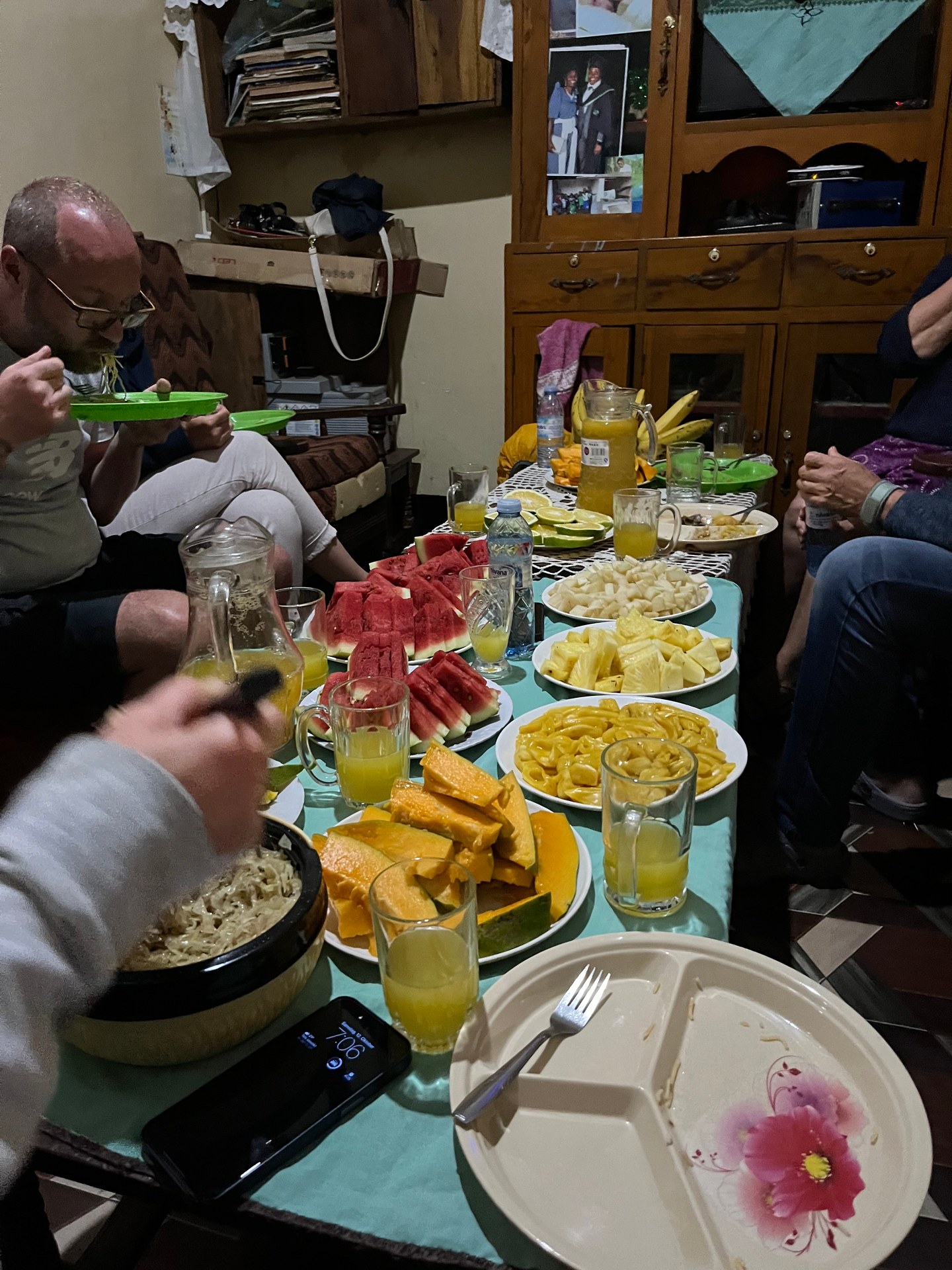
In October 2024, during a visit with the NGO Butiru Freundeskreis, we sat down at the school in Butiru for a midday meal that included everything above. Fresh pineapple with that sharply sweet flavour that disappears the moment it travels. Avocado, ripe and cool. Chapati and beans. It cost almost nothing to produce and was one of the best things we ate on the entire trip. The same ingredients reappear on lodge tables three hundred kilometres south-west in Buhoma — just with a tablecloth.
What to Expect at Bwindi Lodges as a Vegetarian
Lodge food at Bwindi follows a clear spectrum — from rustic community guesthouses where the cook works with what arrived from the market, to high-end properties with trained kitchen teams and printed menus. Vegetarians fare well across all tiers, but the experience differs.
High-end lodges — from USD 300 per night
Properties like Mahogany Springs, Sanctuary Gorilla Forest Camp, and Volcanoes Bwindi Lodge run full kitchen operations with structured menus. Vegetarian options are standard. Some can accommodate vegan requests with advance notice. Notify them at booking — not the day before arrival.
Mid-range lodges — USD 80–300 per night
Lodges including Gorilla Bluff Lodge and Buhoma Lodge offer set menus but adapt readily for vegetarians. A 24-hour heads-up lets the kitchen plan rather than improvise. Expect generous portions of vegetables, matoke, beans, and the local staples that form the kitchen's foundation.
Budget guesthouses — under USD 80 per night
Community guesthouses in Buhoma and Nkuringo cook to order from what is available. State your requirements simply and clearly: “no meat, no chicken, no fish.” Beans, matoke, and vegetables are always on hand. Presentation is humble but portions are generous and the food is genuinely local.
A Quiet Breakfast at Gorilla Bluff Lodge
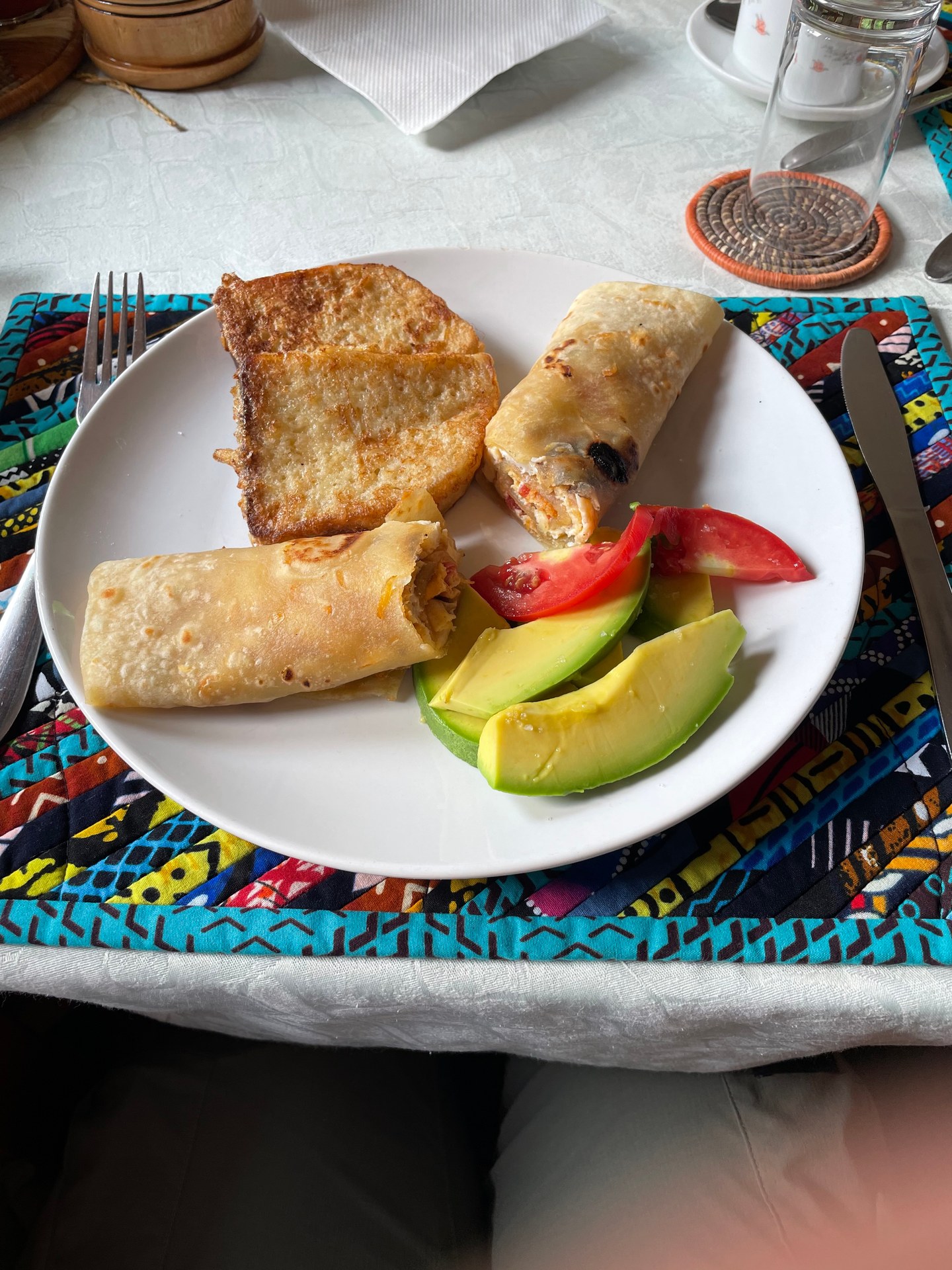
During our eleven-day stay in Buhoma in January 2026, breakfast at Gorilla Bluff Lodge arrived before the trek — a plate with thick slices of avocado, a Rolex, French toast, and sliced tomato. Strong tea. No meat on the table and no absence of anything. We had not specifically ordered a vegetarian breakfast. It came naturally, because the kitchen defaults to what is grown nearby.
Prosper, a tour guide based in Buhoma, notes that most trekking days begin around 07:00. Confirming with your lodge that breakfast can be served at 06:00–06:30 is worth the conversation — most kitchens are accustomed to the early schedule and will prepare accordingly.
Emily Assimwe, who runs a store near the park gate in Buhoma, confirmed that fresh avocados, tomatoes, and produce are stocked year-round. If you want to pick up snacks before a trek or top up supplies between lodge meals, the village market near the Buhoma gate is the practical first stop.
Understanding Meat in Ugandan Food Culture
In Uganda, serving a guest meat is an act of generosity — it signals celebration and hospitality. Declining it can, in some contexts, read as a social signal rather than a dietary choice. The most effective approach is to frame vegetarianism as a positive preference: “I don't eat meat — beans and vegetables are exactly what I enjoy.”
In Buhoma and at lodges throughout Bwindi, staff are entirely accustomed to international visitors with varied dietary requirements. The conversation is straightforward. In more rural settings or local canteens outside tourist areas, a phrase in Luganda helps: sirina nyama (no meat) covers most situations clearly and without ambiguity.
The distinction to keep in mind: plant-based food is not a compromise in Ugandan cooking. It is the core. Meat is the addition, not the default.
Six Practical Tips for Vegetarian Travellers at Bwindi
- 1.Notify your lodge at booking — not on arrival. One sentence in the booking email is sufficient. It gives the kitchen time to plan rather than adapt at the last moment.
- 2.Pack a small supply for the road. The drive from Kampala to Bwindi takes 8–10 hours. Roadside stops are available but vegetarian options are limited outside major towns. Nuts, dried fruit, or energy bars cover the gaps.
- 3.Order extra avocado at every opportunity. The avocados grown around south-western Uganda are exceptional — dense, ripe, and cheap. They are not the same product sold in European supermarkets. Take full advantage.
- 4.Confirm early breakfast timing the evening before your trek. Trekking typically begins at 07:00–08:00. Most lodges will serve at 06:00–06:30 if asked the night before.
- 5.Ask specifically about groundnut stew in local canteens. In rural settings, it is sometimes prepared with meat stock or dried fish. At lodges this is less common, but worth confirming. Most cooks will make a meat-free version on request.
- 6.Visit the market near Buhoma gate for snacks. Fresh chapati, roasted maize, seasonal fruit, and avocados are available near the park entrance. Useful before treks and between lodge meals.
Frequently Asked Questions
Can you travel as a vegetarian in Uganda?
Yes. Ugandan cuisine is built on plant-based staples — matoke (steamed green bananas), beans, groundnut stew, chapati, avocado, and fresh fruit. Meat is present in celebrations but not the default at every meal. Vegetarians eat well throughout Uganda, including around Bwindi.
Are Bwindi lodges vegetarian-friendly?
Most lodges around Bwindi accommodate vegetarian requests without difficulty. Higher-end lodges offer structured vegetarian menus. Mid-range and budget lodges will adapt if you notify them at booking — 24 hours' notice is appreciated and usually sufficient.
What is a Rolex and is it vegetarian?
A Rolex is Uganda's most popular street food: a chapati flatbread rolled around a fried egg with onion, tomato and cabbage. It is vegetarian. The name comes from 'rolled eggs'. You will find it at breakfast tables, markets, and roadside stalls across Uganda.
Is groundnut stew always vegetarian?
Not always. In local canteens and guesthouses, groundnut stew is sometimes prepared with meat stock or dried fish. At lodges it is more reliably vegetarian, but it is worth asking. Most cooks will prepare a meat-free version if you request it in advance.
Can vegans travel to Bwindi?
Vegan travel is possible but requires more active communication. The local staples (matoke, beans, posho, chapati, fruit) are often naturally vegan, but lodge sauces and baked items may contain dairy or eggs. Notify your lodge when booking and confirm again on arrival.