A Species at the Edge — and Uganda at Its Centre
There are approximately 1,063 mountain gorillas left on Earth. Every one of them lives in one of two forested areas: the Virunga Massif, shared between Rwanda, Uganda, and the Democratic Republic of Congo, and Bwindi Impenetrable National Park in southwestern Uganda. There are no mountain gorillas in zoos. There are no mountain gorillas in breeding programmes. The wild population is the only population.
Bwindi holds around 459 of those individuals, approximately 43 percent of the global total. No single national park on Earth protects a higher proportion of any critically imperilled mammal species. That fact carries both enormous responsibility and — when the system works — a strong economic rationale for protection.
What Endangered Actually Means in 2024
In November 2018, the International Union for Conservation of Nature made a historic announcement: mountain gorillas were being downlisted on the Red List from Critically Endangered to Endangered. For a species that had fallen to fewer than 250 individuals in the early 1980s, crossing 1,000 was a genuine landmark, achieved through decades of anti-poaching enforcement, veterinary intervention, habitat protection, and the careful development of gorilla tourism as a financial engine for conservation.
But Endangered is not safe. The mountain gorilla remains one of the most vulnerable large mammals on the planet. Its entire world population occupies less than 1,000 square kilometres of forest, divided between two isolated blocks with no connection between them. The Bwindi population and the Virunga population do not interbreed. Each is effectively its own conservation unit, and each is just large enough to sustain genetic diversity — but only if the habitat holds and the threats remain managed.
The Ranger in the Forest
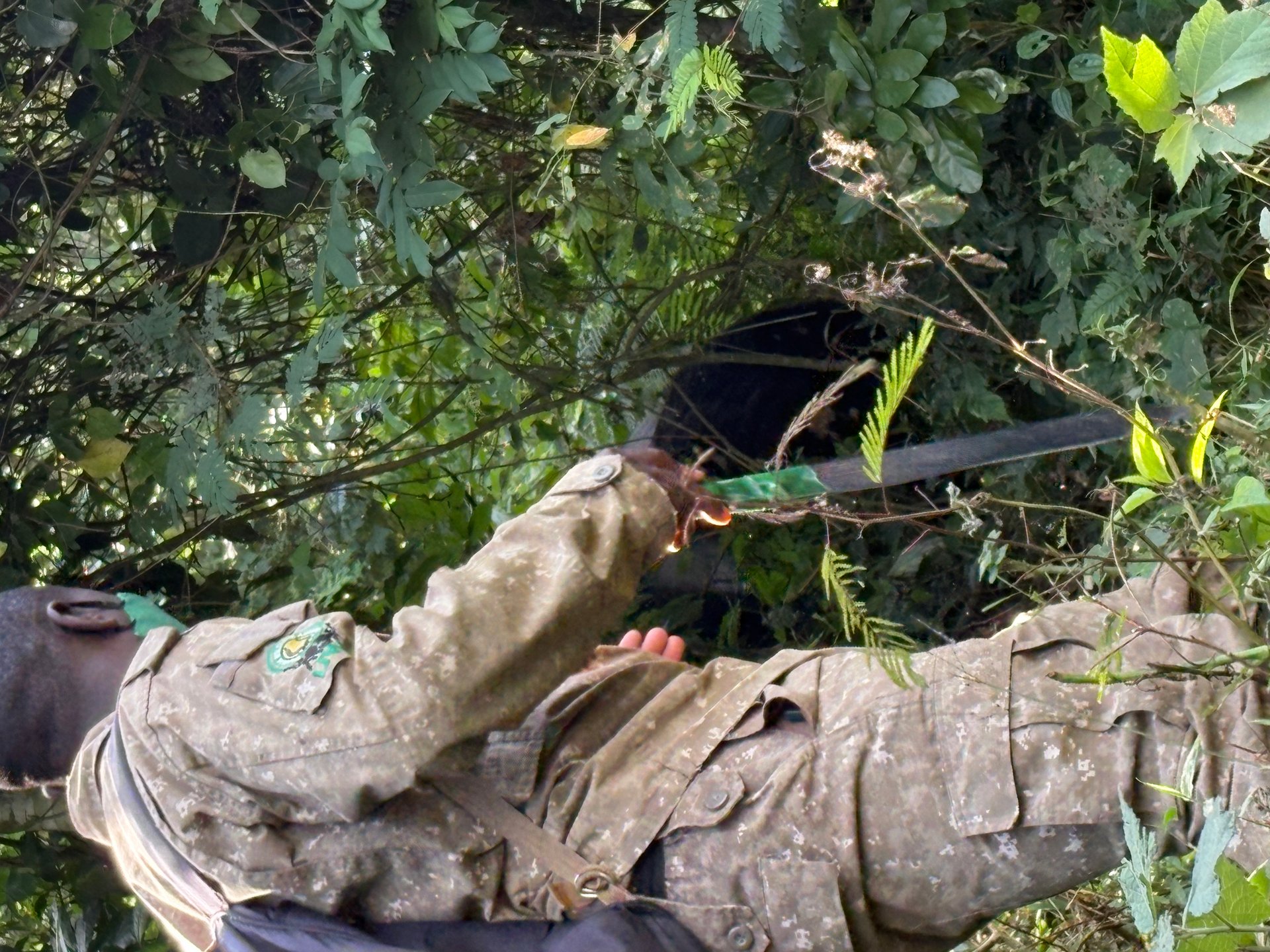
Gorilla trekking in Bwindi is not simply a nature walk. From the morning briefing at the park gate to the hour spent with a gorilla family, every step is managed by Uganda Wildlife Authority rangers. At least one armed ranger accompanies every trek. In sectors close to the DRC border, where political instability has periodically created security concerns, ranger presence is not ceremonial — it is essential.
The ranger's role extends far beyond security. Trackers radio ahead from their early-morning contact with the gorilla group, giving rangers a real-time location. Rangers manage the encounter itself: setting the pace of approach, enforcing the seven-metre minimum distance, watching the gorillas' body language for signs of agitation, and ending the visit at exactly sixty minutes. In the event of a charge — which experienced rangers can typically de-escalate by following the established protocol of crouching down, averting eye contact, and remaining still — they are the ones who stand between the visitors and the gorillas.
It is easy to think of rangers as background figures in the trekking story. Walking with one through the dense, dripping forest of Bwindi, watching them move through undergrowth they have learned across years of daily contact with the same gorilla families, makes clear that they are its central characters.
Susanne's Photo — and What the Mask Is For
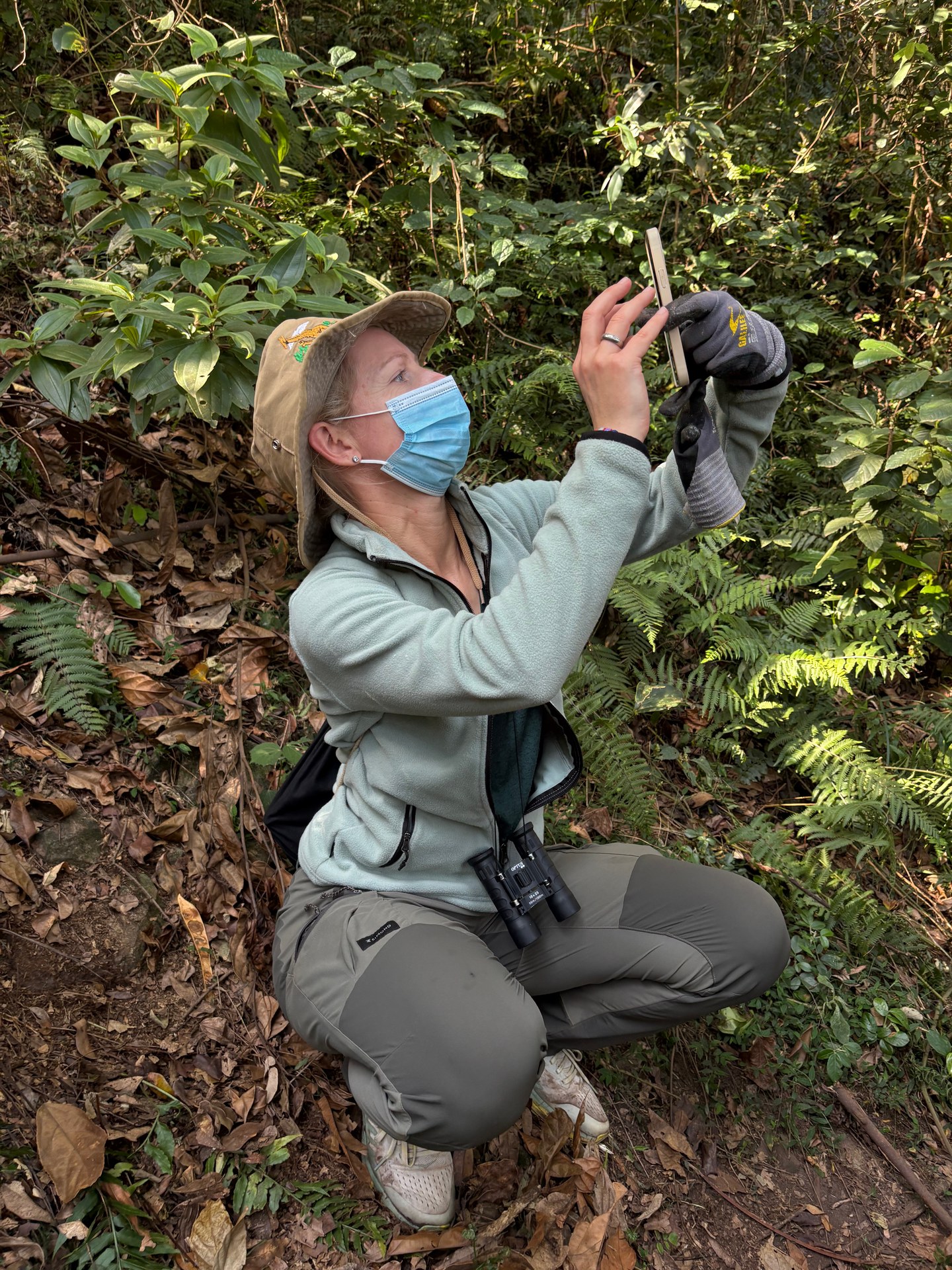
The first thing many first-time trekkers notice, when they finally reach the gorillas, is the strangeness of photographing them through a surgical mask. The mask is mandatory for any visitor within seven metres of a gorilla group. It is not a bureaucratic formality.
Mountain gorillas share 98.3 percent of human DNA. Their immune systems respond to human pathogens — colds, flu, respiratory viruses — with the same vulnerability as a human with no prior exposure to a given strain. A rhinovirus that causes a three-day sniffle in an adult visitor can trigger a serious respiratory illness in a gorilla, and in a group with infants or elderly individuals, the consequences can be fatal. Visitors who are visibly ill are turned away at the morning briefing, and rangers are trained to watch for coughing or sneezing during the encounter.
The mask is, in microcosm, what gorilla conservation looks like in practice: an agreement between visitors and the ecosystem, modest in itself, that only functions if everyone keeps it.
Norman Noel's Buhoma
Norman Noel drives a motorbike taxi — a BodaBoda — in Buhoma, the gateway to Bwindi's northern trekking sector. He is one of thousands of people in the villages and towns around the park whose daily income fluctuates in direct proportion to the number of international tourists arriving at the park gates.
When the 2018–2019 Ebola outbreak in eastern DRC triggered travel warnings and border alerts that reduced international arrivals to the region, Norman described what happened plainly: the clients disappeared, the capital dried up, and he found himself trying to survive between transport work and the occasional local fare while waiting for the situation to normalise. The park entrance, the rangers, the gorillas themselves — none of that changed. What changed was the flow of visitors that made the whole system economically viable.
This is the economic reality of mountain gorilla conservation that population statistics cannot capture. The gorillas' survival depends not only on anti-poaching patrols and veterinary teams, but on a continuous argument that the living gorilla is more valuable than any alternative use of the land around it. That argument is made anew each time a visitor buys a permit, hires a porter, stays at a local lodge, or takes a motorbike taxi from Buhoma to the park gate.
The Number That Matters Most
Population counts matter in gorilla conservation because they are the clearest measure of whether the system is working. The trajectory — from fewer than 300 individuals in the early 1990s to 459 in Bwindi alone by 2019 — is one of the clearest conservation success stories in modern history. It is also a story with a specific geography: every single one of those gorillas lives within a defined area of protected forest in a region where political stability, funding continuity, community economic integration, and disease management all have to hold simultaneously for the number to keep growing.
Uganda Wildlife Authority's General Management Plan for Bwindi identifies over-reliance on gorilla tourism as a management concern in its own right. A park that generates most of its revenue from a single attraction is exposed when that attraction becomes inaccessible — whether through disease alerts, political instability, or global disruptions like the COVID-19 pandemic. Diversifying the park's appeal, developing birdwatching, chimpanzee tracking, and cultural tourism alongside gorilla trekking, is partly a visitor experience strategy and partly a conservation insurance policy.
For now, though, the gorillas remain Bwindi's irreplaceable foundation. The 459 individuals counted in the last census are not just a number on a conservation dashboard. They are the reason Bwindi Impenetrable National Park exists in its current form, the reason the communities around it have a stake in keeping the forest intact, and the reason Norman Noel wakes up in the morning hoping a few more visitors will come through Buhoma today.