Why Uganda Has So Many Primates
Uganda's primate diversity is not an accident of geography. The country sits at the junction of two major African biomes — the Albertine Rift montane forests of the west and the East African savanna — creating a mosaic of habitats that supports species from both. The Albertine Rift in particular is one of Africa's most important biodiversity hotspots, with a high concentration of endemic species found nowhere else.
With 13 primate species, Uganda has a higher primate species density than any country in Africa. The country's western forests — Bwindi, Kibale, Mgahinga, Budongo — collectively contain more habituated great ape groups than anywhere else on the continent. For travellers, this concentration means that a single trip to Uganda can yield encounters with gorillas, chimpanzees, colobus monkeys, and multiple smaller primate species in the same forested region.
The Two Great Apes: Gorillas and Chimpanzees
Uganda is the only country where gorilla trekking and chimpanzee trekking are both established, well-managed ecotourism activities operating simultaneously.
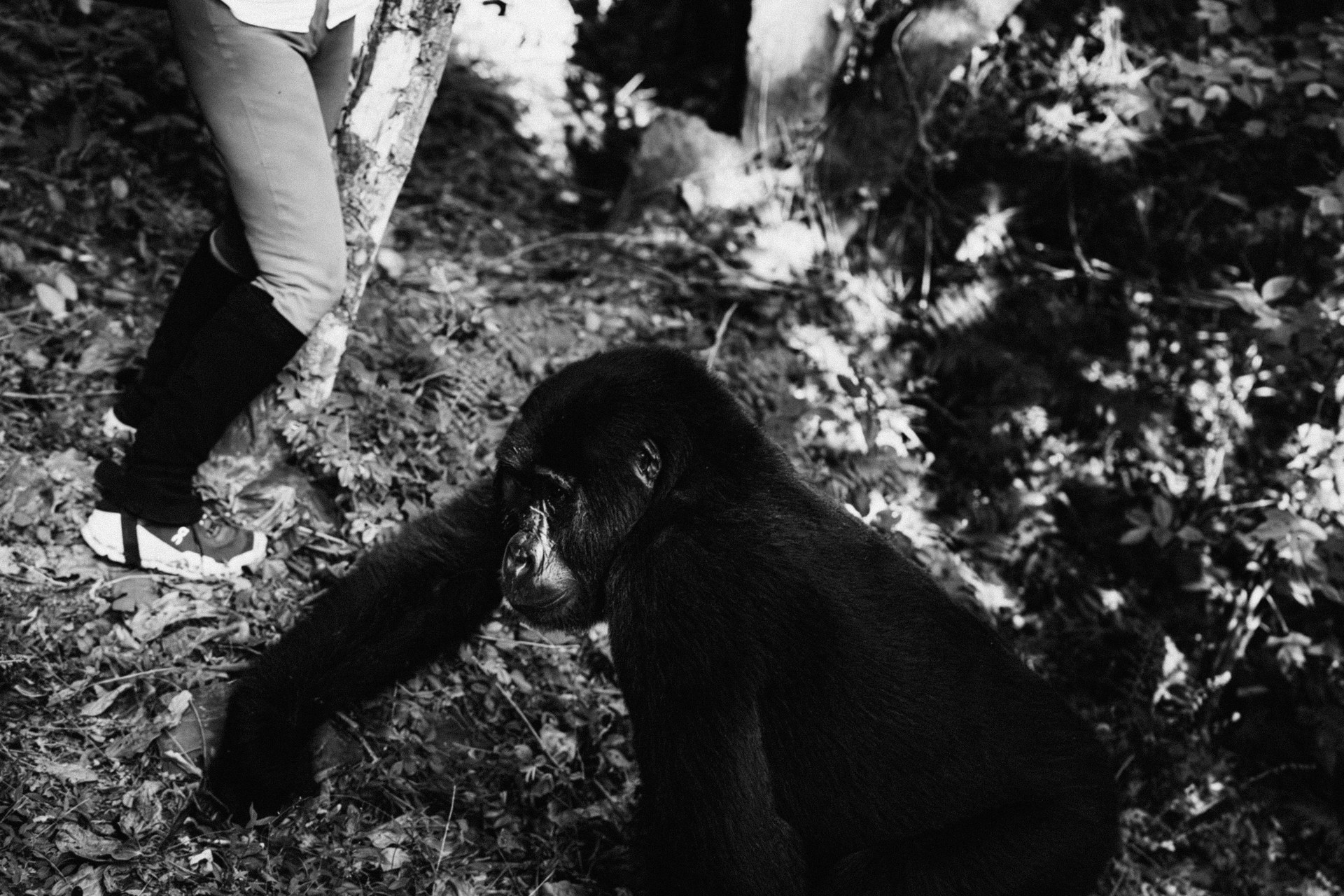
Mountain Gorilla (Gorilla beringei beringei) — Found in two Ugandan parks: Bwindi Impenetrable National Park, which holds approximately 459 individuals across 25 habituated groups, and Mgahinga Gorilla National Park, where a smaller population shares transboundary range with Rwanda and the DRC. Classified as Endangered by the IUCN since 2018, having been downlisted from Critically Endangered after the global population crossed 1,000 individuals. A trekking permit from Uganda Wildlife Authority costs 800 USD (2026).
Eastern Chimpanzee (Pan troglodytes schweinfurthii) — Found in Kibale National Park (the largest remaining chimpanzee population in Uganda), Budongo Forest within Murchison Falls National Park, Kalinzu Forest Reserve near Queen Elizabeth National Park, and in smaller numbers in Bwindi. Classified as Endangered by the IUCN. Chimpanzees share approximately 98.7 percent of human DNA — slightly more than gorillas — and display complex social behaviours including tool use, hunting, and long-term kinship bonds.
The Old World Monkeys: Seven Species
Beyond the great apes, Uganda's forests and savanna support a range of monkey species, each occupying a distinct ecological niche.
Golden Monkey (Cercopithecus kandti) — Endangered; found in Uganda only in Mgahinga Gorilla National Park, in bamboo forest habitats on the slopes of the Virunga volcanoes. Recognisable by vivid orange-gold flanks. One of Uganda's most visually striking primates, and rarely seen outside a narrow altitudinal band. A habituated group is available for trekking in Mgahinga.
L'Hoest's Monkey (Allochrocebus lhoesti) — Vulnerable; a montane forest specialist with a distinctive dark coat and white chest. Regularly seen in Bwindi along the Buhoma and Ruhija trails, and in Kibale. One of the more reliably encountered primate species on forest walks in Bwindi.
Black-and-white Colobus (Colobus guereza) — Least Concern; the most commonly observed primate in Ugandan forests. Its dramatic black-and-white colouring and long white mantle fur make it unmistakeable. Present in Bwindi, Kibale, Budongo, and Queen Elizabeth. Often seen in family groups at forest edges, feeding in the canopy.
Red Colobus (Procolobus rufomitratus) — Endangered; most reliably found in Kibale National Park, which holds one of East Africa's largest populations. Less commonly encountered in Bwindi. Unlike black-and-white colobus, red colobus are often found in large, noisy groups and are preyed upon by chimpanzees.
Red-tailed Monkey (Cercopithecus ascanius) — Least Concern; a medium-sized monkey widespread across Uganda's forests, recognisable by its red-tipped tail and white cheek patches. Found in Bwindi, Kibale, and Queen Elizabeth. Frequently encountered during forest walks.
Blue Monkey (Cercopithecus mitis) — Least Concern; common in montane and lowland forests across Uganda, often found alongside red-tailed monkeys. Despite the name, the coat appears dark grey-olive rather than blue.
Olive Baboon (Papio anubis) — Least Concern; the largest of Uganda's monkeys and the most widely distributed. Present in Queen Elizabeth, Murchison Falls, Lake Mburo, and along forest edges in western Uganda. Not a forest specialist — olive baboons thrive across woodland and savanna habitats.
Nocturnal Primates: The Ones You Hear at Night
Two prosimian species in Uganda are entirely nocturnal and rarely observed during daytime treks.
Galago / Bushbaby (multiple species, including Galagoides demidovii) — Small, large-eyed nocturnal primates that produce high-pitched calls after dark. Their cries are a constant presence around lodges on the Bwindi forest edge at night. Eyes reflect torchlight brightly during night walks.
Potto (Perodicticus potto) — A slow-moving, bear-like prosimian that moves deliberately through the canopy at night. Rarely seen but present in Bwindi. Like galagos, best found during guided night walks.
Where to See Uganda's Primates
| Primate | Best Location | Experience |
|---|---|---|
| Mountain Gorilla | Bwindi Impenetrable NP | Permit trek, 1 hour with the group |
| Chimpanzee | Kibale NP | Guided trek, habituated groups |
| Golden Monkey | Mgahinga Gorilla NP | Guided trek in bamboo forest |
| L'Hoest's Monkey | Bwindi (Buhoma / Ruhija) | Forest walk, seen alongside gorilla treks |
| Black-and-white Colobus | Bwindi, Kibale, Budongo | Frequently seen, no special permit |
| Red Colobus | Kibale NP | Forest walk, often seen in large groups |
| Olive Baboon | Queen Elizabeth NP, Murchison Falls | Game drive, forest edge |
| Galago / Potto | Bwindi (night walk) | Guided night walk, torchlight |
A Local Perspective: Guides Know What Visitors Miss
Prosper, a gorilla trekking guide based in Buhoma who has worked in Bwindi for years, regularly encounters visitors who arrive focused solely on gorillas and leave having discovered an entirely different primate alongside. L'Hoest's monkeys crossing a trail, colobus feeding in the canopy above the waiting point, a galago calling from the lodge garden — the gorilla trek opens a door into a much wider primate world.
This is the argument for Uganda as a primate destination rather than simply a gorilla destination. During October 2024, a twelve-day stay across multiple locations in Uganda's western parks made clear that the gorilla permit is only the beginning of what the country offers. The primates of Uganda represent, collectively, one of the most concentrated and accessible great ape and monkey assemblages left on Earth.