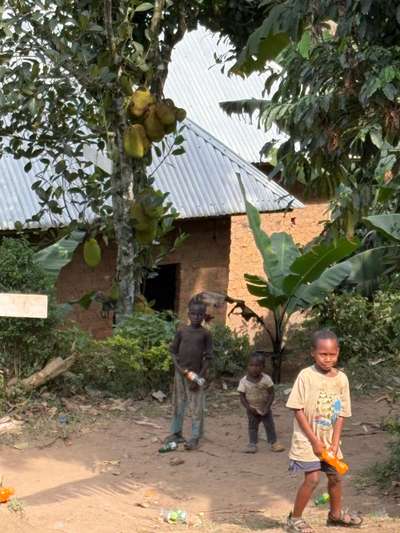
Three children appeared at the edge of the path in Buhoma one morning in June 2026. They were from the neighbourhood near the local orphanage — slightly shy, their clothes worn, their bearing quiet in a way that communicated something about their daily circumstances before you asked. We were preparing to eat, and the decision was immediate: we invited them to join us. They came. That small moment — at GPS coordinates −0.9617°N, 29.6109°E, a few hundred metres from the boundary of Bwindi Impenetrable National Park — sits at the centre of a much larger question: who belongs to this forest, who benefits from it, and who has been shut out.
That boundary is what this article is about. On one side: a 321 km² national park generating USD 800-per-permit gorilla trekking revenue, international conservation funding, and a growing lodge economy. On the other: communities, including the Batwa — the original inhabitants of this forest, displaced when it was gazetted in 1991 — who have been living without land title in settlements like the one around Buhoma ever since. The organisations described here are working, imperfectly and persistently, to make the connection between those two worlds more than symbolic.
Why Organisations Matter for the Batwa
The Batwa of Bwindi are not a monolithic group with unified representation. Settled across parishes in the districts of Kanungu and Kisoro, they live in small, dispersed settlements — sometimes just ten or fifteen households — on land they do not own. A 2022 consultation identified 19 distinct Batwa communities around the park, from Buhoma and Mukongoro in the north to Rushaga, Sanuriro, and Mukungu in the south.
Without organisational infrastructure, these communities have no collective voice in the institutions that govern the forest they once inhabited: Uganda Wildlife Authority, the local district governments, and the international conservation bodies that fund Bwindi's management. A World Bank-financed Vulnerable and Marginalized Groups Plan (VMGP), revised in December 2025, identified "insufficient organisation and capacity of Batwa groups" as one of the primary barriers to their equitable participation in park benefits.
The organisations working with Batwa around Bwindi operate at different scales and with different mandates. Some focus on livelihoods; some on cultural tourism; some on rights and legal advocacy; some on channelling conservation revenue to households. Together, they form an imperfect but increasingly structured framework for Batwa participation in how Bwindi functions.
BDO, BIDO, and BIEO — The Three Batwa-Led Organisations
Three Batwa-led civil society organisations are central to the community governance landscape around Bwindi: BDO (Batwa Development Organisation), BIDO (Batwa Indigenous Development Organisation), and BIEO (Batwa Indigenous Empowerment Organisation). All three work on the same core priorities — mobilisation, training, capacity building, knowledge sharing, and livelihood support — and all three operate close to household level, engaging directly with Batwa community members rather than at policy or national level.
In October 2024, BDO, BIDO, and BIEO jointly raised formal concerns with the World Bank and Uganda Wildlife Authority, arguing that their communities were not fully benefiting from the IFPA-CD conservation project — a World Bank-funded initiative worth US$148.2 million designed to improve sustainable management of forests and protected areas across Uganda. Their concerns directly triggered a comprehensive revision of the VMGP for Bwindi, with community consultations held in July and December 2025. This was a significant moment: three relatively small organisations, representing communities with no land title and limited formal resources, successfully pushing a World Bank-backed process to revise its approach.
The challenges the three organisations face are structural. Batwa households largely depend on casual agricultural labour on others' land. Only 3% of Batwa around Bwindi have reached secondary education level. Access to healthcare remains poor — only 50% of Batwa women deliver at a health facility, and only 32% of children under five complete routine immunisation. Organisations like BDO, BIDO, and BIEO work within these conditions, with resources that are a fraction of what the scale of need requires.
UOBDU — Umbrella Advocacy at National Level
UOBDU (United Organisation for Batwa Development in Uganda) operates at a different level — national advocacy, coordination between government ministries, UWA, and international donors, and support for Batwa mobilisation around all four Bwindi sectors. UOBDU has been involved in the VMGP consultation process since 2021 and is named in UWA's General Management Plan as a formal partner for the Batwa Integration Programme.
UOBDU's most significant legal action is the ongoing constitutional petition in Uganda's High Court: United Organisation for Batwa Development in Uganda and 11 Others v Attorney General and 2 Others (Constitutional Petition No 3 of 2013). The petition challenges the legality of the Batwa's displacement from the forest and their continued exclusion from park resources. It is the most direct legal attempt yet to establish formal accountability for what happened in 1991.
UOBDU's influence is stronger at the national policy level than at the parish level. Daily welfare issues — food security, housing, access to clean water — require hands-on organisational capacity closer to the ground, which is where BBDA, BDO, BIDO, and BIEO operate.
Collaborative Resource Management — The Formal Park Access Mechanism
The most concrete mechanism through which Batwa communities have a formal role in Bwindi park management is the CRM (Collaborative Resource Management) programme. CRM groups are organised community resource-user associations that negotiate formal agreements (MoUs) with UWA for regulated access to specific non-timber forest resources: firewood, handicraft materials, medicinal plants, and beehive placement. As of 2025, there are eight active CRM MoUs in Bwindi. The Batwa are members of seven of them.
Crucially, the CRM agreements require that each group's Executive Committee include at least 2 Batwa members. This is not advisory — it is a structural requirement written into the MoUs themselves. The Batwa are also the only community group with exclusive access to certain forest resources: only the Batwa are permitted to collect wild yam inside Bwindi under the CRM arrangements, a recognition of their particular cultural relationship with the forest.
In practice, the effectiveness of Batwa participation in CRM executive committees has been uneven. The 2025 VMGP revision identified limited awareness of CRM provisions among Batwa communities and insufficient representation on executive committees as persistent problems — and included leadership training for CRM group executives and awareness-raising campaigns among its agreed actions for 2026.
BBDA — The Organisation with a Formal UWA Agreement
BBDA (Bwindi Batwa Development Association) holds a formal Memorandum of Understanding with Uganda Wildlife Authority — making it one of the few Batwa organisations with a direct legal agreement with the park authority. BBDA organises and mobilises Batwa to participate in the CRM programme, runs capacity-building and training activities, and maintains the Batwa Forest Experience trail at Nkuringo.
The Batwa Forest Experience — an interpretive forest walk led by Batwa guides demonstrating traditional skills — was officially launched in April 2019 with support from Nkuringo Cultural Centre, BBDA, and Mbarara University of Science and Technology (MUST). It is Bwindi's most established Batwa-led tourism product and the clearest example of how organisational infrastructure can translate Batwa traditional knowledge into sustainable economic activity.
For the Buhoma sector in the north, UWA is in the process of negotiating a similar tri-partite agreement with ABEG (Action for Batwa Empowerment Group) and BDP (Batwa Development Programme) to manage a Batwa trail for visitors at that sector. The formalisation of this agreement will extend the cultural experience model to the part of the park where the majority of international tourists arrive.
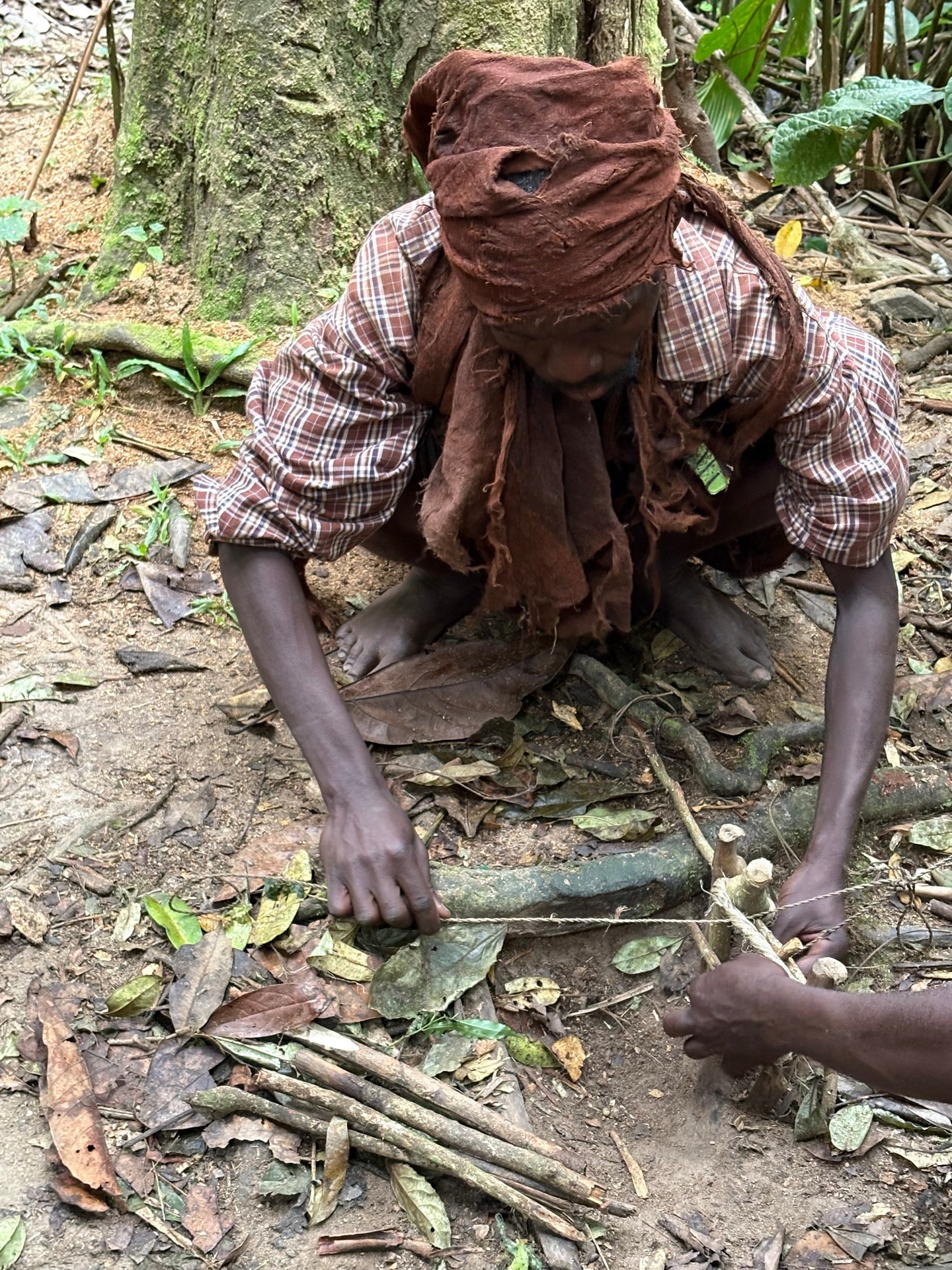
A traditional Batwa hunting trap crafted from forest materials — demonstrated during a community visit near Buhoma in 2026. Skills like this are preserved through cultural experience programmes rather than daily practice.
BMCT — Conservation Revenue for Communities
BMCT (Bwindi Mgahinga Conservation Trust) is the dedicated conservation trust covering both Bwindi Impenetrable National Park and Mgahinga Gorilla National Park. It channels a share of conservation funding to community development projects in surrounding parishes and has conducted the most detailed population census of Batwa communities around Bwindi — the 2016 census counted 578 Batwa households (2,656 individuals) in Kisoro and Kanungu districts.
Separate from BMCT, Uganda's national UWA Revenue Sharing Scheme allocates a portion of gorilla permit revenues to communities within 2km of park boundaries. For parishes with mixed populations — including both settled farming communities and landless Batwa — the question of how this funding reaches Batwa households at the level of individual settlements is a governance challenge that the organisations described above continue to monitor and advocate around.
What I Observed: Nine Visits and the Organisations in Practice
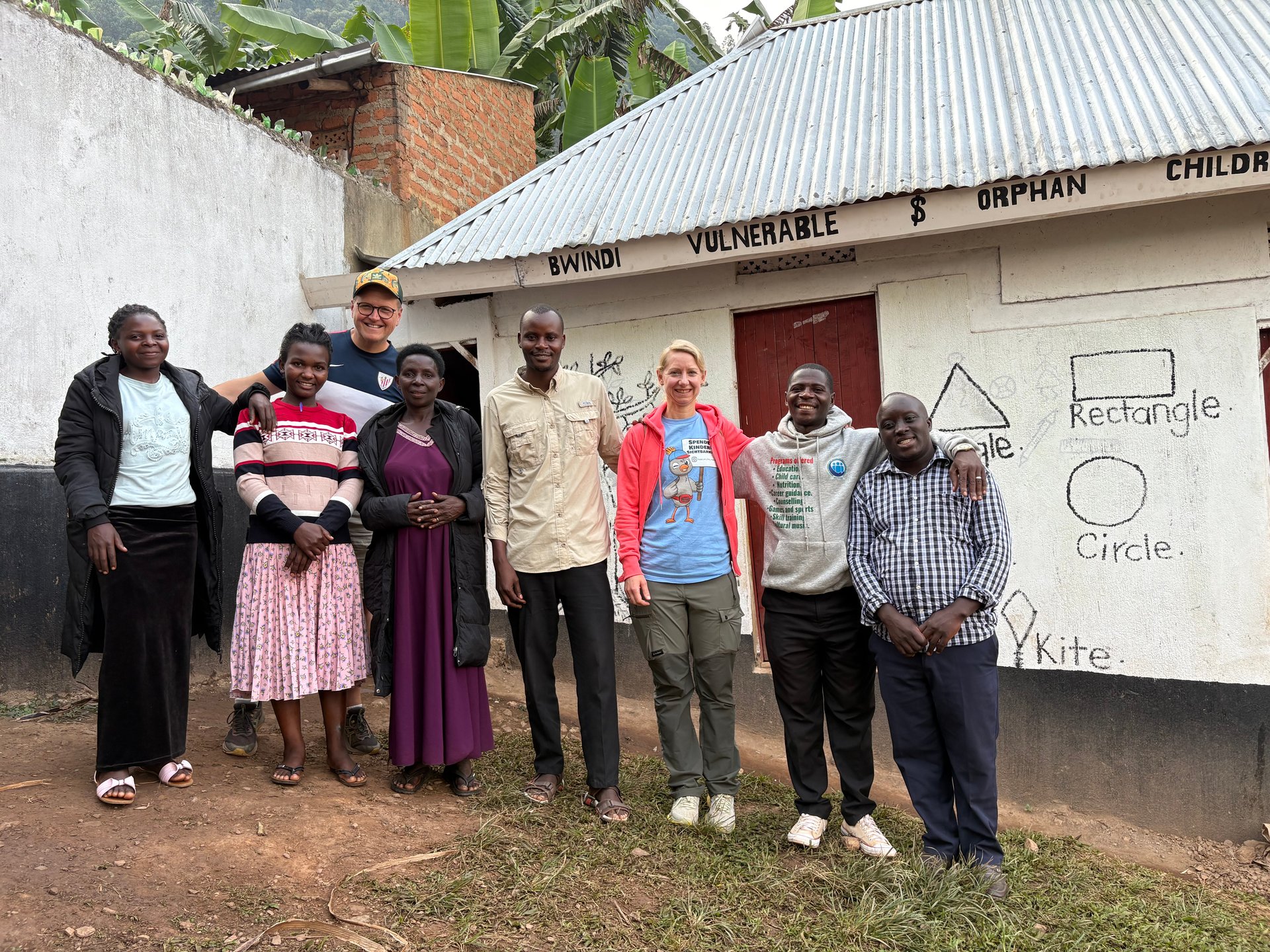
My October 2024 visit to Bwindi — one of nine visits in total, with extended stays in January, April, and May 2026, and a further visit in June 2026 — coincided almost exactly with the moment when BDO, BIDO, and BIEO were formalising their concerns to the World Bank about unequal benefit distribution. I did not know this at the time. What I did observe was the gap between the institutional language of these programmes and the daily reality of Batwa families in the settlements around Buhoma.
During a community visit, a Batwa elder demonstrated the construction of a traditional hunting trap — a precisely engineered object built in minutes from materials gathered in the forest. The precision was notable: this was not a demonstration piece but functional knowledge, assembled by someone who had done it hundreds of times inside Bwindi before 1991. It is the kind of embodied knowledge that no document captures — and it sits at the centre of what the Batwa cultural experience programmes are attempting to preserve.
The organisations described in this article are, at their best, creating formal structures around genuine knowledge — ensuring it has economic value and institutional recognition rather than disappearing without trace. The October 2024 challenge by BDO, BIDO, and BIEO shows that these organisations can also act as watchdogs when formal structures fail to deliver. That combination — cultural preservation and institutional accountability — is what makes the organisational landscape around Bwindi more than a list of acronyms.
Persistent Gaps — What the Organisations Have Not Yet Resolved
The December 2025 VMGP revision for Bwindi is candid about what remains unresolved.
Land tenure was explicitly excluded from the scope of the VMGP revision — the World Bank project cannot address land acquisition within its timeframe or mandate. Most Batwa households still have no land title. Organisations that have made progress here — including UOBDU and the Kellermann Foundation in the Buhoma area — have done so through separate funding channels, not through the main conservation investment framework.
Spiritual site access inside the park — ancestral burial grounds, ritual sites, sacred trees — was also noted in the VMGP as an area where Batwa access under CRM arrangements exists on an ad hoc basis, but without the formalised cultural access agreements that would give communities confidence in their right to visit these places.
Knowledge transmission is the most time-sensitive gap. The VMGP includes funding (UGX 140,000,000) for a second phase of medicinal plant inventory and translation of the first phase into Rutooro and Rukiga languages for use by Batwa communities when tour guiding. But the generation of Batwa who grew up inside the forest is ageing. The urgency of this documentation is not reflected in the pace of its completion.
Enterprise support after training remains inadequate. The VMGP itself notes that previous livelihood trainings — in basket weaving, candle making, beekeeping, gorilla carving — were not followed by start-up capital or sufficient inputs. Training without resources produces skills that cannot generate income. The revised VMGP commits to correcting this, but the project closes in June 2026.
These gaps do not diminish what the organisations described here have achieved. They are the measure by which ongoing progress should be judged — and the reason why the organisational work around Bwindi is not yet finished.