What Is the Revenue Sharing Program?
When Uganda Wildlife Authority gazetted Bwindi as a national park in 1991, it displaced communities that had lived at the forest edge for generations and restricted access to resources many households depended on. The revenue sharing program, introduced in 1994, was conceived as a direct economic response to that displacement — a mechanism to ensure that the people who bear the highest costs of conservation also receive some of its benefits.
The program mandates that 20 percent of all Uganda Wildlife Authority gate fees be allocated to communities living adjacent to national parks. At Bwindi, where gorilla trekking generates the majority of national park revenue in Uganda, this translates into substantial annual transfers to Local Government-managed community project funds.
How the Gorilla Levy Works
The gorilla levy is the component of revenue sharing tied specifically to gorilla tourism income. When a visitor pays USD 800 for a gorilla trekking permit, that payment enters UWA's national account. At the end of each financial year, 20 percent of total gate receipts across all national parks flows into the community revenue sharing pool.
Funds are channelled through District Local Governments, which establish project management committees to receive proposals from communities, select projects, oversee implementation, and report back to UWA. The system is designed to give Local Government ownership over allocation decisions, though this also introduces the risk of mismanagement — a challenge explicitly acknowledged in UWA's General Management Plan 2014–2023.
Who Benefits?
More than 500,000 people live in parishes surrounding Bwindi across four districts: Kanungu, Rukungiri, Kabale, and Kisoro. Eligibility for revenue sharing is determined by proximity to the park boundary — parishes within approximately one kilometre have priority. Within eligible parishes, communities propose projects to Local Government committees, which select the highest-priority investments.
The program is designed to deliver collective rather than individual benefits. It funds shared infrastructure — schools, health clinics, water systems — rather than compensating individual households for specific losses such as crop raiding. This is both the program's strength (broad community benefit) and its most significant limitation (it does not address the real costs borne by specific households).
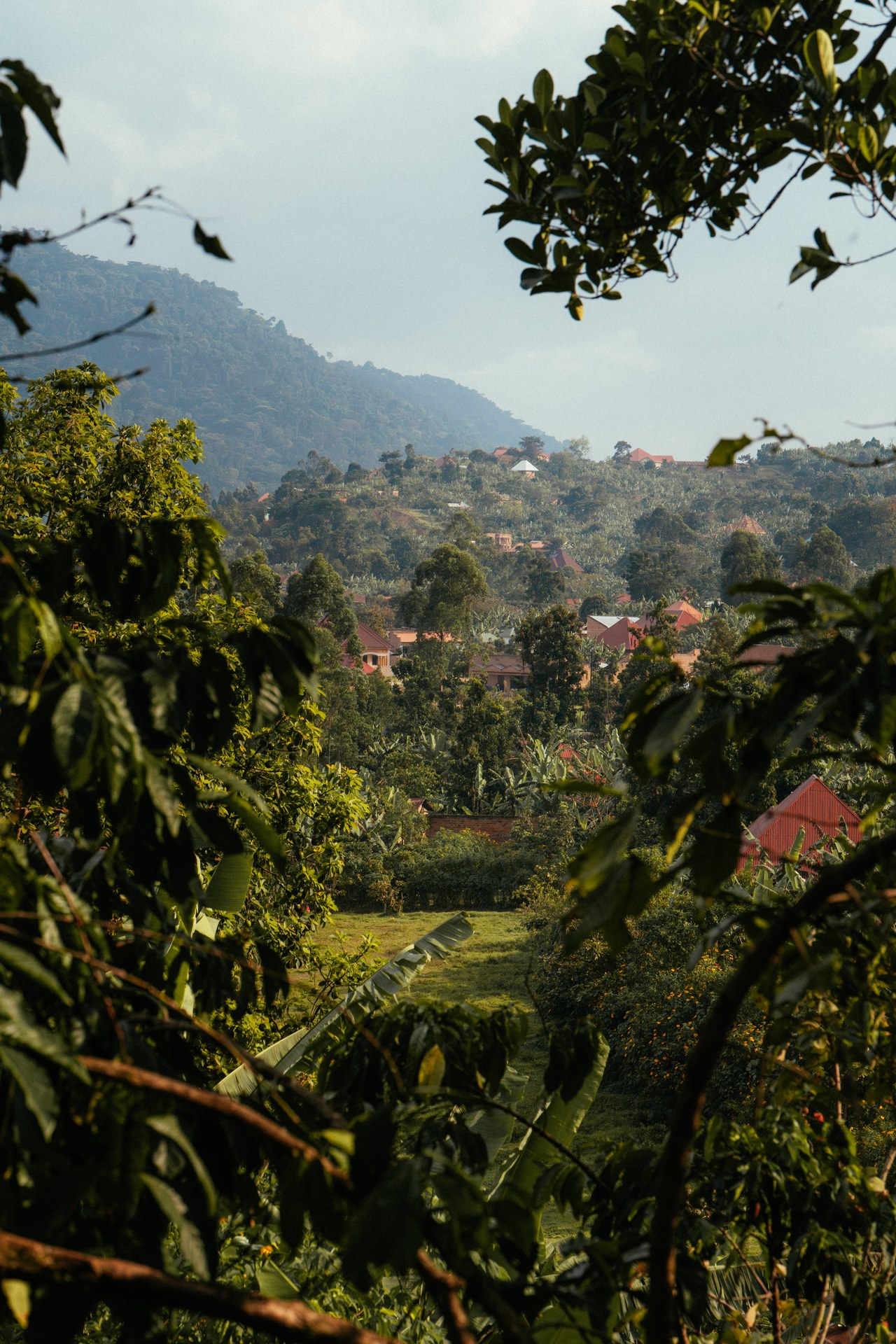
Buhoma: green valley with houses on the hillside
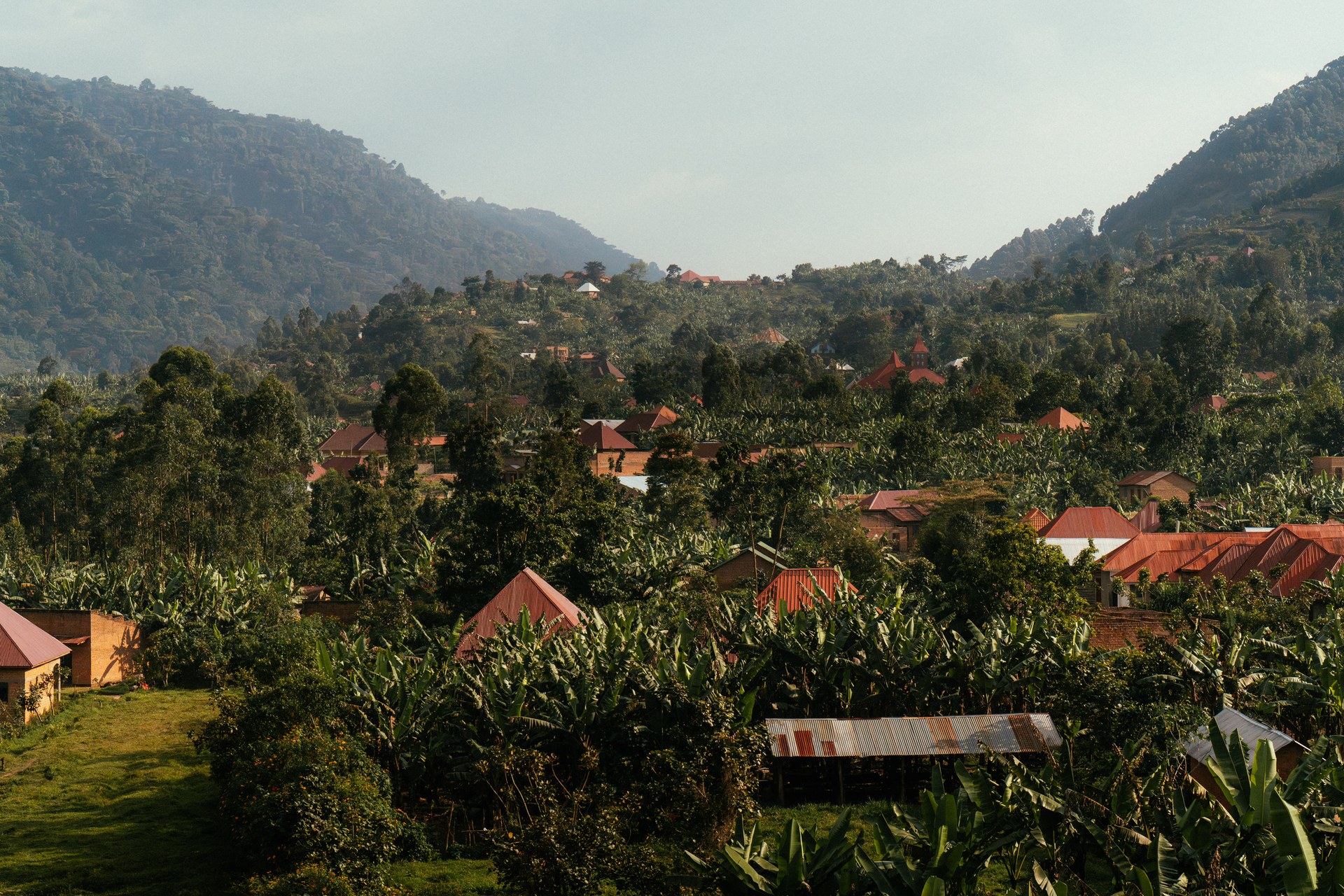
Buhoma: a village between mountains and hope
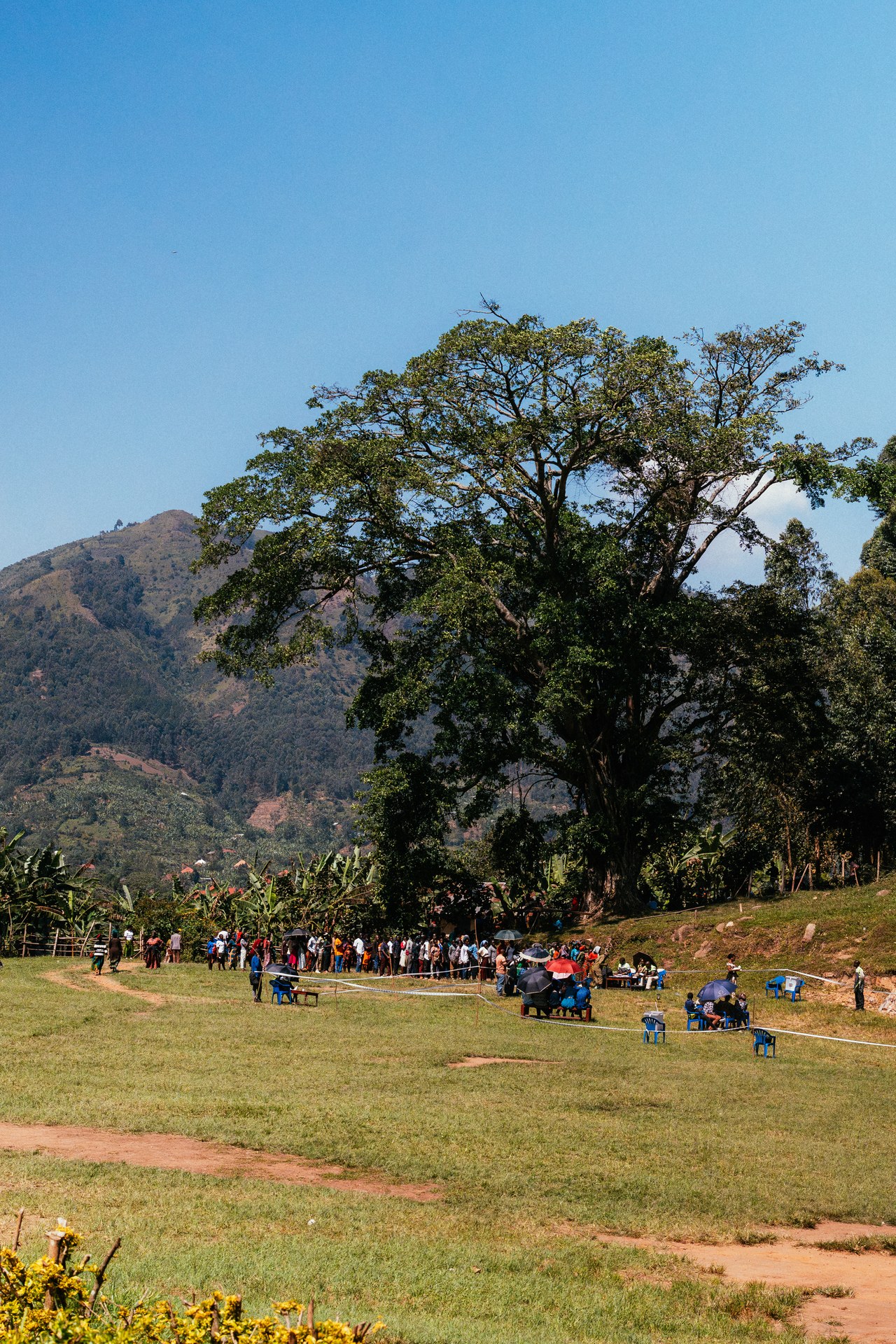
Buhoma: community gathers in the shadow of the mountain
What Projects Are Funded?
Revenue sharing has funded a wide range of community infrastructure around Bwindi. Education has received significant investment: classroom construction, school furniture, and sanitation facilities in primary and secondary schools. Health projects have included community health centre buildings, medical equipment, and maternity ward construction. Water and sanitation infrastructure — boreholes, gravity flow systems, latrines — has improved access to clean water in villages where fetching water previously meant long journeys to unreliable sources.
Livelihood projects such as beehive distribution, vocational training, and small enterprise grants have provided income-generating alternatives to forest resource extraction. Road improvements have connected remote parishes to markets, making farm produce viable for sale and reducing the isolation that makes conservation engagement difficult.
Challenges and Honest Assessments
Uganda Wildlife Authority's own General Management Plan 2014–2023 identifies two specific management challenges related to revenue sharing: that revenue sharing does not always benefit the people most directly affected by the park, and that mismanagement of the gorilla levy and revenue sharing projects has undermined community trust.
These challenges reflect a common tension in community conservation. Collective benefits are easier to deliver than individual ones. Households that lose crops to elephants or face travel restrictions to visit family on the other side of the park boundary do not necessarily feel compensated by a new school classroom funded from park revenue. Closing this gap — ensuring that benefits reach those who bear real costs — remains the program's most important unresolved challenge.
A Model That Changed African Conservation
Despite its limitations, Uganda's revenue sharing program was among the first in Africa to formally institutionalise the principle that conservation should generate tangible economic returns for local communities. The model has been studied and adapted across the continent. In Rwanda, the gorilla revenue sharing program inspired by the Ugandan experience now channels 10 percent of gorilla permit revenue directly to communities adjacent to Volcanoes National Park.
The fundamental logic — that conservation is most durable when local communities have an economic interest in protecting wildlife — has become a cornerstone of modern protected area management. Bwindi's revenue sharing program, whatever its implementation challenges, represents an important step toward making that logic real.
For Visitors: Why Your Permit Matters
When you pay USD 800 for a gorilla trekking permit, you are not simply purchasing an hour with a mountain gorilla family. You are contributing to a fund that pays ranger salaries, supports veterinary monitoring through CTPH, and flows back to farming families in the form of school classrooms and clean water. The permit system is imperfect, and the path from tourist fee to community benefit is long and bureaucratic. But it connects your visit directly to the economic incentives that make gorilla conservation viable in one of the most densely populated rural landscapes in Africa.