Two Species, Four Subspecies
Gorillas belong to the genus Gorilla and are divided into two distinct species: the Western Gorilla (Gorilla gorilla) and the Eastern Gorilla (Gorilla beringei). Each species is further split into two subspecies, giving four gorilla subspecies in total.
All four subspecies are threatened with extinction. Three are classified as Critically Endangered on the IUCN Red List. The mountain gorilla, the only subspecies found in Uganda, is the sole exception — downlisted to Endangered in 2018 after its population crossed 1,000 for the first time since systematic monitoring began.
The Four Gorilla Subspecies at a Glance
| Subspecies | Scientific Name | Range | Est. Population | IUCN Status |
|---|---|---|---|---|
| Mountain Gorilla | G. b. beringei | Bwindi (Uganda), Virungas (Uganda/Rwanda/DRC) | ~1,063 | Endangered |
| Grauer's (Eastern Lowland) | G. b. graueri | Eastern DRC only | ~3,800 (2016, declining) | Critically Endangered |
| Western Lowland | G. g. gorilla | Central/West Africa (9 countries) | ~95,000–150,000 | Critically Endangered |
| Cross River | G. g. diehli | Nigeria–Cameroon border | ~250–300 | Critically Endangered |
Mountain Gorilla: Uganda's Subspecies
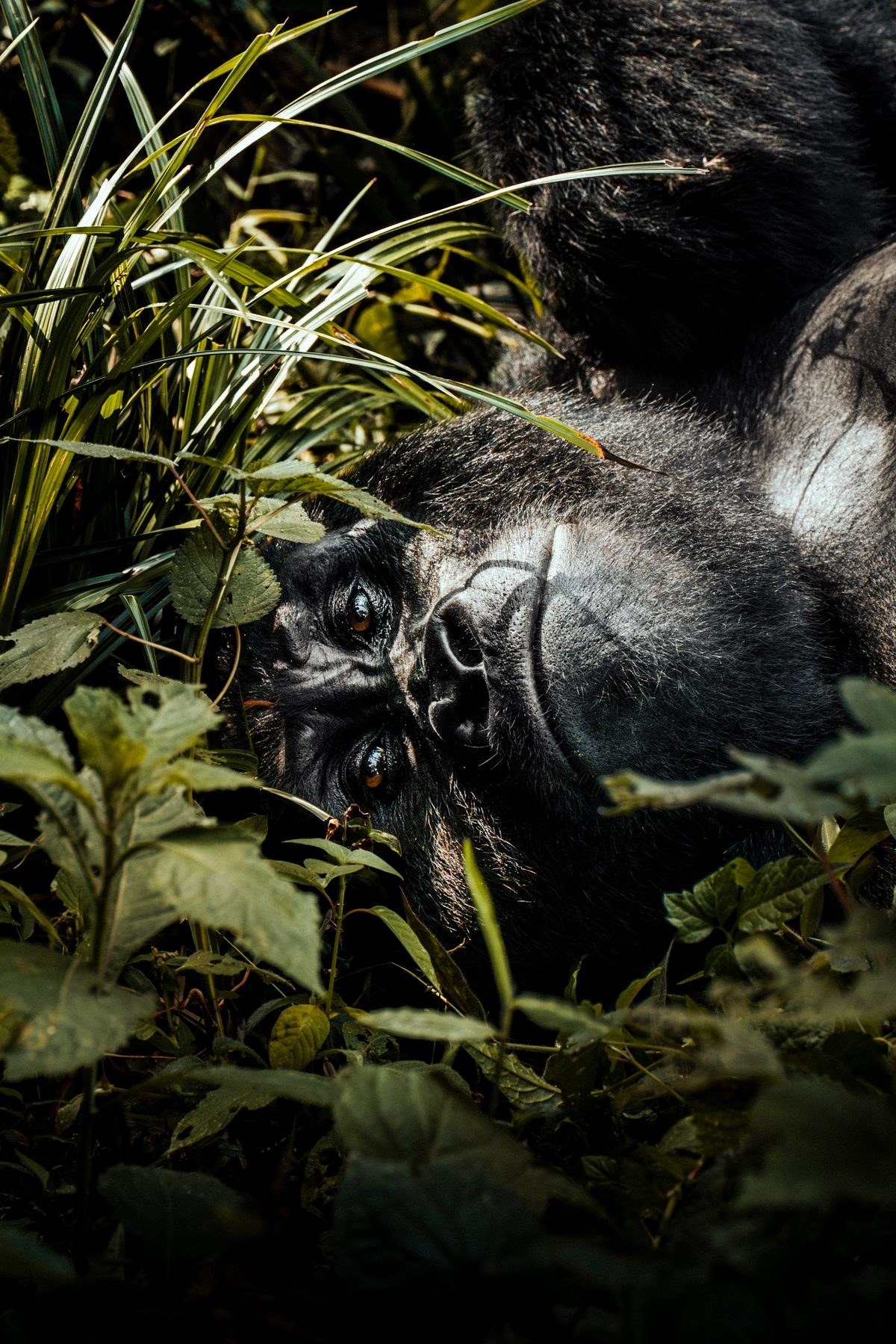
The mountain gorilla (Gorilla beringei beringei) is the subspecies that draws visitors to southwestern Uganda. Physically, it is adapted for high-altitude montane forest: longer and denser fur than any other gorilla subspecies, a slightly broader chest, and a more robust build that provides insulation against temperatures that can drop to near freezing on the upper slopes of the Virunga volcanoes.
Uganda holds approximately 459 mountain gorillas in Bwindi Impenetrable National Park alone — nearly 43 percent of the global total. A smaller population shares transboundary range in Mgahinga Gorilla National Park, overlapping with the Virunga populations of Rwanda and the DRC. Mountain gorillas are the only gorilla subspecies whose population is currently growing.
A critical biological fact distinguishes mountain gorillas from every other subspecies: they have never survived in captivity. There are no mountain gorillas in any zoo or wildlife park in the world. The entire species exists only in the wild. Protecting their forest habitat is not a conservation preference — it is the only option.
During twelve days at Bwindi in October 2024 and a further two days in January 2026, the distinction between reading about these animals and sitting three metres from a silverback becomes stark. Every conservation statistic maps onto something real: a specific individual, a specific family, a specific hillside of ancient forest.
Grauer's Gorilla: Largest of All Gorillas
Grauer's gorilla (Gorilla beringei graueri), also known as the Eastern Lowland Gorilla, is the largest gorilla subspecies by body size. Adult males can exceed 200 kg and stand taller than their mountain gorilla relatives. Despite this, they live at lower altitudes than mountain gorillas, inhabiting the lowland and mid-altitude rainforests of eastern DRC.
Grauer's gorillas are Critically Endangered. A systematic survey in 2016 estimated approximately 3,800 individuals — a decline of more than 75 percent from estimated historical population levels. Conflict minerals mining in eastern DRC, associated displacement of communities, bushmeat hunting, and the collapse of ranger infrastructure during periods of armed conflict have driven this dramatic reduction. Grauer's gorillas are not found in Uganda.
Western Lowland Gorilla: The Zoo Gorilla
Western Lowland Gorillas (Gorilla gorilla gorilla) are the most numerous gorilla subspecies, with an estimated population between 95,000 and 150,000 individuals spread across nine countries in western and central Africa, including Cameroon, the Central African Republic, the Republic of Congo, Gabon, and Equatorial Guinea.
Despite their relative abundance, Western Lowland Gorillas are classified as Critically Endangered. Their forest habitat is subject to logging, agricultural conversion, and bushmeat hunting. They are also the gorilla subspecies kept in captivity worldwide — all gorillas in zoos are Western Lowland Gorillas. Unlike mountain gorillas, Western Lowland Gorillas have survived and reproduced in managed facilities, though no captive population could sustain the subspecies without wild habitat protection.
Cross River Gorilla: The World's Rarest
The Cross River Gorilla (Gorilla gorilla diehli) is the rarest great ape in the world, with an estimated population of only 250–300 individuals. It lives in a narrow corridor of highland forest along the Nigeria–Cameroon border, fragmented across at least 11 separate forest patches with limited movement between them.
Cross River Gorillas are not accessible to tourism. The population is unhabituated, the terrain is remote, and the communities surrounding these forests are among the poorest in the region with limited alternative livelihoods. Conservation efforts focus on community engagement, corridor restoration, and anti-poaching. The subspecies has never been reliably photographed in the wild by researchers, let alone visitors.
Why Subspecies Classification Matters for Conservation
The distinction between subspecies is not a technicality for zoologists. Each gorilla subspecies represents a distinct evolutionary lineage, adapted to a different habitat and geographic range, with unique genetics that took hundreds of thousands of years to develop. The extinction of a subspecies is an irreversible genetic and ecological event.
For conservation planning, the subspecies level is where decisions get made. Population surveys, habitat protection strategies, veterinary protocols, tourism management and community engagement programmes are all designed around specific subspecies in specific locations. Prosper, who has worked as a gorilla trekking guide in Buhoma for years, regularly explains to visitors that understanding what makes mountain gorillas distinct from other gorillas is what makes their protection in Uganda intelligible. This is not one species that lives everywhere — it is four separate subspecies, each in a defined territory, each requiring a tailored conservation response.