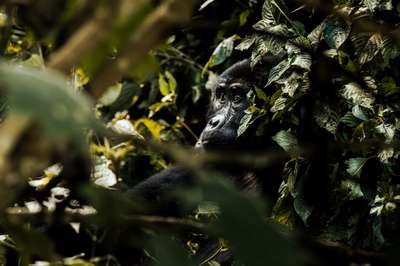
Sustainable gorilla trekking is not primarily about the visitor's experience — it is about managing human access to a critically endangered species in a way that makes continued access possible. Every protocol in place at Bwindi Impenetrable National Park exists because someone calculated the cost to the gorillas of not having it. Understanding why the rules exist makes the experience more meaningful and makes the conservation case more persuasive to the visitors who fund it.
The First Hour: What You Actually See
During our gorilla trek from Buhoma in January 2026, the first family appeared after approximately one hour of walking — sooner than expected. The initial sighting was a single gorilla sitting in the canopy of a tree, methodically stripping and eating leaves. Calm, absorbed, entirely aware of our presence and completely unbothered by it. A second visit in June 2026 produced a similar first encounter: a gorilla feeding high in the branches, the forest canopy providing just enough light to see clearly. In both cases, the habituated family's composure was the result of years of careful daily contact by UWA rangers and trackers — not a natural state, but a managed one that required sustained professional effort.
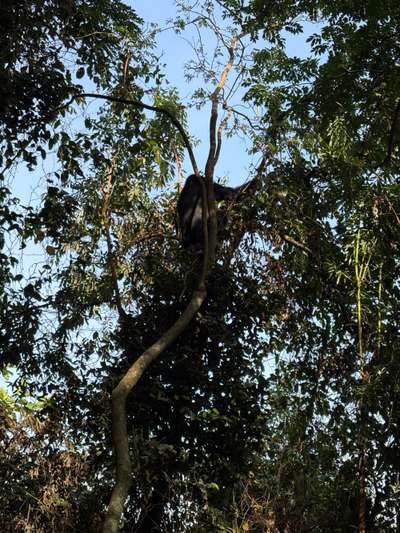
The one-hour time limit with each gorilla family is enforced strictly by the guide. It is not a guideline — when the hour is up, the group moves away from the family, regardless of what is happening. The reason is behavioural: extended human presence beyond the managed protocol progressively alters the gorillas' daily routine. Feeding, movement patterns, and social behaviour all shift when humans remain for longer periods. The limit preserves the integrity of the habituation — ensuring the animals remain wild rather than becoming dependent on or desensitised to human presence beyond what the tourism model requires.
Gorillas as Keystone Species: What the Entire Forest Depends On
Mountain gorillas are classified as a keystone species — meaning their ecological role is disproportionately large relative to their population. As heavy-bodied frugivores that range across hundreds of hectares, they disperse seeds from dozens of plant species across the forest. Their feeding patterns — stripping vegetation, breaking branches, creating small clearings — alter the forest structure in ways that benefit other species: sunlight reaches the understorey, new growth emerges, microhabitats are created and destroyed on a seasonal cycle.
This makes gorilla conservation an umbrella under which the entire Bwindi ecosystem is protected. The 321 km² that UWA maintains for mountain gorillas also shelters over 120 mammal species, more than 350 bird species, and a globally significant concentration of Albertine Rift endemic plants and invertebrates. Protecting the gorilla is not a choice between one species and many others — it is a choice that protects all of them simultaneously.
The 7-Metre Distance: Disease Prevention, Not Ceremony
Mountain gorillas share approximately 98.3% of their DNA with humans and are susceptible to human respiratory pathogens. A common cold introduced to a habituated gorilla family can spread rapidly through the group. Infants are particularly at risk: approximately 30% of gorilla infant mortality occurs in the first year of life (Uganda travel guide, 2020 edition), a period when immune systems are most vulnerable. The 7-metre minimum distance between visitors and gorillas reduces the risk of airborne transmission. UWA also requires that visitors with active respiratory infections do not participate — a rule with real conservation weight behind it.
When gorillas approach closer than 7 metres — which they do — visitors are instructed not to retreat but to remain still, avert their gaze, and let the animal pass. Fleeing behaviour from humans would increase gorilla stress; calm, predictable human presence is what habituated contact is built on.
The Ranger: Monitoring, Not Just Escorting
The armed ranger who accompanies every trek is not purely a security presence. Rangers are trained wildlife monitors: they observe gorilla behaviour, record health indicators, track family membership changes, and report snare injuries or illness to the veterinary response teams. The permit fee ($800 per person, 2026 rate) covers this ranger escort as a direct inclusion — along with the guide, tracker, and trail-cutter — because the monitoring function requires trained, full-time staff regardless of visitor numbers.
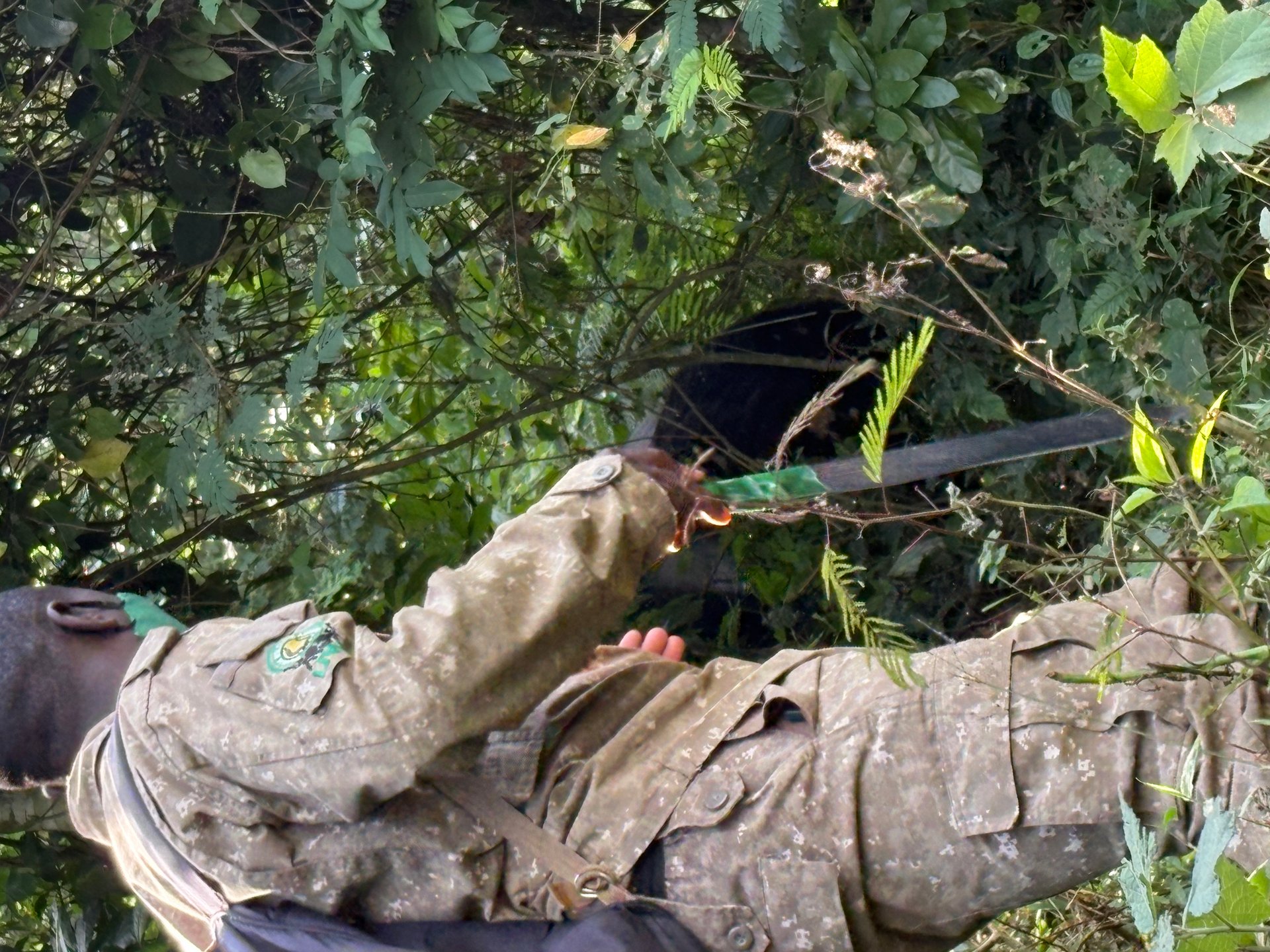
During our January 2026 trek, we were accompanied by one lead guide and two armed rangers. The weaponry felt out of place at first — a rifle on a forest walk. Within the first twenty minutes that impression dissolved: the rangers were the most useful people in the forest, cutting a path through dense undergrowth, assisting during the steep sections, and moving with a quiet expertise that made the whole experience significantly more manageable. When we reached the gorilla family after an hour, they stepped back and let the encounter happen without interference.
The Community Economy: Tourism as Conservation Infrastructure
According to a Uganda travel guide (2020 edition), 10% of national park tourism revenues is shared with bordering communities to fund local schools, health centres, and road infrastructure. The economic reach of gorilla tourism extends further than this formal mechanism. Lodge employment, porter fees (approximately $20 per trek — 2020 rate), guide salaries, craft markets, and transport all depend on the park remaining functional and visitor-ready.
On the road opposite the Gorilla Bluff Lodge in Buhoma, we met Clinton — 17 years old, selling paintings he had made himself. His subjects were gorillas. Clinton's father had died, leaving him as a contributor to the family income: a mother, two brothers, and a younger sister with disabilities. He had a single, specific ambition: to become a tour guide. That ambition is not abstract — it is built on the existence of an industry that employs guides, and an industry that exists because permit fees fund the rangers who protect the gorillas that tourists travel to see.
Sustainable gorilla trekking is not only about what happens during the one-hour encounter in the forest. It is about the economic chain that makes that encounter repeatable — across decades, not just seasons. Clinton's prospect of becoming a guide depends on the same conservation investment that keeps the gorilla families habituated and the park functioning. Every permit sold is a link in that chain.
Practical Sustainable Trekking Checklist
Book directly through UWA or a registered operator
Why: Ensures permit revenue reaches the conservation system. Third-party brokers add cost without adding conservation value.
Do not visit if you have a respiratory infection
Why: Gorillas are susceptible to human respiratory pathogens. This rule has real conservation weight — not a formality.
Maintain the 7-metre distance
Why: Reduces airborne transmission risk. If a gorilla approaches closer, stand still and look away rather than retreating.
No flash photography
Why: Bright flashes cause stress. In dense forest light, high-ISO settings without flash produce better images anyway.
Hire a porter
Why: Porter fees (~$20 USD — verify current rate) go directly to local young men from surrounding villages. This is a direct community conservation payment.
Follow guide instructions immediately
Why: The guide controls your position relative to the family. In a dense forest with a large primate family, their read of the situation is always faster than yours.
Stay for the full hour — but no longer
Why: You have paid for time with the family. Leaving early wastes a permit slot. Staying beyond the hour damages the habituation protocol.
Consider visiting in low season
Why: April, May, and November are wetter but less crowded. Spreading visitor pressure across the year reduces cumulative impact on each habituated family.