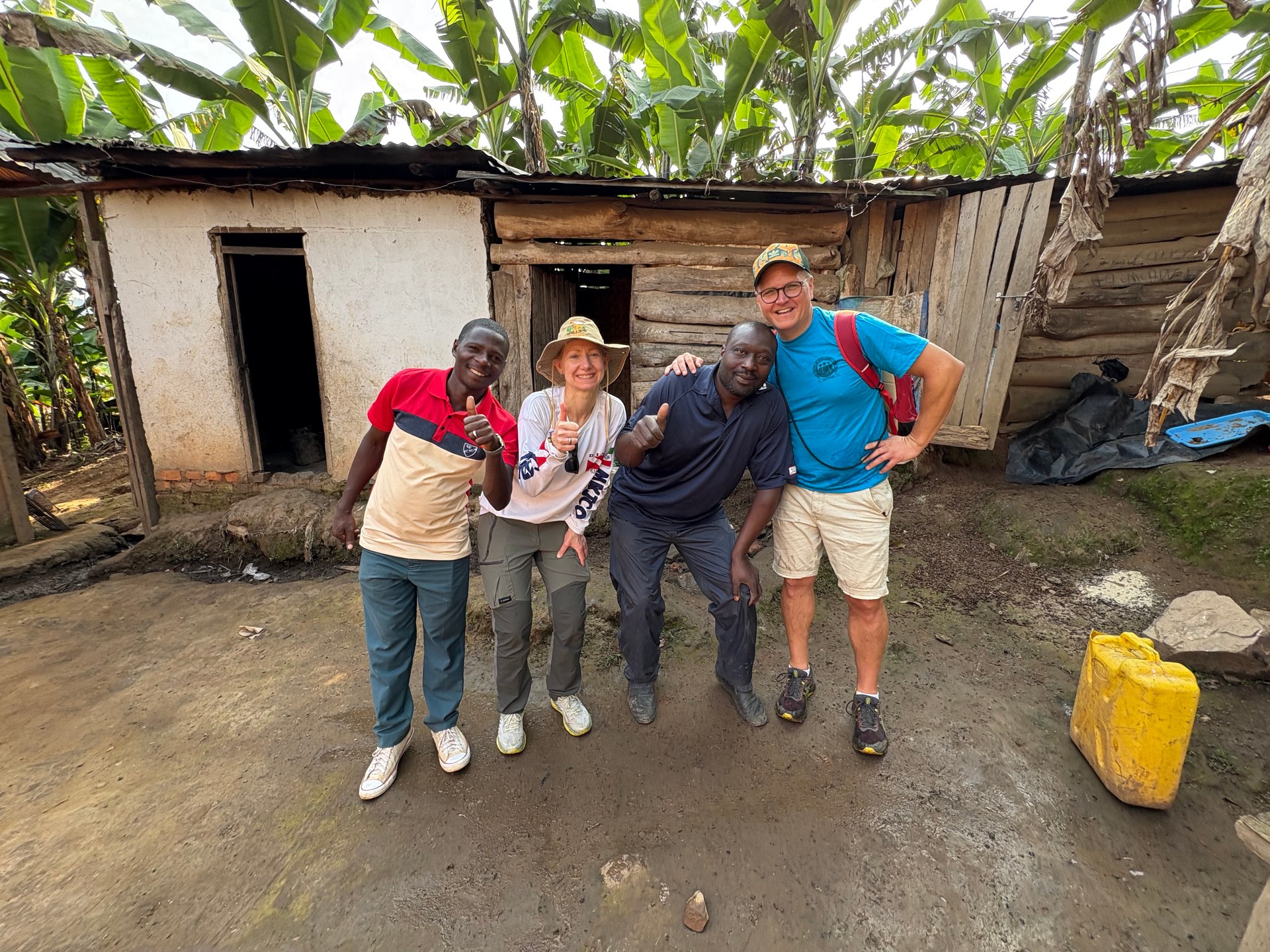
The chicken farmer we visited in Buhoma in June 2026 kept his small holding with real care. At GPS coordinates −0.9713°N, 29.6142°E — a ten-minute walk from the Bwindi park boundary — his chicks were well-maintained, the enclosure clean, the animals treated with evident attention. We had purchased chicks from him before for the nearby orphanage: some would be raised for eggs, others eventually for meat, a reliable source of protein for children who otherwise went without it. None of this exists without the gorilla tourism economy. The USD 800 permits, the lodge workers, the rangers, the community revenue fund — Bwindi gorillas are the reason any of it functions.
That connection is worth naming before discussing what the forest contains, because the Bwindi forest does not protect itself. During my visits to Bwindi in January and June 2026, the relationship between the gorilla population and the surrounding community was visible everywhere: in the gate staffing, in the lodge employment, in the revenue-sharing discussions at the community centre. The 459 bwindi gorillas counted in the most recent survey period are alive in part because the forest they live in has economic value to the people who might otherwise need it for agriculture.
This article covers the full ecology: the gorilla population itself, the other mammals that move through the same forest, the extraordinary bird life concentrated here, and the physical conditions of the landscape that make this concentration of wildlife possible in a country the size of Uganda.
Bwindi Gorillas: Two Populations, One Question of Subspecies
Mountain gorillas exist in exactly two places on earth. The larger group — approximately 459 individuals at the time of the most recent census — lives in Bwindi Impenetrable National Park. The other group inhabits the Virunga volcanic massif, a chain of mountains spanning eastern DRC, Rwanda, and the very southwest corner of Uganda. Between them lies a belt of agricultural land, cultivated fields that have grown wider and more continuous over generations, making any movement between the populations impossible. The two groups are genetically isolated — no gene flow has occurred for long enough that some researchers now consider the Bwindi population taxonomically distinct.
The physical and behavioural differences support this view. Bwindi gorillas are generally smaller than their Virunga counterparts. They spend substantially more time in trees — foraging at canopy level, which is consistent with a diet that includes more fruit and fewer terrestrial herbs than the Virunga group. Their facial structure differs visibly. During my January 2026 trek in the Buhoma sector, the gorilla I observed feeding in the forest canopy was working efficiently through the upper branches, precisely the arboreal behaviour that distinguishes Bwindi animals from the more ground-focused Virunga population. Whether this reflects a different subspecies or adaptive variation within a single subspecies is a question that field scientists are still working through. What is clear is that the Bwindi population is not simply a southern extension of the Virunga group.
The 459-individual count from the 2018–2020 census period is a snapshot, not a current real-time number. Mountain gorilla population assessments require multi-year field efforts and are conducted infrequently. The actual population in 2026 is very likely higher — the trend since the 1980s has been consistent growth, from an estimated fewer than 300 individuals to the current level. This recovery is attributed primarily to the combination of effective anti-poaching enforcement, veterinary intervention for injured and sick individuals, and the revenue from gorilla tourism that funds both.
The park's four sectors — Buhoma, Ruhija, Rushaga, and Nkuringo — each host habituated gorilla groups available for trekking. The number of habituated families has expanded over decades of careful, protocol-driven work by Uganda Wildlife Authority researchers. Habituation is not domestication: the animals are accustomed to close human presence, not dependent on it. The rangers and trackers who monitor these families are with them daily, maintaining the familiarity that makes a one-hour encounter possible without distressing the animals.
Forest Elephants: Quiet Presence in the Undergrowth
Uganda's elephant population across all parks and protected areas has been estimated at close to 8,000 individuals — one of the larger protected populations in East Africa. Within Bwindi, the resident population is forest-adapted: smaller in body size on average than the savanna elephants of Murchison Falls or Queen Elizabeth, more secretive, and accustomed to moving through dense vegetation rather than across open plains.
Encountering elephants directly in Bwindi is genuinely unpredictable. The density of the forest means that large animals can be close without being visible. The more common experience is indirect evidence: dung, wide trails broken through secondary growth, stripped bark where an animal has fed. Rangers on gorilla treks are trained to read these signs and adjust routes when elephants are nearby. The Ruhija sector in the northeast and the southern sectors near Rushaga tend to show more elephant sign than Buhoma, though the animals move across the entire park without regard to sector boundaries.
The ecological role elephants play in this forest is structurally important. By dispersing large seeds through their dung and by opening gaps in the understorey as they move, they influence the species composition of the forest over time. Some of Bwindi's large-fruited trees depend on elephants or other megafauna for seed dispersal — a process that, if interrupted by population decline, can cause the tree's regeneration to slow significantly over decades.
350 Bird Species: The Ornithological Weight of Bwindi
Bwindi Impenetrable National Park has recorded over 350 bird species — roughly a third of Uganda's total avifauna contained in a single 321 km² park. Of these, 23 are Albertine Rift endemics: species found only in the narrow chain of highland habitats that runs along the western edge of the East African Rift from the Ruwenzori Mountains south to the Nyungwe forest in Rwanda. For several of these species, Bwindi is one of only a handful of sites where sightings are reliably achievable.
The Mubwindi Swamp, covering approximately two square kilometres in the southeastern sector near Ruhija at higher altitude, provides habitat conditions that the surrounding forest cannot replicate. Waterbirds and species adapted to open wetland edges are concentrated here. For any visitor prioritising birds alongside gorillas, a half-day at Mubwindi is among the most productive single field sessions available in Uganda.
The acoustic character of Bwindi's forest is distinctive. On my visits in both January and June 2026, the forest was layered with simultaneous calls from different height zones — canopy specialists audible above, mid- storey species at eye level, and understorey voices at ground level simultaneously. This vertical stratification of birdlife reflects the structural complexity of the forest and is part of why species richness is so high: multiple habitat niches stacked on top of one another allow species that would compete on flat ground to coexist vertically.
Among the species that draw dedicated birders specifically to Bwindi are the African Green Broadbill — a vivid small species restricted to the Albertine Rift highlands — Chapin's Flycatcher, Grauer's Warbler, Ruwenzori Nightjar, and the Ruwenzori Turaco. None of these occur in the savannas of northern Uganda; several cannot be found anywhere else in East Africa outside the Albertine Rift escarpment.
Bwindi's butterfly fauna adds another dimension: over 220 species have been recorded, and three of these — genuinely endemic to Bwindi — occur on no other site on earth. This extraordinary level of endemism in a single protected area reflects Bwindi's role as a Pleistocene refugium: a patch of forest that persisted through the dry, cool periods of the last ice age while surrounding habitat was transformed into grassland. Species that survived that period in Bwindi continued evolving in isolation; what emerged are butterflies that will never be found anywhere else.
Other Primates and Nocturnal Forest Mammals
Gorillas and chimpanzees both occur in Bwindi — but where chimpanzee trekking is the primary draw at Kibale Forest National Park further north, Bwindi's chimpanzees are unhabituated. They move through the forest without the protocol-driven familiarisation that makes close observation possible. Occasional sightings happen, but they are not part of the standard visitor experience.
The other primate species are more consistently seen on forest trails. L'Hoest's monkey — endemic to the Albertine Rift — is frequently encountered in family groups in the mid-altitude forest. The grey- cheeked mangabey, the red-tailed monkey, the olive baboon, and the black-and-white colobus all have populations in Bwindi. On most morning treks in Buhoma, at least one of these species is visible from the trail before the gorilla family is reached.
For nocturnal primates, a guided night walk is necessary. The potto — a slow-moving, large-eyed primate that grips branches with remarkable force — is present in Bwindi but rarely seen without a guide who knows specific tree sections where they sleep during the day. Galago species (bush babies) are more detectable at night by eye-shine from a torch. Both are animals that most Bwindi visitors, focused on the gorilla experience, never observe.
Larger mammals are similarly present but elusive. The giant forest hog, which can exceed 200 kilograms, appears occasionally at dawn on trails near Buhoma. The forest buffalo — smaller and more reddish-brown than the Cape buffalo of the savanna parks — is present throughout the park but rarely approached. The African golden cat, one of Africa's least- known forest felids, is recorded from camera trap data in Bwindi but sightings by visitors are genuinely rare.
The Forest Ecology: What Makes Bwindi Impenetrable
The word "impenetrable" refers specifically to the understorey vegetation: a dense interlocking growth of ferns, climbing plants, woody shrubs, and young trees that fills the gaps between established canopy trees so thoroughly that movement without a machete-cut trail is nearly impossible. This character is most pronounced at mid-altitude, between roughly 1,400 and 2,000 metres, where the combination of high rainfall, moderate temperature, and low wind creates conditions for dense secondary growth.
The park spans from 1,160 metres at its lowest edge to 2,607 metres at its highest point. This altitude gradient produces distinct vegetation zones stacked on one another: lower-altitude mixed forest at the park boundary, montane rainforest at middle elevations, and afromontane forest at the higher reaches near Ruhija. Each zone has different species compositions, different temperature ranges, and different wildlife communities — which is part of why the species count in a single park is so high. A visitor trekking from the Buhoma gate upward passes through multiple habitat types in a single morning.
Annual rainfall exceeds 1,200 millimetres and is distributed across two wetter periods — March to May and October to November — and two drier periods in June to July and December to February. The drier months are generally preferred for trekking: paths are firmer, leeches (which are abundant in wet conditions) are less active, and the forest is slightly more navigable. On my January 2026 visits, the drier season delivered exactly this — consistent access and good trail conditions despite a dense forest. The June 2026 visit was at the beginning of a wetter phase, but all sectors remained fully open and wildlife was active.
The Mubwindi Swamp, covering approximately two square kilometres in the Ruhija sector in the southeast, is the park's most significant wetland. It functions as a dry-season water source for elephants, buffalos, and other mammals, and as a year-round concentration point for wetland bird species. The swamp's presence within the park boundary ensures a moisture reserve that the surrounding montane forest draws on during drier periods.
Bwindi's status as a Pleistocene refugium is what explains its extraordinary endemism rates. During the colder, drier periods of the last ice age, much of Central Africa's forest retreated or was replaced by savanna. The Bwindi area retained forest cover throughout, becoming a refuge where species survived while populations elsewhere were eliminated. The three butterfly endemics, the 23 Albertine Rift endemic bird species, the potentially distinct gorilla population — all are products of this long period of isolation and separate evolution in a forest that never stopped being forest.
Practical Wildlife Notes from the Field
A gorilla trekking permit grants one hour with a habituated family. Most of the meaningful wildlife observation on a Bwindi visit happens outside that hour — on the approach trail, around the lodge at dawn, and on any additional forest walk arranged through UWA or a local guide. Treating the gorilla trek as the only wildlife experience Bwindi offers means missing most of what the forest contains.
Dawn is the single most productive time. Before 7 a.m., L'Hoest's monkeys are frequently visible near the trail starts in Buhoma. Bird activity peaks in the first two hours of light. The giant forest hog occasionally crosses the main Buhoma access trail at this time. In January 2026, before reaching the gorilla family, we passed through a section of trail where the forest was dense enough that visibility dropped to under five metres — then opened briefly into a gap where a red-tailed monkey was feeding in the canopy directly above the path.
For birding specifically, the Ruhija sector offers the most concentrated access to Albertine Rift endemics. The Mubwindi Swamp walk from Ruhija is a half-day activity that can be combined with a gorilla trek in the same sector on consecutive days. Serious birders should allow at least two full days at Ruhija on top of any gorilla trekking days.
[QUOTE: local guide on wildlife patterns and best observation times]
Night walks, arranged through UWA or lodge operations at Buhoma or Nkuringo, give access to nocturnal species entirely invisible to day visitors. The potto, galagos, and certain owl species require darkness and a guide who knows where to look. These walks are not widely promoted but are available — and they represent a genuinely different category of Bwindi wildlife experience from the standard daytime trek.