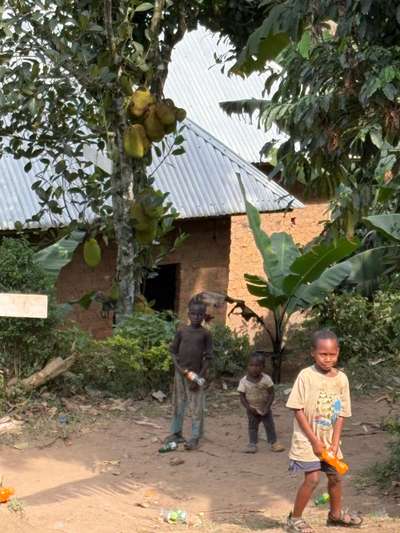
On the morning of 21 June 2026, at coordinates -0.9676°N, 29.6195°E, outside a low building with a corrugated iron roof in Buhoma, three children from the neighborhood of the local orphanage appeared at the edge of our group. They were shy in the way that comes not from natural reserve but from circumstances — their clothes worn, their posture carrying a particular kind of uncertainty. We did not deliberate. We invited them immediately to join us for a meal. That moment of direct, unhesitating hospitality is one of the things that stays with you after any visit to Bwindi's border communities: the distance between a child who needs help and a child who receives it can sometimes be measured in a single decision.
Conservation in Uganda operates in this same territory — between intention and delivery, between a written target and a measured outcome. The Uganda Large Carnivore Action Plan 2024–2034 sets a benchmark of at least 30 percent population growth for lions, leopards, and spotted hyenas across their established ranges by 2034. On paper it is a statistical commitment, structured around baseline surveys already conducted in 2018, 2022, and 2023. On the ground, it is a question about whether a country can simultaneously protect the wildlife that draws international visitors and sustain the communities that live alongside that wildlife — and whether the institutional will to do both will hold across an entire decade.
A Bold Conservation Benchmark: The 30 Percent Target and What It Requires
Uganda's Large Carnivore Action Plan 2024–2034 commits the Uganda Wildlife Authority to a measurable and time-bound objective: each of the three target species — lion, leopard, and spotted hyena — must demonstrate at least 30 percent population growth across surveyed ranges by 2034. This is not a directional aspiration but a specific numerical threshold, anchored to baseline surveys already completed in 2018, 2022, and 2023. The existence of three survey years before the plan's formal launch reflects deliberate institutional preparation: the data needed to calculate growth against a credible zero point had to exist before a percentage target could be meaningful.
The 30 percent figure applies across each species' documented range in Uganda, not only within national park boundaries. That distinction carries real weight. Uganda's large carnivore populations do not confine themselves to park edges. Lions, leopards, and hyenas move through buffer zones, community wildlife management areas, game reserves, and — in the case of leopards — even forest patches adjacent to agricultural land. A target measured only inside gazetted parks would systematically undercount dispersing individuals and miss the corridor dynamics that determine whether isolated populations can exchange individuals and maintain genetic diversity over a decade.
For Bwindi Impenetrable National Park specifically, the relevance of this plan is not about direct species overlap. Lions are not resident in Bwindi's dense montane forest. But the plan's implementation draws on the institutional infrastructure — survey capacity, law enforcement, community liaison programs — that Uganda Wildlife Authority manages across the entire national park system. The revenue that Bwindi generates through gorilla trekking permits funds a budget that flows into carnivore research and management elsewhere. Understanding the Large Carnivore Action Plan is therefore part of understanding how Bwindi's conservation success ripples outward into a broader national wildlife strategy.
The 2034 accountability horizon gives the plan something most conservation documents lack: a clear moment of reckoning. Progress will be assessed against the documented baselines, and the methodology for that assessment — camera trap coverage, structured transect surveys, acoustic monitoring — is defined in advance. Whether 30 percent is achievable depends on factors including prey base recovery, community tolerance for livestock predation, anti-poaching capacity, and the sustained flow of conservation funding. All of those remain active challenges across Uganda's savanna and forest ecosystems.
Lions in Uganda: A Population Under Serious Pressure
Uganda's lion population is small by the standards of East African conservation. The evidence is sobering in its simplicity: as recently as 2011, the Uganda Wildlife Education Centre in Entebbe held just three individual lions. That figure reflects not a captive breeding program but the broader scarcity of the species across the country. Wild populations are largely confined to Queen Elizabeth National Park in the southwest and Kidepo Valley National Park in the far northeast, with limited and uncertain evidence of presence in other protected areas.
The history of Uganda's lions is inseparable from the country's political history. The instability and armed conflict of the 1970s and 1980s caused catastrophic losses across Uganda's wildlife. Park management infrastructure collapsed, poaching went unchecked, and lion populations were reduced to fragments. The recovery since the restoration of peace has been genuine but uneven, and the populations remain small enough that a single disease outbreak, a sustained period of retaliatory killing, or a deterioration in prey availability could reverse years of recovery.
The baseline surveys from 2018, 2022, and 2023 provide the statistical foundation from which the 30 percent growth target is calculated. Lion survey methodology in Uganda typically combines camera trap arrays deployed across known movement corridors, direct sighting records from structured vehicle transects, and in some areas, GPS collar data from individually tracked animals. Each of the three survey years adds a data layer, and the comparison between the 2018 and 2023 figures already tells a preliminary story about trajectory — one that informed the design of the ten-year plan.
Reaching the 30 percent target for lions will require interventions across several fronts simultaneously. Prey base management — ensuring that kob, buffalo, and warthog populations within lion range remain stable — is a prerequisite for any meaningful lion recovery. Snaring, which kills lions as incidental bycatch in traps set for bushmeat species, is a significant source of unintentional mortality that anti-poaching operations must address. And retaliatory killing after livestock predation remains a persistent threat wherever communities and lion populations share landscape. Community livestock protection programs, including predator-proof enclosures and early warning systems, are practical components of the plan's human dimension.
[Field note: Collect firsthand account from Uganda Wildlife Authority lion monitoring ranger on changes observed between the 2018 and 2023 surveys in Queen Elizabeth National Park — to be added on next site visit.]
The Leopard's Complicated Policy Position
Of the three target species in Uganda's Large Carnivore Action Plan, the leopard (Panthera pardus) occupies the most complex policy position. Across most of its African range the leopard sits on CITES Appendix 1, which prohibits commercial trade in specimens and effectively rules out legal trophy hunting. Uganda's situation is different: the leopard was downlisted from Appendix 1 to Appendix 2 in the country, a regulatory decision that opened the door to controlled trophy hunting and regulated trade in leopard specimens under defined conditions.
Appendix 2 status under CITES does not mean a species is considered safe. It means that international trade is permissible when a non-detriment finding can be established — that is, when competent national authorities can demonstrate that the level of trade will not push the population toward qualifying for Appendix 1. In practice, this has meant that Uganda has been able to issue trophy hunting quotas for leopards in designated hunting concessions, generating revenue that is meant to flow back into wildlife management in areas where national park permit income does not reach.
The argument for this approach is a long-standing one in African conservation: if local communities and private landholders derive economic benefit from living with predators, they are more likely to protect them rather than eliminate them. Trophy hunting revenue, at high price points per animal, can in principle deliver more conservation value per individual than photographic tourism revenue on the same land. Whether that logic has translated into measurable benefit for Uganda's leopard population is exactly the question the Large Carnivore Action Plan must answer over the coming decade.
Leopards are more widely distributed across Uganda than lions — they are present in multiple national parks, forest reserves, and unprotected areas — but they are also the hardest of the three target species to census accurately. Their solitary, nocturnal, and secretive habits mean that camera trap surveys provide the most reliable data, but camera trap coverage across Uganda's full leopard range is still uneven. The baseline surveys in 2018, 2022, and 2023 represent an effort to reduce that uncertainty, with the honest recognition that leopard counts in complex terrain are population estimates with confidence intervals, not precise tallies. The monitoring framework's value lies partly in the accumulation of survey effort over time, which steadily improves baseline quality.
[Field note: Collect firsthand account from Uganda Wildlife Authority carnivore monitoring officer on the practical challenges of counting leopards across Uganda's varied terrain and what the 2023 baseline survey revealed about population trends — to be added on next site visit to Queen Elizabeth or Murchison Falls.]
Hyenas, Integrated Monitoring, and the Full Carnivore Guild
The spotted hyena completes Uganda's large carnivore target species trio. In terms of numerical resilience, hyenas are the most robust of the three. They are highly adaptable generalist carnivores capable of persisting in a wider range of habitats and tolerating closer proximity to human settlements than either lions or leopards. Their ability to subsist on carrion, agricultural waste, and opportunistic livestock predation makes them ecologically flexible — and a frequent source of human-wildlife conflict in farming communities adjacent to protected areas.
That ecological flexibility has a conservation flip side. Because hyenas can survive at lower densities and in more disturbed habitats, they are sometimes treated as the least urgent of the three target species. The Large Carnivore Action Plan implicitly pushes back against that framing by setting the same 30 percent growth target across all three species, recognizing that a functional large carnivore guild requires all three components. A park that maintains lions but has lost hyenas — or has them at very low densities — will show different scavenger guild composition, different competitive dynamics between carnivore species, and different disease ecology compared to one where the full guild is present.
The monitoring framework designed to track progress under the action plan treats all three target species as an integrated system. Camera trap deployments collect data on leopards, hyenas, and lions simultaneously. Transect surveys cover overlapping ranges. This integrated methodology is more efficient than species-specific programs and generates the cross-species data needed to analyze guild interactions rather than just single-species trajectories.
For visitors to Bwindi and the surrounding region, hyenas are not part of the forest wildlife encounter. Bwindi's dense montane habitat does not support the open savanna prey communities on which spotted hyenas most readily thrive. But in the adjacent landscape — in Queen Elizabeth National Park, reachable in a half-day drive from Buhoma — hyenas are present and their sign is frequent. The carnivore plan's ambition to grow hyena populations by 30 percent means that encounters in the greater southwestern Uganda circuit should become more reliable over the coming years, provided the management and monitoring investments deliver results.
Tourism Revenue, Protected Areas, and the Institutional Framework That Connects Bwindi to Carnivore Conservation
Uganda's protected area network comprises twelve national parks and three active game reserves, a structure that has been legally defined for decades but whose management capacity has improved substantially since the Uganda Wildlife Authority developed systematic partnerships with tourism operators, research institutions, and conservation NGOs. Between 2009 and 2013, visitor numbers to Uganda's national parks grew 41 percent — from just over 151,800 to nearly 214,000 annual visitors — with foreign non-residents accounting for 47 percent of that total in 2013. That growth trajectory generated the permit revenue that funds park operations across the system.
Bwindi's contribution to that financial ecosystem is disproportionate to its geographic size. Mountain gorilla trekking permits — currently among the most expensive single wildlife permits in East Africa — concentrate substantial conservation revenue in one corner of southwestern Uganda. Some of that revenue stays in Bwindi's management budget; some flows into the Uganda Wildlife Authority's central accounts, which fund operations, surveys, and infrastructure across the full park network. When a monitoring team deploys camera traps for lions in Murchison Falls or conducts a hyena transect survey in Queen Elizabeth, part of the financial foundation for that work traces back to gorilla permits purchased at Bwindi.
Game reserves and controlled hunting areas occupy a separate legal category in Uganda's statutory framework — designated by law for wildlife conservation, landscape protection, and scientific research, with activities including regulated trophy hunting permitted under defined conditions. The coexistence of strict national park protection with adjacent areas where limited extractive use is allowed reflects Uganda's pragmatic approach to financing conservation across a landscape too large and diverse to be maintained through one revenue model alone.
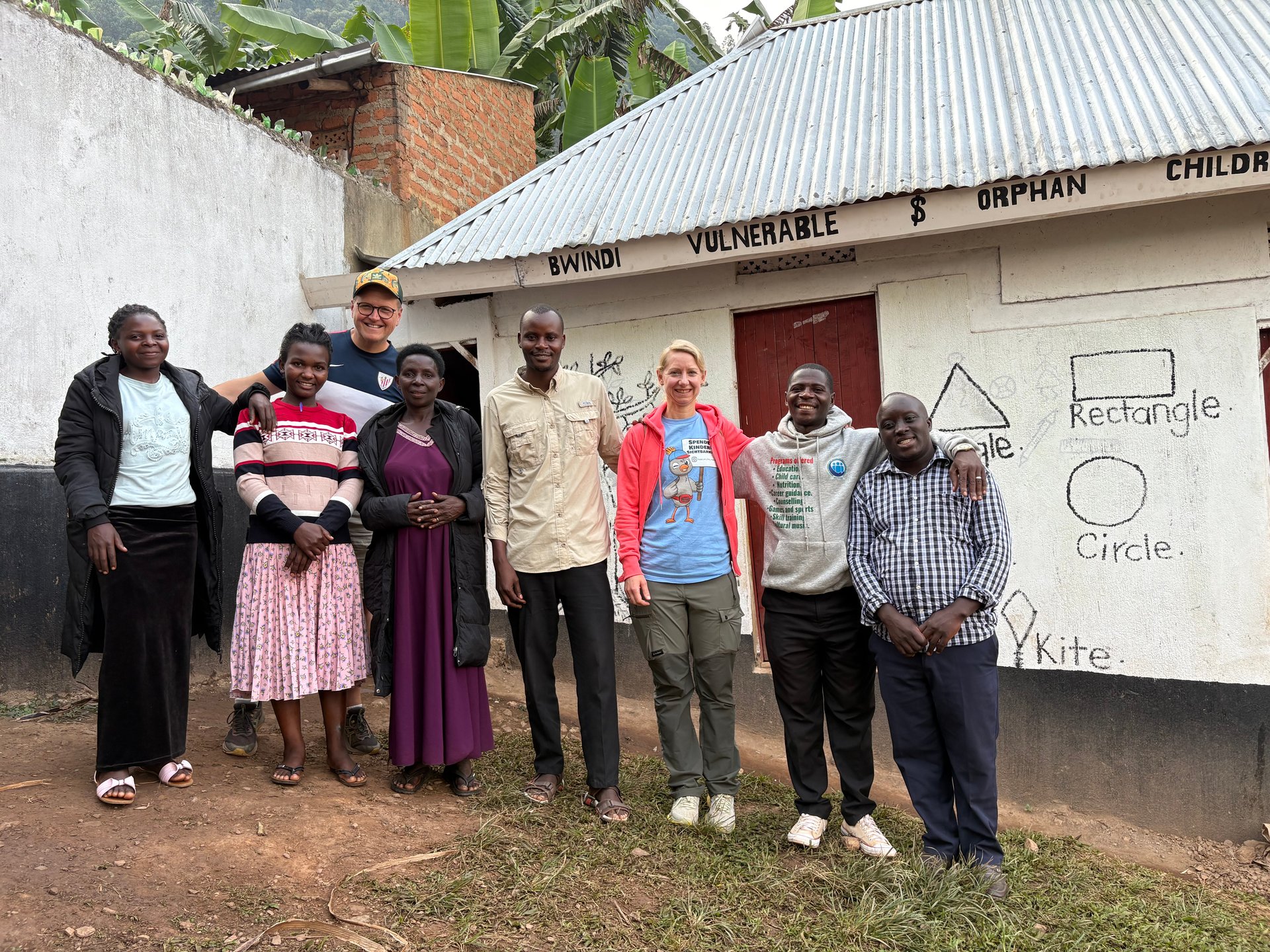
During fieldwork in Bwindi in June 2026, GPS-verified at -0.9676°N, 29.6195°E, the degree to which conservation outcomes here depend on community relationships became immediately apparent. The settlement at Buhoma, pressed against the park boundary, is not a passive buffer between wilderness and human population. It is an active social landscape: development organizations, tourism lodges, schools, informal markets, and community structures interact daily with the park's presence. Children from the neighborhood orphanage join communal meals at the edge of the forest. Guides who know every trail through the gorilla zones grew up in villages where forest access defined subsistence. Conservation in Uganda cannot be analyzed purely as wildlife management. It is simultaneously a question of whether the institutions and financial flows that currently support it will remain functional — and whether communities adjacent to protected areas continue to see net benefit from the wildlife living alongside them. The Large Carnivore Action Plan's 30 percent target is a measure of species recovery. It is also, indirectly, a measure of whether that social contract is holding.
What the 2034 Horizon Demands: Challenges and Realistic Expectations
Achieving 30 percent population growth across three large carnivore species in ten years is an ambitious commitment, and the honest assessment of the challenges involved is part of what makes the Uganda Large Carnivore Action Plan a serious document rather than a promotional one. Several structural constraints will determine whether the target is met.
Prey base recovery is the most fundamental prerequisite. Lions and leopards cannot increase in number if the ungulate populations that sustain them are themselves under pressure from poaching, habitat loss, and livestock competition. Survey data on kob, buffalo, and impala populations within carnivore ranges will therefore be as important to reading the 2034 outcome as the carnivore counts themselves. A 30 percent rise in lion numbers against a backdrop of declining prey is neither stable nor credible.
Human-wildlife conflict management is the second structural challenge. Large carnivores that kill livestock generate retaliatory responses that can eliminate individual animals or destabilize recovering populations in a matter of months. The plan's community engagement component — predator-proof enclosures, compensation schemes, early warning systems, and community wildlife scouts — is not peripheral to the conservation strategy; it is central to whether the carnivore populations can grow into the landscape outside park boundaries, which is where the mathematical space for 30 percent growth actually exists.
Monitoring continuity is the third requirement. The 2018, 2022, and 2023 surveys provide a valuable baseline, but their value depends on methodological consistency in subsequent surveys. Changes in camera trap coverage, transect protocols, or analytical methods between now and 2034 would make the comparison between baseline and endpoint unreliable. Institutional memory, staff continuity at Uganda Wildlife Authority, and sustained funding for survey operations are therefore as important to the plan's success as any single conservation intervention.
Uganda has the institutional foundation — the legal framework, the park network, the tourism revenue base, and the documented scientific capacity — to meet an ambitious carnivore recovery target. The Large Carnivore Action Plan 2024–2034 is the mechanism. Whether the decade it describes will deliver the 30 percent outcome depends on decisions that are not yet made, about budget allocations, community partnerships, and the sustained political prioritization of wildlife in a country with many competing development demands. The baseline is set. The clock is running.
Frequently Asked Questions
Related Articles
Endangered Species in Uganda: What Is at Stake
Mountain Gorilla Facts: Population, Behavior, and Biology
Elephants in Bwindi: Presence, Corridors, and Conflict
Gorilla Trekking in Bwindi: Permits, Sectors, and Practical Guide
Buhoma Sector: The Gateway to Bwindi