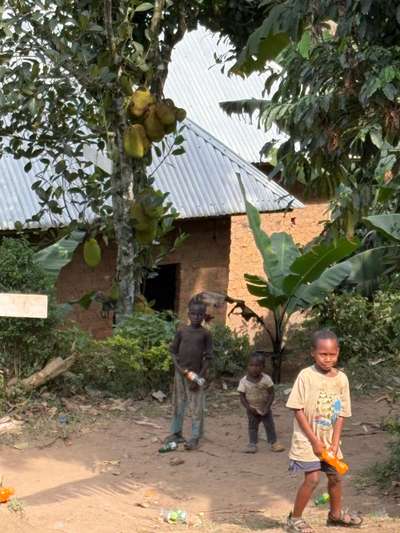
In June 2026, three children from the neighbourhood of the orphanage in Buhoma stood outside a simple mud-brick building and watched us with cautious eyes. They were slightly nervous — their clothes worn, their manner quieter than you would expect from children watching strangers arrive. We invited them to eat with us without thinking twice. They sat down. The caution dissolved almost immediately.
These children live within walking distance of one of the most intensively monitored forests on Earth. Buhoma is the main gateway to Bwindi Impenetrable National Park — the place where more than half of the world's remaining mountain gorillas live, where 40 forest elephants move through 321 km² of dense rainforest, and where international conservation funding flows in quantities that would be difficult to imagine in most of the surrounding region. The gap between that concentrated funding and the daily reality of families in the village is one of the harder things to sit with after multiple visits.
This article covers the full picture of Uganda's threatened wildlife — the flagship species that drive the tourism economy, and the less visible ones that face serious pressure without attracting equivalent attention or funding. It is written from 14 documented visits to Bwindi and its surrounding communities, including fieldwork in October 2024, January 2026, and most recently June 2026, when the photos on this page were taken at GPS coordinates −0.9617°N, 29.6109°E — Buhoma village, a few minutes' walk from the park gate.
Mountain Gorillas: The Species That Changed Everything
Uganda holds more than half of the world's remaining mountain gorillas. The 2018 Great Ape Census counted 459 individuals living within Bwindi Impenetrable National Park alone — in a forest of 321 square kilometres. A second, separate population inhabits the Virunga Massif, a chain of volcanoes shared between Uganda, Rwanda, and the Democratic Republic of Congo, bringing the global total to approximately 1,063. There are no mountain gorillas in captivity anywhere in the world; every individual alive exists within this narrow strip of highland forest.
During our gorilla trek in January 2026, after roughly an hour of moving through dense, steep forest in the Buhoma sector, we encountered the first gorilla family. The first individual we saw was sitting high in the branches of a large tree, pulling leaves with the deliberate calm of an animal that had stopped registering human presence as a threat. That composure is the product of years of habituation — daily ranger visits, morning after morning, that gradually accustomed each gorilla family to humans as a neutral, non-threatening element of the forest. Approximately 19 gorilla families are currently habituated in Bwindi, each monitored and located by trackers every single day.
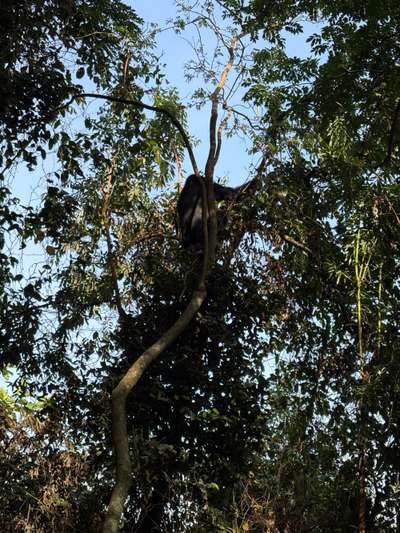
The mountain gorilla (Gorilla beringei beringei) was reclassified from Critically Endangered to Endangered by the IUCN in 2018 — reflecting genuine population growth, from an estimated 620 individuals in 2008 to over 1,000 by the census year. This reclassification represented a conservation success story built on decades of anti-poaching work, veterinary intervention through the Gorilla Doctors programme, and the economic model of high-value, low-volume trekking tourism that funds ranger operations.
What makes Bwindi's population particularly significant is its genetic isolation. Bwindi and Virunga gorillas diverged thousands of years ago and are genetically distinct. They cannot supplement each other; the loss of Bwindi's gorillas would mean the irreversible disappearance of a unique genetic lineage. Gorilla families in Bwindi also regularly cross into the DRC and back, making transboundary cooperation between Uganda Wildlife Authority, Rwanda Development Board, and the Institut Congolais pour la Conservation de la Nature not a diplomatic nicety but a biological necessity.
The gorilla trekking permit — $800 per person in 2026 — is the financial mechanism that sustains the entire conservation infrastructure. It is a deliberately high price, calibrated to limit daily visitor numbers, reduce disturbance, and generate concentrated revenue from a small group. That revenue funds ranger salaries, patrol operations, snare removal, veterinary care, and the community revenue-sharing scheme that returns 20% of park gate fees to parishes surrounding Bwindi. The economics are designed to make gorilla survival financially rational for the communities living alongside the park.
[QUOTE: local ranger or guide on what it means to work with habituated gorilla families every day]African Elephants: A Decline That Deserves More Attention
Uganda's elephant story does not have the same conservation success narrative as the gorilla. The national population peaked at approximately 7,975 individuals in the 2018–2020 wildlife survey — itself a remarkable recovery from the political violence of the 1970s and 1980s, when widespread poaching reduced Uganda's elephants to a fraction of their historical numbers. By 2025, the national count had declined to around 6,352. The peak was brief. The downward trend is being monitored closely.
Bwindi holds approximately 40 elephants — one of the smallest and most isolated elephant populations in Uganda. They are distributed across all four trekking sectors but are almost never seen. Their activity is primarily nocturnal; during the daylight hours when gorilla trekking groups move through the forest, the elephants tend to stay in the densest cover, retreating before human groups approach. What visitors encounter is almost always evidence rather than animals: dung deposits the size of a bucket, bark stripped in the distinctive bands that no other species produces, sections of undergrowth flattened by something many times human weight.
The ecological significance of these 40 animals is disproportionate to their number. Elephants are primary seed dispersers — they consume large quantities of fruit and deposit seeds in viable condition far from the parent tree through their dung. In a complex rainforest where many tree species depend on large frugivores for dispersal, elephants are functionally irreplaceable. They also create forest gaps by pushing down trees and stripping bark, generating microhabitats that benefit other species. A forest without elephants is a different forest — and over enough time, a diminished one.
The national decline from 7,975 to 6,352 matters because it reflects a pattern visible across multiple Ugandan parks, not just in Bwindi's isolated population. For comparison: Uganda's lion population fell from approximately 493 individuals in 2011 to around 291 by 2025 — a drop of more than 40% in fourteen years. The mountain gorilla population, at 459 in Bwindi, has held stable or grown through the same period, supported by an intensive monitoring and management apparatus that simply does not exist at the same scale for other species.
Pangolins: The World's Most Trafficked Mammal
The pangolin does not appear in most Bwindi visitor guides. It does not feature in permit sales, habituation programmes, or tourism marketing. It is, by every available measure, the world's most illegally traded mammal — and in Uganda, it is under pressure from both the domestic bushmeat trade and international trafficking networks that move pangolin scales toward Asian markets.
Two forest pangolin species are present in Uganda's Albertine Rift: the white-bellied pangolin (Phataginus tricuspis) and the black-bellied pangolin (Phataginus tetradactyla). Both are listed under CITES Appendix I — the highest level of international protection, which prohibits all commercial trade. Both appear regularly in wildlife confiscation records. The gap between legal protection and effective enforcement reflects the structural reality that pangolins generate almost no legal economic interest — no tourism, no research infrastructure, no revenue stream that makes their preservation financially compelling at the community level.
A 2026 assessment of Uganda's wildlife trafficking landscape identified pangolins as among the species most vulnerable to population collapse precisely because of their invisibility. They are nocturnal, solitary, slow-reproducing, and leave almost no trace of their presence in a forest — or of their removal from it. A healthy pangolin population and a depleted one look nearly identical to casual observation. By the time absence becomes measurable, the collapse may already be advanced.
In Bwindi, the park's dense terrain and intensive ranger presence provide some protection through the mechanism designed for gorillas — patrols that intercept snares, monitor movement, and make opportunistic extraction difficult. But pangolins are not the target of this infrastructure; they benefit from it incidentally. No dedicated monitoring programme tracks their population in Bwindi. No habituation programme, no daily tracking, no census data. Their status in the park is, for now, unknown.
Lions, Leopards, and the Larger Predator Crisis
Uganda's lion population stands at approximately 291 individuals — a decline of more than 40% from the 493 recorded in 2011. Queen Elizabeth National Park holds the majority; the rest are distributed between Murchison Falls and Kidepo Valley. The trajectory is steep and largely uninterrupted. None of Uganda's lions live in Bwindi — the dense montane forest is not lion habitat — but the national trend matters as a measure of the broader conservation system's health.
The leopard (Panthera pardus) does occur in Bwindi, though encounters are rare enough to be exceptional. Leopards are solitary and highly secretive; in dense forest terrain, they can move through an area intensively used by gorilla trekking groups without ever being seen. Their Uganda population remains poorly quantified. A controversial classification decision moved the species from CITES Appendix I to Appendix II for Uganda, permitting limited controlled hunting. Conservation organisations challenged this as premature, arguing that the population base is too small and too poorly monitored to sustain any level of regulated offtake. The debate continues, and reflects a wider tension in conservation policy between those who argue that regulated use builds community buy-in and generates funding, and those who see any normalisation of trade in already vulnerable populations as an unacceptable risk.
The black rhinoceros was functionally eliminated from Uganda during the political violence of the 1970s and 1980s. A small number of southern white rhinos — a distinct subspecies — have been reintroduced to Ziwa Rhino Sanctuary in central Uganda under a dedicated programme. There are no rhinos in Bwindi, and no active reintroduction programme is planned for the park.
Wildlife Trafficking and What It Actually Means for Conservation
The 2026 assessment of Uganda's wildlife trafficking landscape documented a trade network more structured than the image of individual poachers with snares. Commercial operations — moving pangolin scales, elephant ivory, gorilla parts, and a range of smaller species — involve urban middlemen, cross-border logistics, and in some cases facilitation by individuals in positions that grant access to park infrastructure. Uganda's geographic position as a transit country compounds the problem: wildlife products originating in DRC, Tanzania, and other neighbouring countries move through Ugandan border points toward export hubs, with domestic consumption running alongside international flows.
Gorilla parts appear in the illegal trade at low volumes but at high symbolic value. No legitimate commercial market exists; the demand is driven by traditional medicine claims and the trophy appeal of material from a globally famous, legally protected species. The threat this poses to Bwindi's gorilla population is real but limited by the fact that the families are under daily observation. A sick or missing gorilla is noticed within 24 hours. The monitoring system that enables tourism also provides effective early warning for any incident involving habituated families.
The species that slip through unnoticed are the ones without habituation programmes, without daily trackers, and without the economic infrastructure that makes their protection financially rational. Pangolins. Forest birds. Smaller primates. A forest can lose significant fractions of these populations before any monitoring system registers the change. This is the structural gap that conservation organisations have flagged consistently — the gorilla protection model works for gorillas, and its benefits cascade through the ecosystem, but it was not designed to protect every species equally.
Uganda has twelve national parks, three active game reserves, and a legal framework — the Uganda Wildlife Act — under which protected areas can only be degazetted through a formal process requiring public approval. This legislative protection matters. It means that the forest itself is structurally difficult to legally reduce. What the law does not automatically protect is the ecological integrity of what remains inside that boundary — and that depends on funding, enforcement, and community economic alternatives that make extraction less rational than conservation.
The Community as Conservation Infrastructure
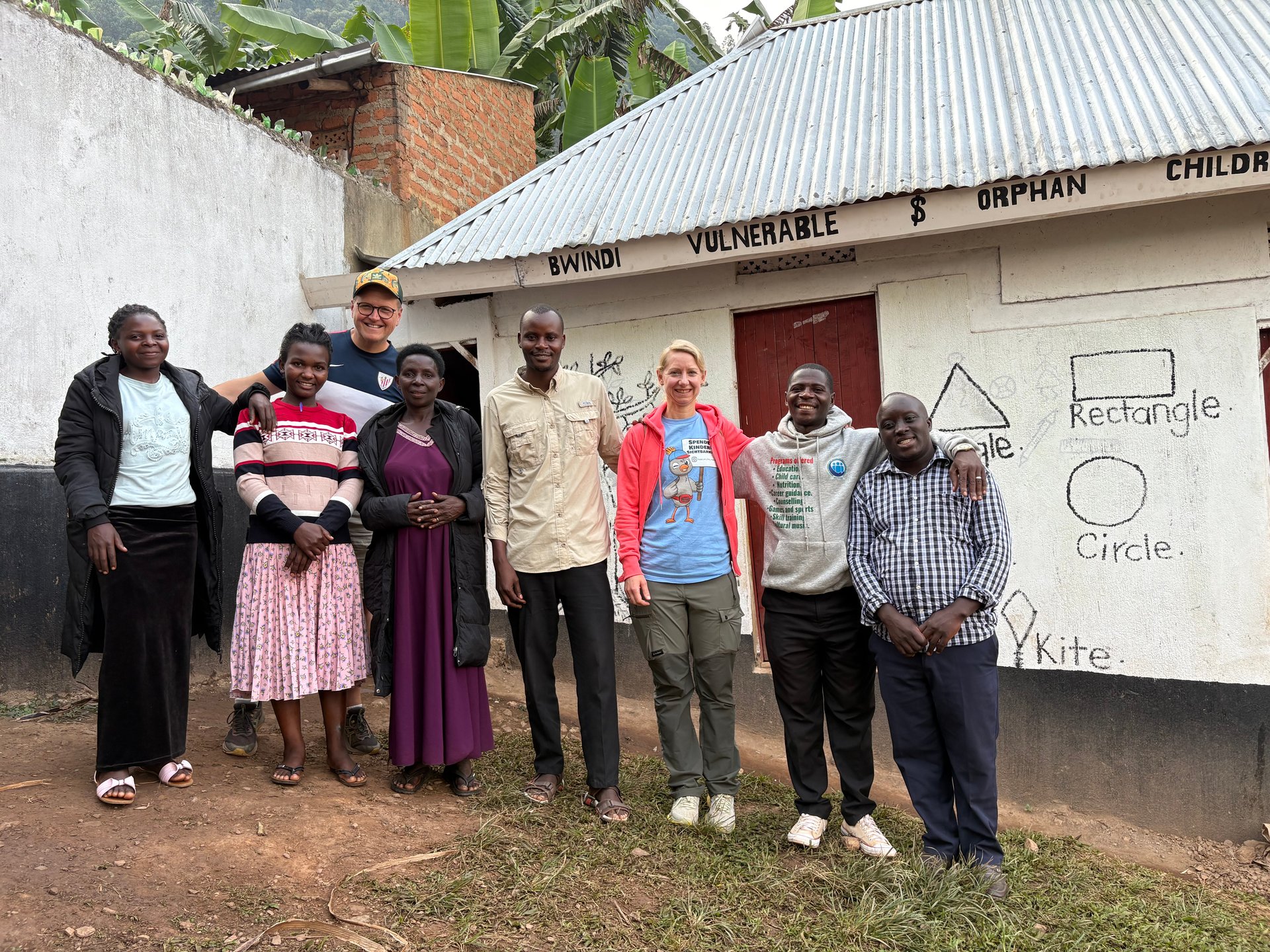
The three children who joined us for a meal in Buhoma that June morning were not case studies or programme beneficiaries. They were neighbours of the orphanage we work with — children who live in the same village that receives 20% of Bwindi's gate fees through the UWA community revenue-sharing mechanism, and who experience the presence of the conservation economy primarily as something that happens to and around their families, rather than something they perceive themselves as participating in.
This matters for conservation because the economic argument for protection depends on communities experiencing a direct benefit. When tourism collapses — as it did during the 2018–2020 Ebola outbreak in eastern DRC, and again during the COVID-19 closure — the revenue stops, the community benefit stops, and the economic case for conservation disappears. What remains is legal enforcement alone, which is expensive and has limits.
The period between 2009 and 2013 saw national park visitor numbers in Uganda grow by 41% — from approximately 152,000 to 214,000 annually. Bwindi specifically received around 21,700 visitors in 2013. By 2025, international visitors to Bwindi far outnumber domestic visitors, with the international share remaining above 95% of the total. This concentration creates structural fragility: a conservation economy built almost entirely on international tourism is one advisory letter away from collapse.
After more than 59 days on the ground across 14 visits to Bwindi and surrounding communities, the overall picture is this: the conservation infrastructure works remarkably well for the species it was designed around. The mountain gorilla population is stable or growing. The ranger presence is genuine and professional. The community revenue-sharing mechanism creates real economic interest in park integrity. And there are quiet gaps — in species monitoring, in trafficking enforcement, in the reach of community benefits — that the success of the gorilla programme does not automatically fill.
The children at the edge of the forest are the most direct measure of how far the conservation economy actually reaches. They live where the park meets the village, where the economic logic of protection is either legible in daily life or it is not. On the morning of June 21, 2026, at −0.9617°N, 29.6109°E, the first thing that happened was a meal. That is where conservation either earns its justification or it does not.