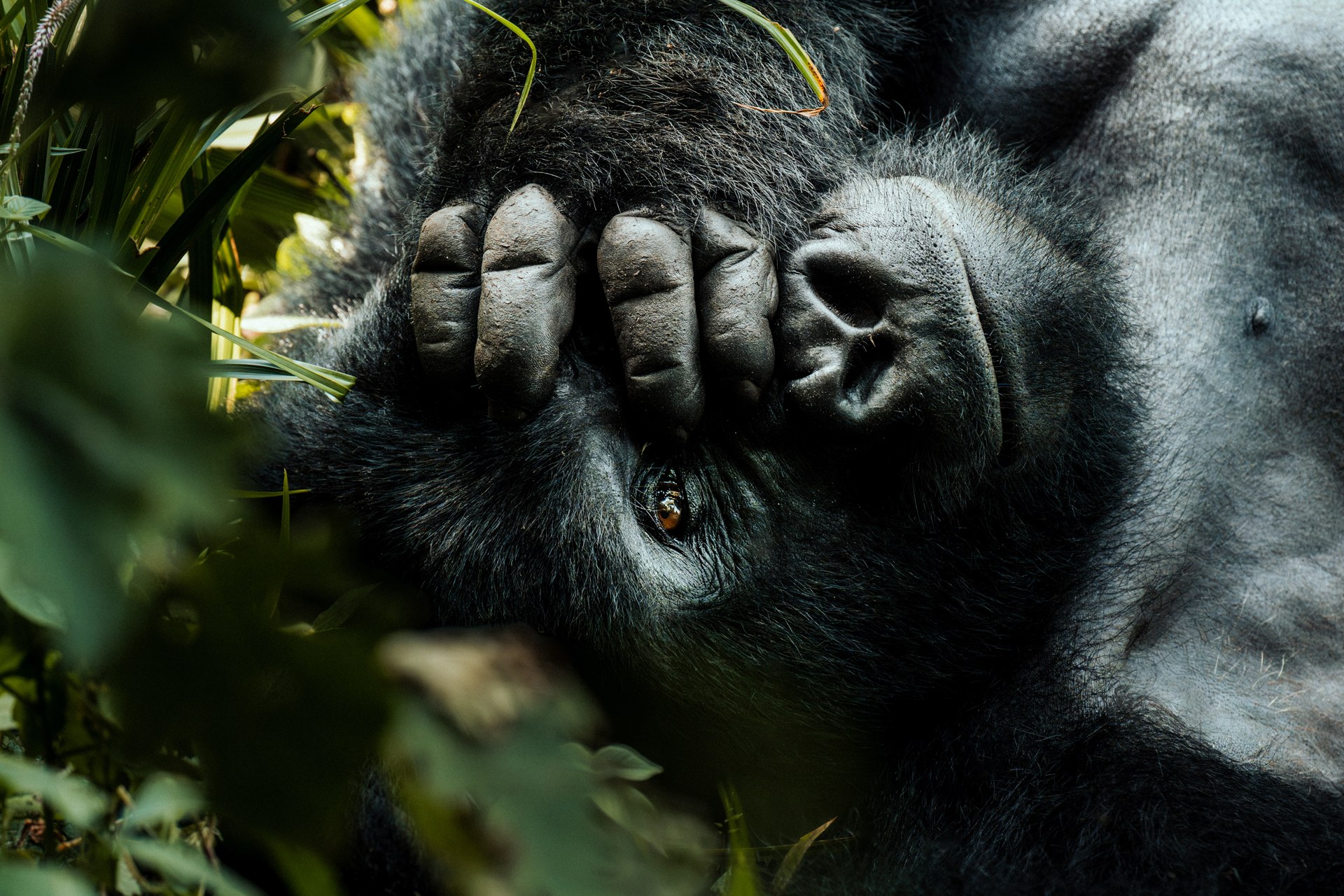
Daily Tracking: The Foundation of Health Surveillance
Every habituated gorilla family in Bwindi is visited by Uganda Wildlife Authority rangers and trackers every day — including days when no tourists are present. These daily visits are the foundation of the health monitoring system. Trackers observe each individual, note behaviour, record signs of illness or injury, and locate the family for the following day. Over years, this continuous data builds a detailed longitudinal record of each animal.
When a tracker observes something concerning — an individual that is lethargic, not eating, moving differently, or showing visible injury — the observation triggers a veterinary assessment. The Mountain Gorilla Veterinary Project, known as Gorilla Doctors, maintains a field presence across Bwindi and can mobilise rapidly when a case requires clinical evaluation.
Gorilla Doctors: Forty Years in the Field
The Mountain Gorilla Veterinary Project — Gorilla Doctors — began operating in Bwindi in 1986, making it one of the longest-running wildlife veterinary programmes in Africa. The programme's veterinarians provide health assessments, treat human-caused injuries, and respond to outbreak events within habituated gorilla families. Their intervention policy is deliberately conservative: the goal is to maintain natural gorilla behaviour and social structure, not to create a managed animal population dependent on veterinary care.
Intervention is triggered by human-caused harm — a snare wound, a spear injury, illness traced to a visitor interaction — or by conditions assessed as life-threatening and unlikely to resolve without treatment. Natural injuries and disease not meeting these criteria are generally monitored rather than treated. The distinction matters because inappropriate intervention in wild animals can alter behaviour, disrupt family hierarchy, and reduce the fitness of individuals over time.
The Respiratory Disease Problem
Mountain gorillas share approximately 98.3% of human DNA — a genetic proximity that makes them highly susceptible to respiratory infections that humans carry and largely survive without incident. A cold that an adult visitor barely notices can become a serious illness in a gorilla infant or an elderly silverback. In a small, closely-bonded family group, a respiratory pathogen can move through every individual within days.
This is the disease threat the visitor protocols are designed to address. The 7-metre minimum distance, compulsory masks during encounters, and symptom screening at park gates are not bureaucratic formality — they are calculated interventions against the most consistent threat to habituated gorilla health. Gorilla Doctors veterinarians have treated respiratory outbreaks in multiple Bwindi family groups; the cases are well-documented and have in several instances required emergency interventions.
What the Visitor Protocols Actually Do
Each element of the gorilla trekking protocol has a specific disease-prevention function. The 7-metre distance rule limits aerosol transmission — the primary route for respiratory pathogens. Masks create an additional physical barrier between human respiratory output and gorilla breathing space. The pre-trek health check at the gate removes visitors who present with symptoms before they reach the forest. The one-hour time limit reduces cumulative exposure per family group across the daily visitor rotation.
These protocols operate collectively. Removing any single element increases the risk even if the others remain in place. Rangers are trained to enforce them and will end a trek if a visitor is visibly symptomatic or persistently breaks distance rules. The gorilla families cannot advocate for themselves; the enforcement framework does it for them.
Population Monitoring and the Census Cycle
Beyond individual health monitoring, periodic Great Ape Censuses assess the status of the entire mountain gorilla population across Uganda, Rwanda, and the DRC. The most recent comprehensive census, completed in 2018, counted 1,063 mountain gorillas globally — 459 of them in Bwindi. This was the count that supported the IUCN downlisting from Critically Endangered to Endangered: a genuine conservation success built on decades of daily monitoring work.
The data quality of those population assessments depends directly on the quality of field records maintained by trackers and rangers. Individual gorillas are identified by unique nose-print patterns — as distinctive as a human fingerprint — and their life histories are tracked from birth through death. That identification system, maintained continuously in Bwindi for decades, makes Bwindi's gorilla population one of the best-documented wild animal populations on Earth.