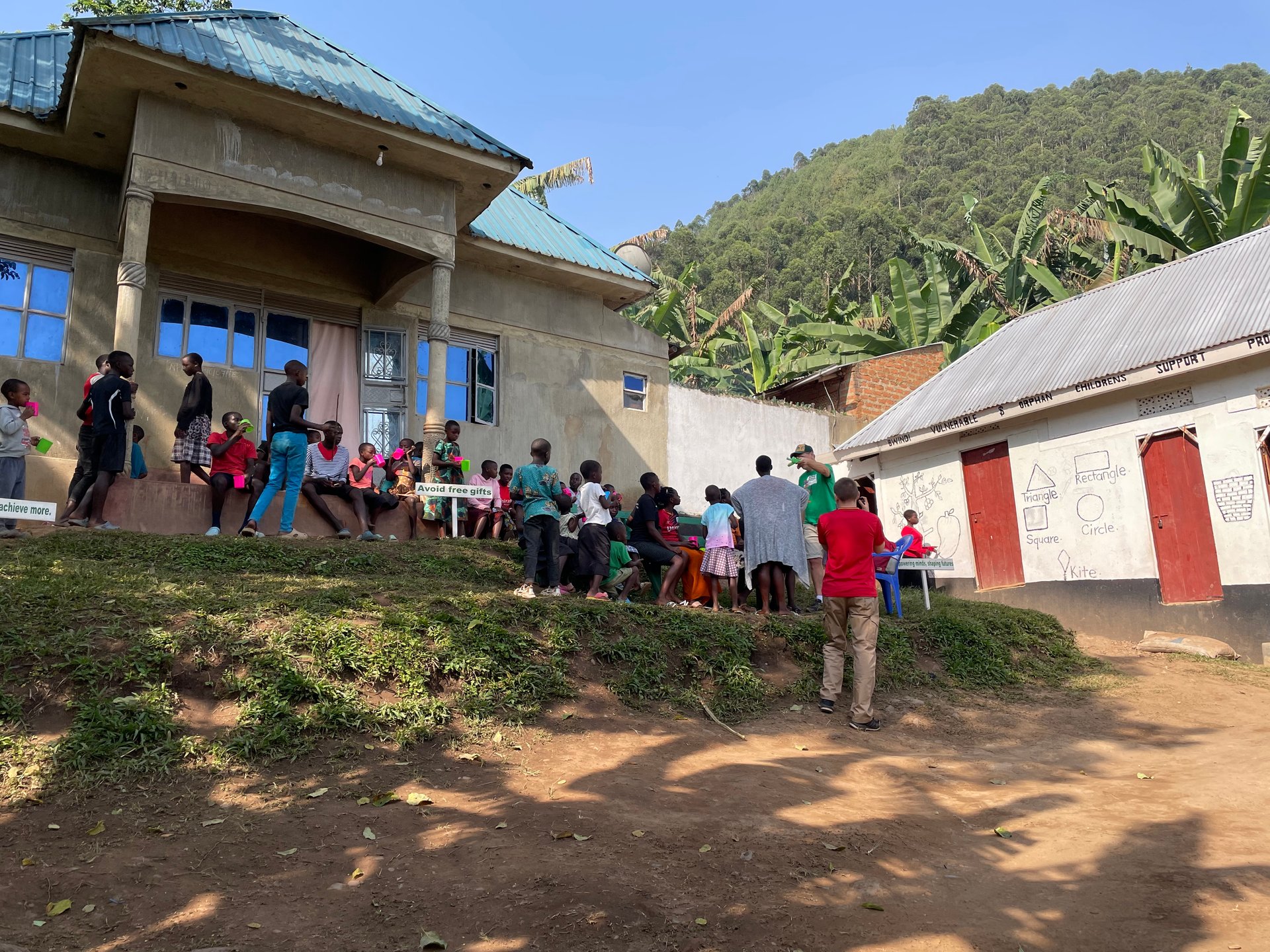
The orphanage in Buhoma looks larger from the road than it actually is. Step through the gate and the scale becomes clear: a main building with three rooms, electricity connected but no running water, and a small annex holding a dormitory and an administrative office. During my visit to this site in January 2026 — GPS coordinates confirmed at 0.1042°N, 32.1684°E — I found that life here happens almost entirely outdoors. Children sat at low wooden benches doing homework in the afternoon shade. A communal meal was being served from pots set out on the swept earth of the central courtyard.
Younger children chased each other between the banana plants that border the yard, with the forested ridgeline of Bwindi visible in the near distance. There is nothing performative about this place. It operates with quiet practicality at the edge of one of Africa's most visited national parks — and that proximity is not incidental. The revenue generated by the tourism economy surrounding Bwindi is, in theory, what helps keep institutions like this one functioning.
The distance between theory and daily reality is what this page attempts to bridge. Community benefit sharing around Bwindi is a real mechanism with real funding flows, real organizations working to direct those flows, and real gaps between what the formal system delivers and what communities along the park boundary actually need. Understanding that distance — and knowing how to close a small part of it as a traveler — is the most useful thing a visitor can bring to Bwindi beyond the cost of a permit.
How Tourism Revenue Reaches Bwindi's Communities
Bwindi Impenetrable National Park sits at the economic center of Uganda's gorilla tourism industry, drawing visitors who pay some of the highest wildlife permit fees in the world. A single gorilla trekking permit for a foreign non-resident costs USD 800. Multiplied across the thousands of permits issued annually across Bwindi's four sectors — Buhoma, Ruhija, Rushaga, and Nkuringo — the aggregate revenue flowing into Uganda Wildlife Authority accounts is substantial. The critical question, one that conservation practitioners have debated for decades, is how much of that income reaches the hundreds of thousands of people living along the park's boundaries.
The formal redistribution mechanism is the Community Revenue Sharing scheme, administered by the Uganda Wildlife Authority. Under this arrangement, a defined percentage of park entrance and permit fees is channeled back to community development projects in the parishes immediately surrounding Bwindi. Historically, these funds have supported the construction of school buildings, health centers, community water sources, and small infrastructure upgrades in villages that would otherwise receive no direct economic return from the tourism industry operating beside them.
The scale of the opportunity is significant. Between 2009 and 2013, visitor numbers to Uganda's national parks increased by 41 percent — rising from 151,818 to 213,950 annual visitors. In 2013 alone, foreign non-residents accounted for 47 percent of all national park visitors, making them the dominant visitor group ahead of East African Community citizens at 24 percent. That sustained growth in visitation translates directly into a larger revenue base available for community benefit programs — though the challenge of equitable distribution across multiple communities and competing priorities remains a defining tension.
Uganda's 12 national parks and three active game reserves, all managed by the Uganda Wildlife Authority, together generate a portfolio of tourism products including gorilla tracking, nature walks, and bird watching. Bwindi's status as the access point for roughly half the world's remaining mountain gorilla population means it draws a disproportionately high share of international visitors and associated revenue. The responsibility to distribute that revenue in ways that genuinely benefit adjacent communities is correspondingly greater than at most other parks in the region.
Bwindi Impenetrable National Park is managed under a General Management Plan that divides the park into four distinct zones: a tourism zone, a wilderness zone for strict conservation, an administration zone, and a collaborative management zone. The collaborative management zone is particularly significant for community relations: it is the area where adjacent community members are permitted access under specific agreements with the Uganda Wildlife Authority, allowing controlled use of natural resources such as selected plant harvesting. This zonal framework reflects a deliberate effort to balance the park's conservation mandate with the practical needs of communities that historically lived inside and around the forest before it was protected.
The Batwa: From Forest Dwellers to Community Partners
No account of community benefit sharing at Bwindi can begin without the Batwa, the indigenous forest people who inhabited this rainforest for thousands of years before it received formal protected status in 1991. When Bwindi was gazetted as a national park, the Batwa were removed from their ancestral territory. The displacement was total: there was no compensation, no consultation process that met any meaningful standard, and no transition support for communities whose entire economy, food system, medicine, and cultural identity had been built inside the forest over countless generations.
The consequences were severe and long-lasting. Stripped of their only resource base, Batwa families found themselves competing for agricultural land they had no tradition of cultivating, in a region where other ethnic groups had long-established land tenure systems and social networks. In many areas around Bwindi's sectors, Batwa communities settled on the margins of villages, often without formal land ownership of any kind. The social and economic gap between Batwa and neighboring Bakiga or Bafumbira communities was stark and has taken sustained effort to partially address.
The growth of international gorilla tourism created both pressure and opportunity. Conservation organizations and government agencies increasingly recognized that protecting the forest over the long term required the genuine participation — and fair treatment — of the communities who had most directly paid the price of its creation. The Batwa, once the forest's de facto stewards, became central to discussions about who should benefit from Bwindi's tourism economy and on what terms.
Today, benefit sharing for Batwa communities takes several forms. Direct livelihood support programs provide agricultural training, land access assistance, and small enterprise development. Forest trail management roles give community members an active function in the tourism experience rather than a passive one. The Batwa Forest Trail, operating in selected sectors, enables indigenous community members to guide visitors through their ancestral landscape — generating income while keeping oral knowledge and forest practice alive across generations. Cultural tourism programs at sites such as the Nkuringo Cultural Center provide additional economic pathways that do not depend solely on forest access.
Organizations Driving Community Development at Bwindi
The practical work of connecting conservation revenue to community welfare around Bwindi is carried out by a network of organizations operating with different mandates but overlapping goals. Understanding who is doing what helps explain why benefit sharing functions inconsistently across sectors — and where the genuine gaps remain.
The Bwindi Mgahinga Conservation Trust, known as BMCT, is one of the most established funding bodies in the region. It channels international conservation finance into community development programs and Batwa-specific initiatives, including support for land acquisition for Batwa families who would otherwise have no legal claim to property. BMCT has also funded capacity-building work that enables community organizations to participate more equitably in decisions affecting park management and revenue allocation.
The Batwa Development Program focuses specifically on advocacy and livelihood support for Batwa communities across the region, addressing land tenure issues, access to education, and economic integration. The Nkuringo Cultural Center, based in the southern sector of the same name, has developed cultural tourism products that provide Batwa and neighboring communities with an economic stake in visitor activity extending beyond the park gates themselves.
International partners contribute significant resources and technical support. The International Gorilla Conservation Programme supports community development enterprises around Bwindi, problem animal control initiatives — a critical concern where crop-raiding elephants and primates directly threaten farmer livelihoods — and tourism development at the sector level. The Gorilla Organisation funds advocacy and ecological restoration work, including strengthening the Batwa Forest Trail and supporting indigenous tree planting in pocket forests adjacent to the main park boundary. Pro-biodiversity Conservationists in Uganda, known as PROBICOU, rounds out the active network with a focus on conservation-compatible livelihoods for farming families on the park's edge.
These organizations do not operate a unified system. Each has its own funding base, donor requirements, and programmatic focus. The result is uneven coverage: some communities and sectors have multiple active programs, while others remain relatively underserved. Coordinating across this landscape is one of the persistent challenges for anyone working on community benefit sharing in the Bwindi context.
Life on the Ground: What Community Support Looks Like in Buhoma
Policy frameworks and organizational mandates describe what community benefit sharing is supposed to achieve. The orphanage I visited in Buhoma in January 2026 illustrates what the gap between intention and reality can look like in a specific place.
The facility operates with electricity but without running water — a telling detail. Water must be carried in by hand, which adds labor to every meal, every wash, every basic sanitation task. The three rooms of the main building serve children who have lost family care through poverty, illness, or family breakdown — circumstances common across rural southwestern Uganda. The annex provides sleeping space and a small administrative office. Everything else happens outside: meals served in the open courtyard, homework done on wooden benches, younger children playing between the banana plants that border the yard. The mountain landscape in the background is beautiful. The operational constraints are real.
Facilities like this one receive partial support through the community revenue sharing funds distributed via local government structures. They also depend on donations from travelers who find their way to community sites through informal tourism routes in Buhoma. The combination rarely covers full operational costs. The gap between what the CRS scheme delivers in a given annual cycle and what a facility actually needs to function well — and to expand to meet demand — is visible in the infrastructure details: rooms that function, but fewer than needed; water that has not yet arrived.
This is not an indictment of the benefit sharing concept. It is a reflection of the arithmetic involved. The communities surrounding Bwindi are numerous, their needs substantial, and the total revenue pool, while significant in absolute terms, is distributed across multiple parishes with competing priorities. The organizations working in the area help bridge the distance between formal UWA-administered schemes and the specific, granular needs of individual households and facilities. But the distance remains, and it is measured in things like water connections not yet made.
The Road to Bwindi: Infrastructure and Access as a Development Factor
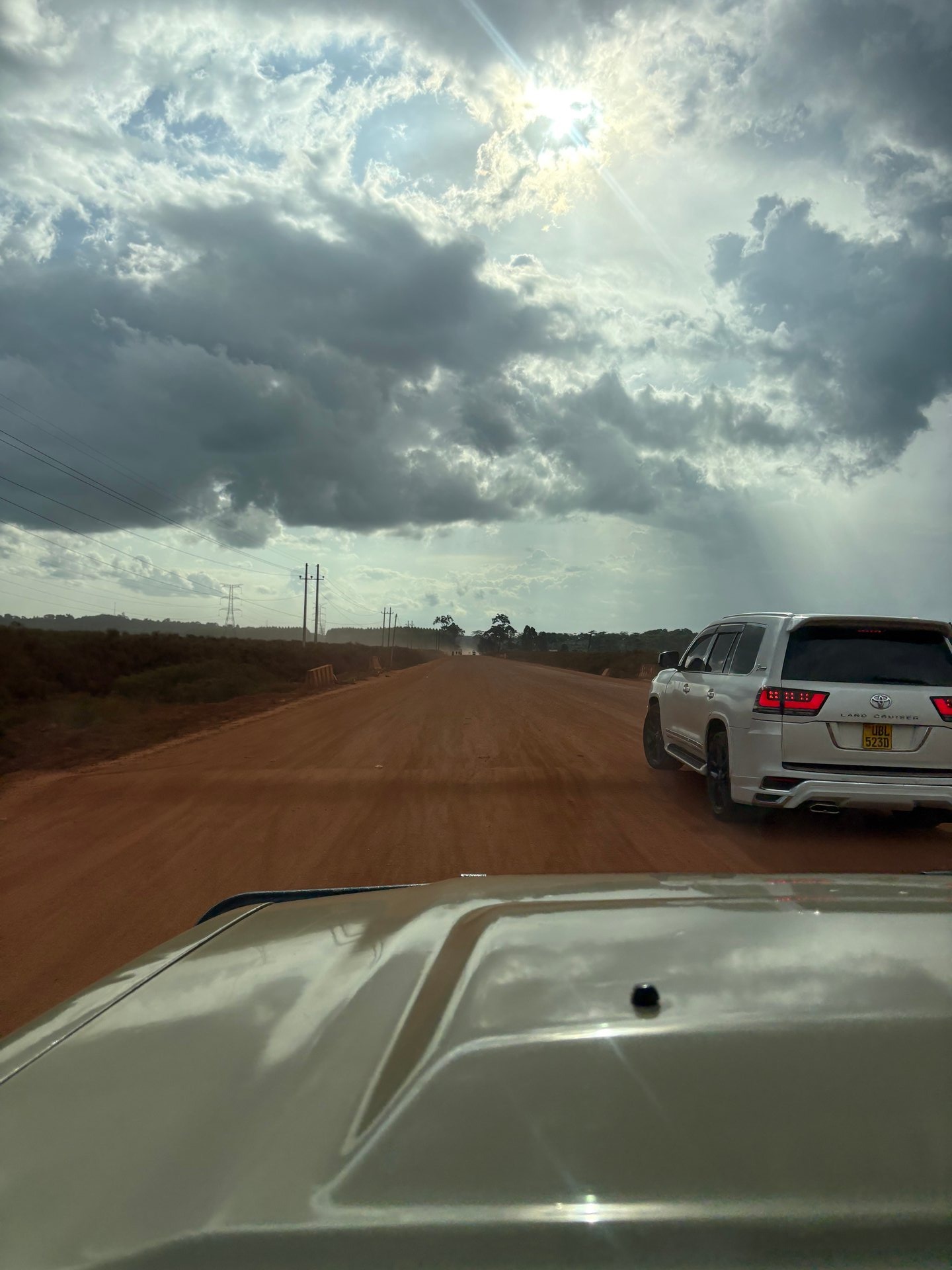
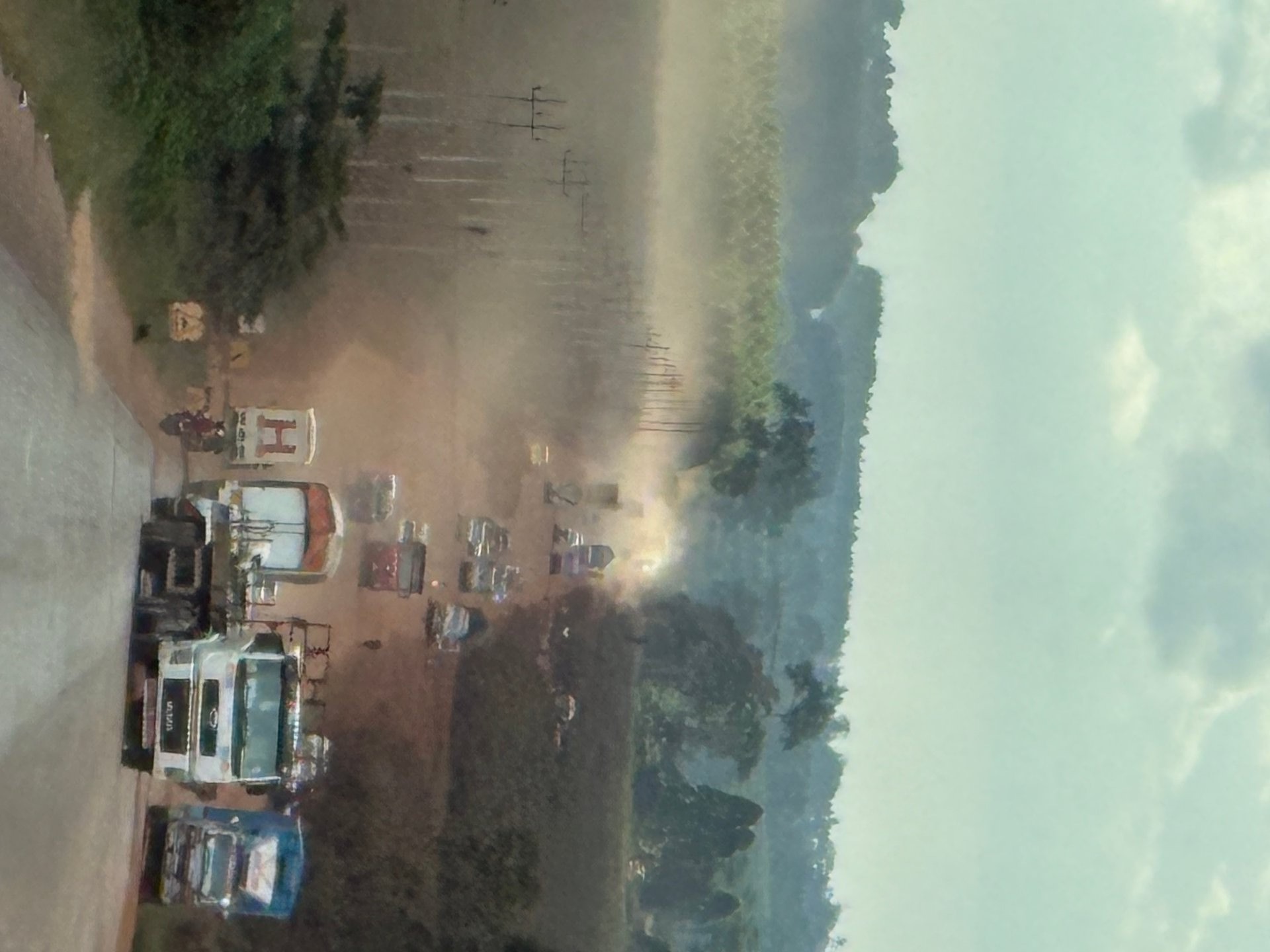
Getting to Bwindi requires engaging with the realities of southwestern Uganda's road network — and that reality has a direct bearing on both tourism numbers and the ability of communities to convert benefit sharing funds into tangible outcomes. Traveling toward Buhoma in January 2026 along the Masaka Highway, I drove through flat, open agricultural country carrying a constant stream of trucks, buses, boda-boda motorcycle taxis, and private vehicles. The road is long. Sections were unpaved or degraded, and in the dry season the dust rises in sustained clouds that coat passengers and riders alike. Many vehicles have no air conditioning. Boda-boda riders breathe the road dust directly through every kilometer of their working day.
Sections of the Masaka Highway were scheduled for rehabilitation beginning in 2026 — a project that, once complete, will reduce journey times between Kampala and the approaches to Bwindi. Rehabilitation projects on roads of this scale take time, and in the interim, communities along the route remain at a logistical remove from services available in larger urban centers. Health workers traveling to rural clinics, school supplies moving by truck, community organization staff accessing training programs — all of these depend on the same road infrastructure that tourists navigate on their way to gorilla trekking.
The connection between tourism infrastructure investment and community welfare is closer than it might initially appear. Road improvements benefit the tourism industry by making Bwindi more accessible to a wider range of visitors, including independent travelers who currently depend on organized transfers. They benefit communities by reducing the cost and time involved in accessing markets, health facilities, and educational institutions. When benefit sharing funds are available for a water project or a school construction, the quality and cost of that work depends partly on whether the materials can be transported efficiently to the site.
Viewing the road network as peripheral to the benefit sharing question is a mistake. Infrastructure access is the condition on which everything else depends — how revenue reaches communities, how communities access services, and how effectively tourism and conservation policy translates into improved daily life for the people living alongside one of Africa's most significant forests.
How Travelers Can Contribute Directly to Community Benefit Sharing
Visitors to Bwindi are, by the act of arriving and paying for a permit, already participants in the benefit sharing ecosystem. Every gorilla trekking permit purchased from the Uganda Wildlife Authority contributes to the revenue base from which community development funds are drawn. But there are additional, more direct ways to direct spending toward communities rather than exclusively toward internationally owned tourism businesses.
Accommodation choices matter significantly. Staying in locally owned guesthouses and lodges in Buhoma and the other sectors rather than solely in large internationally managed properties means a greater share of accommodation spending circulates within the local economy. Hiring local guides, porters, and cultural hosts — through community-managed programs operating in each sector — creates direct wage income for people living adjacent to the park. Purchasing crafts, produce, and services from community cooperatives rather than imported goods keeps spending local.
The Batwa Forest Trail represents one of the most direct ways to contribute to benefit sharing for the community most severely affected by Bwindi's creation as a national park. Fees paid to participate in this guided cultural experience go directly to Batwa community members. The experience itself — a walk through ancestral forest landscape with Batwa guides who carry genuine intergenerational knowledge of that environment — is substantively different from a standard nature walk and worth seeking out on its own terms.
Visiting community-managed sites such as the Nkuringo Cultural Center or local social facilities in Buhoma — including the kinds of community institutions I documented in January 2026 — connects tourism spending to the daily operational needs of places that the formal benefit sharing system does not fully cover. Understanding the mechanics of community benefit sharing before arriving at Bwindi requires no background in conservation policy. It requires only a willingness to ask where money goes, and to make choices that keep more of it with the communities that live with the consequences of conservation every single day.
Frequently Asked Questions
Related Articles
Gorilla Trekking at Bwindi: Permits, Sectors & What to Expect
Buhoma Sector: The Northern Gateway to Bwindi
Boda-Boda in Buhoma: Community Transport and Local Life
Endangered Species in Uganda: Conservation Context
Mountain Gorilla Facts: Biology, Behavior & Population