After three hours of hiking through dense, humid rainforest during my visit to Bwindi Impenetrable National Park in January 2026, our group reached a gorilla family. They were entirely peaceful. We were, in ways I had not anticipated, very close — close enough to watch a young mountain gorilla climb into the canopy and pull leaves directly to its mouth, close enough to feel the silence change when one of them turned and looked at us. That level of proximity is only possible because of the safety and habituation systems that Bwindi's management has built over decades. And yet the question I hear most from travellers researching this trip is not about the gorillas themselves, but about whether it is safe to go. GPS-verified coordinates from my six original photos place me at -0.9725°N, 29.6213°E — inside the park, inside the forest, and inside an experience that is both carefully managed and genuinely wild.
Rangers, Guides, and the Safety Architecture of Every Trek
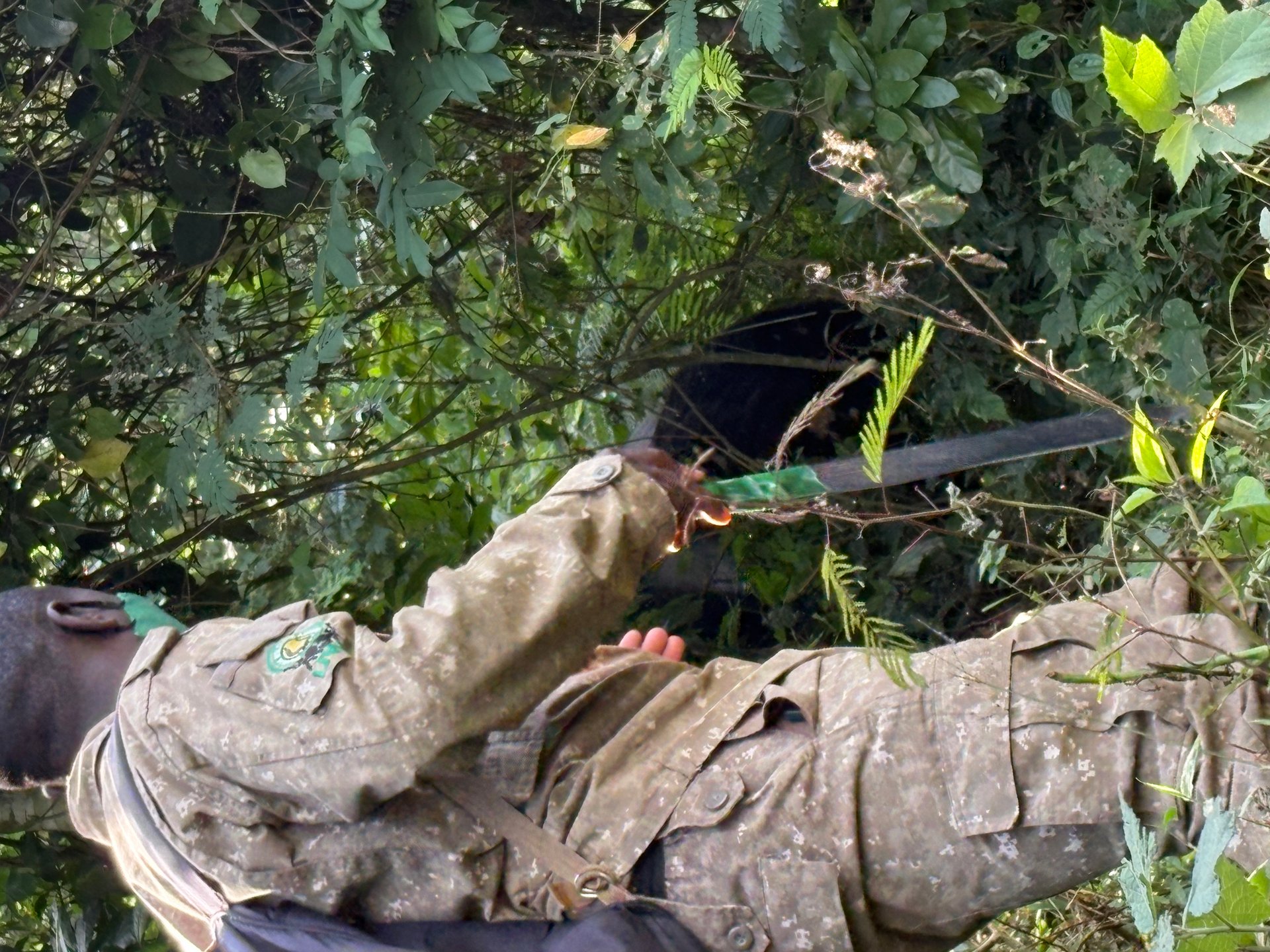
On our gorilla trekking excursion in Bwindi, our group was accompanied by one guide and two rangers. The rangers were armed — an initial surprise that quickly made sense. Their role is not primarily protective against wildlife; it is a broader field security function that covers everything from clearing steep trail sections with machetes to supporting hikers on difficult ascents. What I noticed was how comfortable the rangers themselves were in the forest. They moved through the undergrowth with practiced ease, pointed out tracks and sounds, and helped each member of the group when the terrain required it. The armed presence added nothing threatening to the atmosphere; it was simply part of the professional structure that allows these encounters to happen safely.
Every gorilla trekking experience at Bwindi Impenetrable National Park is managed through Uganda Wildlife Authority (UWA), which administers the country's national parks and continues to oversee them today. Trekking groups are escorted at all times — visitors do not enter the forest independently. The guide maintains knowledge of the habituated gorilla families and their likely locations based on daily monitoring by park trackers who head out before the tourist groups. This preparation means that while a trek can last anywhere from one hour to six or more depending on where the family has moved overnight, the guide maintains radio contact and adjusts the route in real time.
The physical challenge of gorilla trekking in Bwindi is real and should not be underestimated. The terrain is steep, the vegetation dense, and the humidity considerable. Walking sticks — available for hire at the trailhead — make a genuine difference. When I visited in January 2026, the trail surface was slick in places and sections required pulling yourself up by roots and branches. The rangers' practical help on these climbs is part of the safety system as much as any formal protocol.
Understanding Movement Restrictions and Normal Life Around Bwindi
Data from the Uganda SMI Report (March 2026) points to a nuanced picture for the Bwindi region: movement freedom is approximately 64 percent restricted, but 78 percent of normal life continues in national park areas. These figures reflect the layered nature of life in and around a protected forest that sits at the intersection of community land, tourism infrastructure, and genuine conservation activity. For visitors, the practical meaning is that gorilla trekking operations continue as normal, that Buhoma village functions as an active community with shops, lodges, and daily commerce, and that the disruption to tourism itineraries is minimal when properly planned.
This does not mean the region is without complexity. Bwindi borders communities with real economic pressures, and the relationship between the park and its surrounding villages has been carefully managed through community revenue-sharing programs over many years. The park itself operates under a model that combines community participation with public-private management — a structure that has contributed to the relatively stable security environment visitors experience today. Understanding this context helps travellers calibrate their expectations: this is not a hermetically sealed safari destination, but a living landscape where tourism and local life coexist.
For travellers worried about safety, the most useful frame is this: gorilla trekking in Bwindi has been operating continuously for decades, the park employs a significant ranger force, and the habituated gorilla families that trekkers visit are monitored daily. The SMI data showing 78 percent normal life continuation suggests that concerns about regional instability should be evaluated against actual operational conditions rather than generalized regional advisories. Checking the current UWA operational status and consulting a reputable local operator remains the right approach for any visit.
The Mountain Gorillas of Bwindi — Population, Families, and Conservation Status
Bwindi Impenetrable National Park in southwestern Uganda is one of only two places on Earth where mountain gorillas can be tracked in the wild — the other being the Virunga massif shared between Uganda, Rwanda, and the Democratic Republic of Congo. The mountain gorilla population in Uganda stood at 459 individuals during the 2018–2020 assessment period, a figure that represents a recovery from historic lows and reflects the impact of sustained conservation work by UWA, international programs such as the International Gorilla Conservation Programme (IGCP), and the revenue generated by gorilla trekking permits.
The gorilla families at Bwindi are divided across several sectors of the park — Buhoma in the north, Rushaga and Nkuringo in the south, and Ruhija in the east. Each family is monitored daily by a dedicated team. Habituation — the multi-year process of acclimating gorilla families to human presence — is what makes trekking possible at all. Habituated families have learned that human observers are neither a threat nor a source of food; they largely ignore visitors while going about their normal activities, which is why encounters feel as intimate and unhurried as they do.
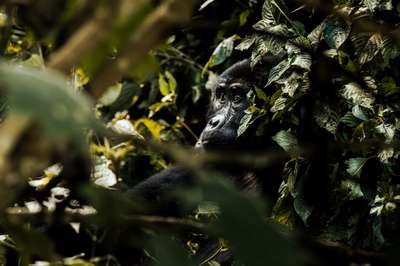
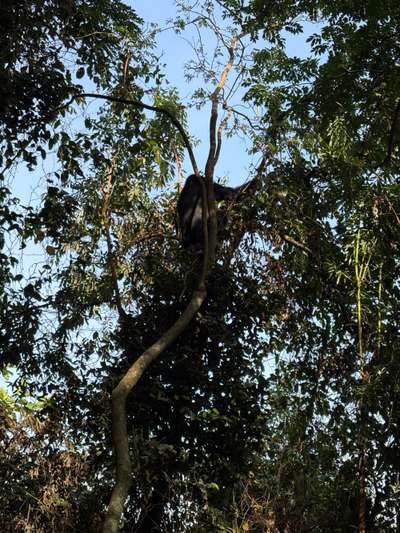
On our trek in January 2026, we encountered the first gorilla family after roughly one hour of hiking. One individual was seated in the canopy of a large tree, feeding on leaves. The behavior was entirely undisturbed — the gorilla continued eating while the group observed from below. A separate encounter after approximately three hours of total trekking brought us close to a larger family group. Both encounters demonstrated the effectiveness of the habituation process; the gorillas were at ease, and the experience was quiet in a way that no managed wildlife encounter in a vehicle-based safari can replicate.
The permit fee of USD 800 per person funds UWA operations directly and contributes to the community revenue sharing that makes local support for conservation possible. Without sustained community benefit, the political and practical conditions for gorilla protection would be far harder to maintain. The price is a conservation mechanism as much as a tourism product.
Buhoma: The Northern Gateway, Its Community, and What the Village Tells You About the Park
Buhoma is the main village at the northern entrance to Bwindi and the starting point for gorilla trekking in the park's northern sector. It sits along the main road near the park headquarters and has developed a small but functional tourism infrastructure: lodges ranging from budget guesthouses to mid-range and premium options, a handful of community enterprises, and the daily activity of a village that has been connected to international tourism for more than two decades.
During my stay at Gorilla Bluff Lodge in January 2026, the rhythm of Buhoma was immediately visible. Each morning began with coffee and African tea on the terrace of our room — a wooden deck set into the hillside with views over dense vegetation. The lodge itself is built into steep terrain; the wooden stairs connecting our room to the main house were a daily reminder that this is mountain country. The physical landscape of Buhoma is inseparable from the trekking experience: the hills that challenge hikers on the trail are the same hills that shape the village.
Walking through Buhoma, the community character of the place is evident. Small shops of around 20 square meters line parts of the main street, typically run by women who sell water, packaged snacks, and daily essentials to both local residents and visitors passing through. On one morning, we stopped at a local store to buy water for the children outside and supplies for ourselves — a brief exchange that was entirely ordinary and, in that ordinariness, reassuring. The presence of active small commerce, community life going about its routine, and children in school uniforms is itself a form of safety signal that no statistical report fully captures.
Buhoma also hosts community initiatives connecting tourism revenue to local development. A women's organization established in 2009 has offered mountain bike tours through the rainforest and surrounding villages, sewing courses, and a souvenir shop — a model that channels visitor spending directly into community income and educational programs for women. This kind of enterprise is part of what makes Bwindi's management model unusual: the park is not simply a protected area with a fence around it, but a system in which surrounding communities have an active stake.
Permits, Logistics, and What the Statistics Tell Visitors About Gorilla Trekking Demand
The gorilla trekking permit for Bwindi costs USD 800 per person and must be booked in advance through Uganda Wildlife Authority or an accredited operator. Permits are limited in number per day per gorilla family — typically eight visitors per family — which controls the impact on the gorillas and maintains the quality of the encounter. Demand has historically exceeded supply during peak months, making early booking essential.
Between 2009 and 2013, visitor numbers across Uganda's national parks increased by 41 percent, rising from 151,818 to 213,950 visitors. In 2013, foreign non-residents accounted for 47 percent of national park visits, with East African Community nationals making up a further 24 percent. These figures predate more recent expansion, but they establish the trajectory: Bwindi and its gorilla trekking product have been a significant driver of Uganda's nature tourism for an extended period.
For practical planning, visitors arriving at Buhoma for a morning trek typically gather at the park headquarters before 8am. Briefings from park staff cover behavioral rules for the encounter — maintaining a minimum distance, no flash photography, what to do if a gorilla approaches — and the guide assigned to each group provides a route update based on tracker information from the morning. The actual trekking time varies considerably; on my January 2026 visit, the first family was reached within the first hour, but trek duration across different visits has ranged from one to six hours.
Travel insurance covering medical evacuation is strongly recommended. The nearest hospital with full surgical capacity is several hours from Buhoma, and the terrain means that any significant injury during a trek requires evacuation planning. Altitude is also a factor: parts of Bwindi sit above 2,000 meters, and visitors arriving from lower elevations should allow at least one acclimatization day before trekking.
First-Hand Experience: What Gorilla Trekking Safety Actually Looks Like on the Ground
The gap between the question 'is it safe?' and the lived reality of a gorilla trek in Bwindi is considerable. Having visited Bwindi multiple times — including a stay in January 2026 during which I took six GPS-verified photographs on location — I can report that the safety infrastructure is thorough, professionally delivered, and largely invisible in the sense that it does not intrude on the experience itself.
The armed rangers are the most visible element, and they warrant honest description. They carry rifles and move through the forest as if they have spent their careers there — which many have. Their demeanor is calm rather than tense. On our trek, they used machetes to open sections of dense undergrowth, lifted trailing vegetation to clear the path, and at one point helped a member of our group navigate a near-vertical slope by bracing below and guiding footing. The weapons are a background fact rather than a constant presence.
The gorillas themselves are the most meaningful safety consideration in a different sense. Habituated gorilla families are not tame, and male silverbacks are capable of charges that, even when they are bluff charges intended to establish dominance rather than cause harm, require specific responses. The guide's pre-trek briefing covers this directly: stand still, do not run, avert your eyes, crouch slowly. The guides and rangers have managed these situations many times. In my experience, the families we encountered showed no signs of agitation — behavior that reflects both the quality of habituation and the effectiveness of the daily monitoring program.
What the data and the experience combine to suggest is this: gorilla trekking safety at Bwindi is not a marketing claim but an operational reality built on decades of ranger training, community investment, and careful management of habituated gorilla families. The 78 percent normal life continuity figure from the SMI March 2026 report aligns with what a visitor to Buhoma actually sees — a functioning community, active lodges, daily commerce, and a park entrance that operates on schedule.