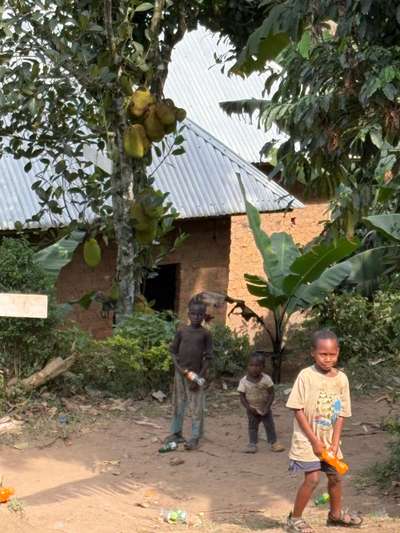
During my visit to Buhoma in June 2026, three children from the neighborhood near the local orphanage appeared at the edge of the road. They were shy — noticeably so — and their clothing and overall appearance gave away the difficulty of their circumstances. GPS coordinates on my camera confirmed the spot: -0.9617, 29.6109, a few minutes' walk from the park gate. We did not hesitate. We invited them to join us for a meal, as we always do when the moment calls for it. It was one of those quiet interactions that says more about a place than any wildlife encounter could.
Buhoma sits at the northern boundary of Bwindi Impenetrable National Park, and it is a place of extremes. Mountain gorillas move through the forest canopy a few hundred meters uphill. Children with uncertain access to food move through the village a few hundred meters downhill. Both realities are true simultaneously, and both deserve honest documentation.
This coexistence — between wildlife and human communities, between conservation priorities and immediate human need — defines the challenge of protecting Uganda's largest predators. The five large carnivore species that still survive in Uganda do so in landscapes where land use, poverty, and wildlife management intersect in ways that resist simple solutions. Uganda's Large Carnivore Action Plan 2024-2034 is the country's formal response to that complexity: a ten-year framework built around a clear target of at least 30 percent population growth across all five species by 2034.
Uganda's Predator Landscape: Five Species, One Shared Future
Uganda is home to five large carnivore species: the lion (Panthera leo), leopard (Panthera pardus), spotted hyena (Crocuta crocuta), cheetah (Acinonyx jubatus), and African wild dog (Lycaon pictus). Their presence is distributed unevenly across the country's protected areas, shaped by the availability of prey, habitat type, and proximity to human settlement. These species occupy the top of Uganda's food chains across habitats ranging from savanna to montane forest edges, and their population health is widely understood as a proxy for ecosystem integrity overall.
Uganda maintains twelve national parks and three active game reserves, all under the management of the Uganda Wildlife Authority. The growth in wildlife tourism over recent decades has added both funding and pressure to this system: visitor numbers to Uganda's national parks rose 41 percent between 2009 and 2013, from roughly 152,000 to just over 214,000 annual visits, with foreign non-residents accounting for nearly half of all visits in 2013. That growth creates incentives — more revenue for conservation infrastructure — but also demands on wildlife managers to deliver predictable visitor experiences in ecosystems that are fundamentally unpredictable.
The five carnivore species do not receive equal public attention. Lions generate the strongest conservation advocacy and the most tourism interest. African wild dogs — more accurately called painted wolves — are far rarer in Uganda and appear in very little travel literature despite their ecological significance. Cheetahs occupy a marginal niche at the edge of suitable habitat. Yet all five species appear within a single unified framework: the Uganda Large Carnivore Action Plan 2024-2034, which treats their futures as interconnected rather than separate conservation problems. This is a significant shift in approach, and understanding what it means requires looking at each species in its own context.
The Lion in Uganda: A Fragmented Presence
Uganda's lion population is no longer spread across the country's savanna regions. The species has contracted to a handful of core protected areas, primarily in the north and west of the country. As a data point that illustrates how severe this contraction had become: in 2011, only three individual lions were recorded at the Uganda Wildlife Education Centre, the country's primary wildlife education facility. That figure speaks to a population under significant pressure from habitat loss, prey base reduction, and direct persecution.
Lions remain present in Queen Elizabeth National Park and Murchison Falls National Park, the two savanna parks that form the backbone of Uganda's predator tourism offer. Their continued survival in these areas depends on park-level management decisions and on the relationship between Uganda Wildlife Authority, surrounding communities, and livestock owners. Livestock predation is one of the primary drivers of retaliatory killing of lions across sub-Saharan Africa, and Uganda is no exception to this pattern. When a lion kills cattle, years of goodwill built through community conservation programs can dissolve overnight.
Across multiple visits to Uganda — including an eleven-day stay in January 2026 and twelve days in October 2024 — conversations with experienced guides consistently highlighted the fragility of community tolerance for predators. The tolerance that exists is conditional, tied to specific agreements, compensation mechanisms, and the memory of the last serious livestock incident. The conservation challenge for lions in Uganda is therefore as much social and political as it is biological.
The 2024-2034 Action Plan explicitly acknowledges that previous population estimates for lions in Uganda have been inconsistent, with different organizations producing figures that were sometimes defended more vigorously than the quality of the underlying science warranted. Standardizing survey methods is identified as a prerequisite for measuring progress toward the 30 percent increase target — which means the early years of the plan period will be as much about establishing reliable baselines as about direct conservation action. This is an honest admission that sets realistic expectations for what the plan can achieve by 2034.
“[Quote on the current status of lion populations in Queen Elizabeth National Park and the frequency of human-lion conflict in adjacent communities — to be collected on next visit.]”
— Local guide or Uganda Wildlife Authority ranger (attribution pending, next field visit)
The Leopard: Uganda's Most Adaptable Large Cat
Of Uganda's five large carnivores, the leopard is the species most capable of persisting across the widest range of habitats. Leopards (Panthera pardus) are documented in fragmented forest patches, agricultural buffer zones, and the edges of forest reserves throughout Uganda — including areas adjacent to Bwindi Impenetrable National Park. Their ability to survive in close proximity to human settlements, subsist on a wide range of prey species, and operate largely at night gives them a resilience that lions and African wild dogs simply do not possess in Uganda's increasingly fragmented landscape.
Uganda took a notable regulatory step with its leopard population by downlisting the species from CITES Appendix 1 to Appendix 2. The CITES Appendix 1 classification provides the strictest possible international trade controls; Appendix 2 allows regulated commercial trade under specific conditions. Uganda's stated rationale was that controlled, legal offtake could generate conservation revenue and reduce the pressure of illegal trade by providing a sanctioned alternative. Critics of the decision argued that any legal trade in leopard trophies creates conditions that allow illegal trade to operate alongside it, and that the move signals reduced international commitment to species protection.
Within Bwindi specifically, leopard presence is documented but direct sightings are rare. I have spent more than 59 days on the ground across Bwindi and its surroundings since October 2024, across visits in October 2024, January 2026, April 2026, May 2026, and June 2026. In that time, leopard encounters have been limited to tracks and occasional reports from trackers. The forest's density and the leopard's highly nocturnal behavior mean that even extended on-site stays rarely produce direct visual contact. That rarity is itself evidence of a functioning adaptation: the cats appear to have adjusted their activity patterns to avoid high-traffic areas during daylight hours.
The Uganda Wildlife Regulations 2022 govern domestic management of leopards and other protected species, and the Action Plan builds on this framework to define specific monitoring targets for the 2024-2034 period. What the plan cannot resolve alone is the international dimension of the CITES downlisting decision, which continues to attract scrutiny from conservation organizations outside Uganda. The domestic framework and the international regulatory environment are moving in different directions, and this tension will shape leopard management in Uganda throughout the plan period.
Spotted Hyena, Cheetah, and African Wild Dog: Three Species Under Pressure
The spotted hyena (Crocuta crocuta) is the most widespread of Uganda's three lesser-known large carnivores. It occurs across multiple northern and western protected areas and plays an ecologically important role as both a hunter and a scavenger. Hyenas clean carcasses that would otherwise create disease risk in the ecosystem, and their population health is closely tied to prey abundance. Despite this ecological value, spotted hyenas face persistent persecution in Uganda rooted in cultural attitudes that associate them with danger and, in some communities, with spiritual harm. The Action Plan specifically identifies these cultural perceptions as a challenge to be addressed through targeted conservation education programs — acknowledging that population targets cannot be met through management alone if community attitudes remain hostile.
Cheetahs represent a genuinely marginal presence in Uganda. The species' core continental range is savanna and semi-arid habitat, and Uganda's predominantly tropical forest and forest-edge ecosystems offer limited suitable territory. The cheetah's inclusion in Uganda's large carnivore framework reflects its historical presence in the country's northern and northeastern regions and an aspiration to maintain viable populations where conditions allow. Realistic expectations for cheetah recovery in Uganda are modest compared to lion or leopard targets. The 30 percent growth benchmark, when applied to a population that may currently number only in the tens of individuals, produces a very different conservation challenge than the same percentage target applied to a larger base population.
The African wild dog is the rarest of Uganda's five large carnivores and faces the most precarious long-term future. This species requires large connected territories — individual packs roam areas that can exceed 500 square kilometers — and it lives in tightly bonded family groups that are highly sensitive to disruption. Road mortality, disease transmission from domestic dogs, and habitat fragmentation between protected areas are the primary threats. Wild dogs require landscape-level connectivity that extends well beyond any individual park boundary, which means their conservation depends on decisions made in agricultural and pastoral areas that are formally outside the protected area system.
Across all my visits to Bwindi and its surroundings, I have never encountered an African wild dog, and the trackers and guides I work with consistently describe direct sightings as extremely rare. This is consistent with regional data indicating that Uganda's wild dog population is small and widely dispersed. All three of these species — hyena, cheetah, and wild dog — are captured under the unified 30 percent population increase target of the 2024-2034 Action Plan, but the baseline data quality varies significantly between them, and reliable population estimates for all three remain a work in progress.
The Uganda Large Carnivore Action Plan 2024-2034: What the Targets Mean in Practice
The Uganda Large Carnivore Action Plan 2024-2034 establishes a goal of at least 30 percent increase in viable large carnivore populations across all five species over the plan's ten-year period. This target was agreed upon during a stakeholders' consultative workshop involving Uganda Wildlife Authority, conservation organizations, researchers, and community representatives. The figure represents a deliberate balance between ambition and realism given current baseline conditions — enough to signal serious intent without committing to numbers that the available evidence cannot support.
The vision statement underlying the plan is direct: viable and sustainable populations of large carnivores in a healthy ecosystem in Uganda. The 30 percent target operationalizes this vision with a measurable metric. What makes the target significant beyond the number itself is the plan's honest acknowledgment that previous population estimates for Uganda's large carnivores were often produced using inconsistent methods and defended without adequate scientific underpinning. The plan treats baseline standardization not as a preliminary administrative step but as a substantive conservation priority in its own right.
Habitat loss is identified as the central structural driver of large carnivore decline in Uganda. Agricultural expansion, settlement growth, infrastructure development, and deforestation have reduced and fragmented the habitats on which all five species depend. The plan does not treat this as a problem that conservation management alone can solve. It explicitly calls for integration with broader land-use planning processes and community development frameworks — an approach that reflects the same reality visible from the ground in Buhoma, where the forest boundary, the village, and the livelihoods of families living in both overlap in ways that defy neat administrative categories.
For the plan to achieve its targets, the first two to three years will be critical. Standardized monitoring protocols need to be established and consistently applied across different protected areas and different research organizations. Communities adjacent to carnivore habitat need to see tangible benefits from coexistence — or at minimum, effective compensation when coexistence carries costs. And the legal and regulatory framework needs to function with enough consistency to support rather than undermine management goals. The 2034 deadline is a decade away, but the foundational work that determines whether the targets are achievable has to happen now.
Bwindi, the Forest Boundary, and What Large Carnivores Mean for Visitors
Bwindi Impenetrable National Park is not a large carnivore destination in the conventional sense, and visitors should not come expecting savanna predator encounters. The park's dense montane rainforest is mountain gorilla habitat. The ecological conditions that make it exceptional for gorillas — altitude, forest density, permanent water, fruiting trees — are not the conditions that support lion or cheetah populations. Bwindi's large carnivore story is primarily a leopard story, told quietly at the edges of the forest where the park boundary meets agricultural land.
During my multiple extended visits to Bwindi, I have heard trackers describe leopard activity at the park periphery — tracks near community fields, occasional sounds at night, rare glimpses along forest trails before dawn. Gorilla trekking permits take groups into the forest during daylight hours, which is the period of lowest leopard activity. The practical upshot is that most visitors to Bwindi, including those staying multiple nights and doing multiple treks, are extremely unlikely to encounter a leopard directly. The experience Bwindi delivers is of a different kind of wildness: proximity to an endangered great ape in its intact forest home.
“[Quote on the rarity of large carnivore sightings near Bwindi and what that absence reveals about the ecosystem — to be collected on next visit.]”
— Local guide at Bwindi Impenetrable National Park (attribution pending, next field visit)
The connection between gorilla trekking and large carnivore conservation is ecological rather than direct. The same forest ecosystem that supports mountain gorillas also supports the forest buffalo, giant forest hogs, and smaller mammals that form the prey base sustaining any leopard population present in the area. Protecting the integrity of Bwindi's forest — from poaching, encroachment, and climate-driven vegetation change — serves both gorillas and the predators that share the landscape with them.
Visitors who want to observe large carnivores in Uganda should plan itineraries that combine Bwindi with Queen Elizabeth National Park or Murchison Falls National Park. The drive between Bwindi and Queen Elizabeth passes through the Ishasha sector, known regionally for its tree-climbing lions — a behavior associated with the lions of this specific area and uncommon elsewhere. This circuit, covering gorilla trekking in the southwest and savanna wildlife in the west, is the standard framework for experiencing Uganda's full range of wildlife. A combined itinerary of twelve to fourteen days gives genuine depth to both experiences and mirrors the kind of extended on-site time that reveals how Ugandan ecosystems actually function.
Uganda's twelve national parks represent a significant conservation infrastructure. The 2024-2034 Action Plan's success will ultimately be measured not by the sophistication of its monitoring systems or the quality of its stakeholder consultations, but by whether lions, leopards, hyenas, cheetahs, and wild dogs are present in greater numbers and in more stable populations in 2034 than they are today. That is a straightforward benchmark. Whether it is achieved will depend on decisions made over the next decade by governments, communities, conservation organizations, researchers, and visitors — all of whom have a stake in the outcome.
Frequently Asked Questions
Related Articles
Endangered Species in Uganda: What Is at Stake
Elephants in Bwindi: Presence, Behavior, and Encounters
Mountain Gorilla Facts: Biology, Behavior, and Status
Gorilla Trekking in Bwindi: Permits, Preparation, and What to Expect
Buhoma Sector: Northern Entry Point to Bwindi