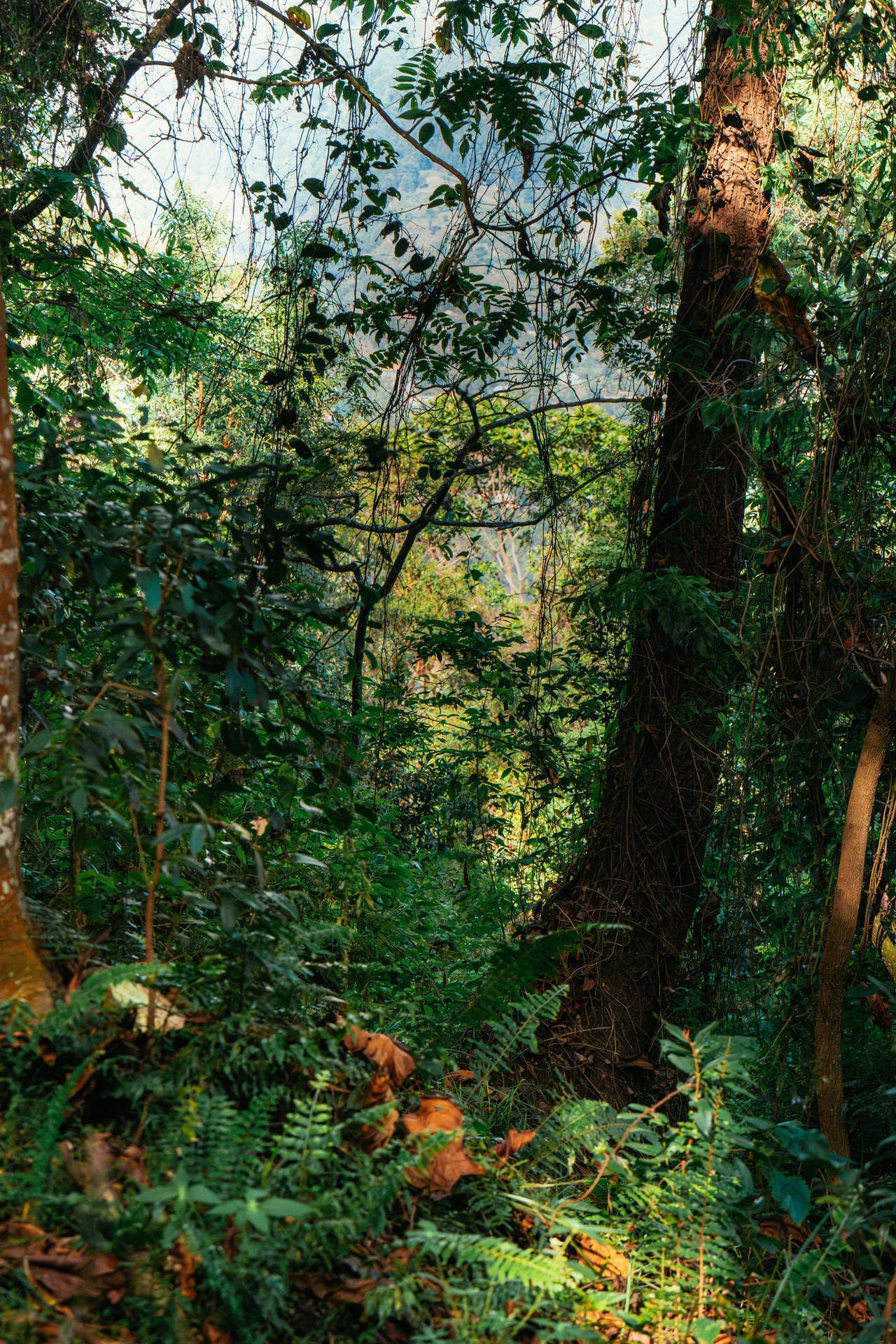
At Bwindi Impenetrable National Park, the question of who is accountable for the welfare of the Batwa people does not have a single answer. Uganda Wildlife Authority holds formal authority over the forest and has made explicit commitments to Batwa integration in its management framework. The district governments of Kisoro and Kanungu carry statutory responsibility for all residents in their jurisdictions. The relationship between these two systems of governance — and the gaps between them — shapes the daily reality of Batwa communities living along the park boundary. During multiple extended research visits to Bwindi between October 2024 and June 2026, including eleven days in January 2026 and thirteen days in May 2026, the complexity of this governance landscape became increasingly apparent.
Two Institutions, One Boundary
Uganda Wildlife Authority was established in 1996 as the parastatal body responsible for managing Uganda's protected areas, including Bwindi. Its mandate covers conservation, anti-poaching, tourism management, and the relationship between the park and surrounding communities. For the Batwa, whose ancestors lived inside the forest until the 1991 gazettement, UWA is the institution that most visibly controls what they can and cannot do in relation to the landscape they once called home.
But UWA's legal remit stops at the park boundary. Beyond it, the Districts of Kisoro and Kanungu, together with their sub-county governments, are responsible for land administration, social services, and the welfare of all residents — including the Batwa who live on private land, in resettlement areas, or in informal settlements near the forest edge. This creates a governance architecture in which the institution with the most direct influence over Batwa livelihoods (UWA, through its control of forest access and tourism revenues) operates separately from the institutions with statutory welfare obligations (local governments).
UWA's own General Management Plan for Bwindi identifies this structural tension directly. Weak partnership between park management and local governments is listed as a named management challenge. The absence of qualified technical staff at district, sub-county, and lower local government levels to handle protected area management issues is a separate identified weakness. These are not peripheral concerns — they go to the centre of how governance at Bwindi actually functions for communities like the Batwa.
Collaborative Resource Management and Forest Access
One of the most significant practical expressions of UWA's opening toward community engagement is the Collaborative Resource Management framework, known as CRM. Under this framework, UWA negotiates formal Memoranda of Understanding with community resource use groups, permitting controlled access to designated forest resources within the park's resource use zone. For Batwa communities, this represents a partial, structured restoration of access to the forest that was entirely closed to them after 1991.
The resource use zone is one of four formal management zones established within Bwindi — alongside tourism, wilderness, and administrative zones. Access through CRM MoUs is not unlimited. Residents, including Batwa, must register as members of a recognised resource use group. UWA staff conduct situational analyses of resource demand and negotiate the terms of access accordingly. Special requests for specific items needed infrequently — materials used for traditional purposes only occasionally — are also considered on a case-by-case basis.
This governance mechanism does not fully restore pre-1991 conditions, nor does it claim to. What it does is create a regulated channel through which some traditional forest use can continue, within a conservation framework that prioritises ecological integrity. The challenge is monitoring. Between 2020 and 2025, non-timber forest product extraction incidents recorded at Bwindi ranged from 20 to 60 per year, with 60 incidents documented in the most recent reporting period. These figures reflect both unsanctioned collection outside CRM structures and the practical difficulty of enforcing boundaries across a forest of more than 330 square kilometres of dense terrain.
UWA has responded with an awareness-raising programme specifically targeted at Batwa communities. Twenty formal sessions on sustainable wildlife management were conducted with Batwa households living adjacent to the park. These sessions aim to build understanding of why certain extraction patterns are harmful and to encourage participation in the structured CRM pathway rather than unsanctioned collection. The deeper question — whether communities facing significant poverty have meaningful alternatives — is acknowledged in the management framework but not fully resolved by awareness-raising alone.
The Vulnerable and Marginalized Groups Plan
The most structured expression of UWA's commitment to Batwa welfare is the Vulnerable and Marginalized Groups Plan, known as the VMGP. Its development followed a broader framework — the Vulnerable and Marginalized Groups Framework, or VMGF — adopted in 2020 after consultations conducted under Uganda's REDD+ programme. During those consultations, Batwa communities and civil society organisations working with the Batwa identified several consistent priorities: full inclusion of Batwa leadership in planning and implementation; strengthening collaborative resource management with UWA; investment in Batwa livelihoods through skills training in crafts and beekeeping; and integration of Batwa cultural values into protected area management.
Preparation of the VMGP specifically for Batwa communities around Bwindi began in 2021. Community consultations were held in 2021 and 2022, with significant delays caused by COVID-19 restrictions that disrupted travel and assembly. The VMGP was formally adopted and publicly disclosed in March 2023. It covers a range of interconnected interventions: supporting Batwa groups through craft training and beekeeping; promoting gender-balanced employment in roles such as community guides, porters, and boundary management workers; linking Batwa cultural knowledge to education and employment; and ensuring that interventions are culturally sensitive and coordinated rather than fragmented across multiple NGO and government actors.
Practical measures implemented during the first period of VMGP operation include training Batwa households in the construction of energy-efficient cooking stoves. Twenty-five stoves were built at Mukongoro Batwa Settlement in the northern sector and at Sanaliro Batwa Settlement near the Nkuringo sector headquarters in southern Bwindi. These installations reduce reliance on firewood collection, which in turn reduces pressure on forest resources — a connection that frames the Batwa's daily energy needs as a conservation issue as well as a welfare one.
Implementation of the VMGP also included outreach to a total of 300 Batwa community members with information on sustainable wildlife management. Batwa participants were also involved in planning for the construction of a Visitor Information Centre, with employment opportunities offered during the construction phase — a small but concrete mechanism for channelling park-related economic activity to Batwa households.
The VMGP Revision: Voices from the Ground
The VMGP was designed from the outset as an adaptive document rather than a fixed programme. Its architects recognised that conditions change and that community needs and governance realities evolve. This design philosophy was tested in October 2024, when three Batwa representative organisations — the Batwa Development Organisation, the Batwa Indigenous Development Organisation, and the Batwa Indigenous Empowerment Organisation — formally communicated to project management that they believed some of their proposals had not been captured in the original document and that anticipated benefits were not flowing to communities as expected.
This led to a Phase III consultation process carried out in July and December 2025. Validation meetings were organised in direct coordination with Batwa community leadership. Participation was deliberately structured to include elders, women, and youth — groups whose interests and priorities do not always align and who are sometimes underrepresented in formal governance processes. Meetings were held in culturally appropriate settings, scheduled with ten days' prior notice, and facilitated jointly by representatives of the Ministry of Water and Environment and UWA. Proceedings were documented in the local language most widely spoken by Batwa communities around Bwindi.
The outcome was a revised VMGP that reflects both the lessons of implementation and the updated priorities of Batwa communities. Not every proposal raised during the July 2025 consultations could be incorporated into the agreed action list for the next six-month period, and facilitators explained these limitations directly to participants. This transparency — acknowledging scope constraints openly rather than making commitments that cannot be kept — is characteristic of the governance approach the VMGP aims to establish.
Local Governments and the Accountability Gap
The districts of Kisoro and Kanungu are the governmental jurisdictions within which most Batwa communities around Bwindi reside. Their sub-county administrations are formally the closest point of government to village-level concerns. Yet the capacity of these local governments to engage meaningfully with protected area management issues has been a persistent weakness identified in Bwindi's governance record.
UWA's management framework commits to attending district and sub-county council meetings, sharing activity reports and planning documents with local government partners, and harmonising park management plans with local government development plans. The annual stakeholders' forum, which was identified as needing reactivation in the management plan, is a key mechanism for keeping these lines of communication open. In practice, the effectiveness of these engagements depends on the availability of technically informed staff on the local government side — staff who understand both the park management context and the specific vulnerabilities of the Batwa.
Revenue sharing is a specific arena where local government coordination matters enormously. A portion of gorilla trekking income is allocated to community projects through parish-level structures. For Batwa households, whose land tenure situation often places them outside normal administrative categories, ensuring that they are included in parish-level resource distribution requires active attention from both UWA and local government. Past mismanagement of the Gorilla Levy and revenue-sharing projects is acknowledged as a management challenge in UWA's own documentation.
The organisations working directly with the Batwa on the ground — including bodies such as the Nkuringo Cultural Center, the Bwindi Mgahinga Conservation Trust, and organisations like PROBICOU and the International Gorilla Conservation Programme — operate in a space that bridges UWA's park management functions and local government welfare responsibilities. Their presence is a partial solution to institutional gaps, but it also means that Batwa welfare depends on the continued engagement of NGOs rather than being anchored in durable governmental accountability.
What Governance at Bwindi Looks Like in Practice
Visiting the communities adjacent to Bwindi across multiple trips between 2024 and 2026 — including extended stays in the Buhoma and Nkuringo areas — gives a clearer picture of how these governance structures feel from the community side. The VMGP and CRM frameworks are real: Batwa households do participate in resource use groups, some Batwa guides do have formal roles in tourism, and training programmes in crafts and beekeeping have reached documented numbers of participants. The energy-efficient stoves at Mukongoro and Sanaliro represent tangible improvements in daily life, even if modest in scale.
The governance structures are also genuinely evolving. The willingness to revise the VMGP in response to organised Batwa advocacy in 2024–2025 is meaningful. The consultation process that produced the revised plan — with culturally appropriate methods, prior notice, and documentation in the Batwa language — represents a higher standard than earlier engagement processes. The fact that three Batwa organisations felt confident enough to formally raise concerns and have those concerns taken seriously is itself an indicator of changed relationships.
What remains harder to resolve is the structural question: who ultimately carries accountability for Batwa welfare when UWA's park mandate and local government social welfare functions do not align? The management plan's identification of weak local government partnership as a challenge is accurate, but naming the problem does not resolve it. Building the technical capacity of sub-county government staff, harmonising revenue sharing distributions to reach landless Batwa households, and sustaining the annual stakeholder forum all require sustained political will at multiple levels. For travellers exploring the communities of Bwindi Impenetrable National Park, understanding this governance landscape helps make sense of what community conservation actually means here — and how far the journey from dispossession to genuine participation still has to go. The broader story of how UWA engages communities around the park is part of Bwindi's ongoing evolution, described across the community conservation pages of this site.