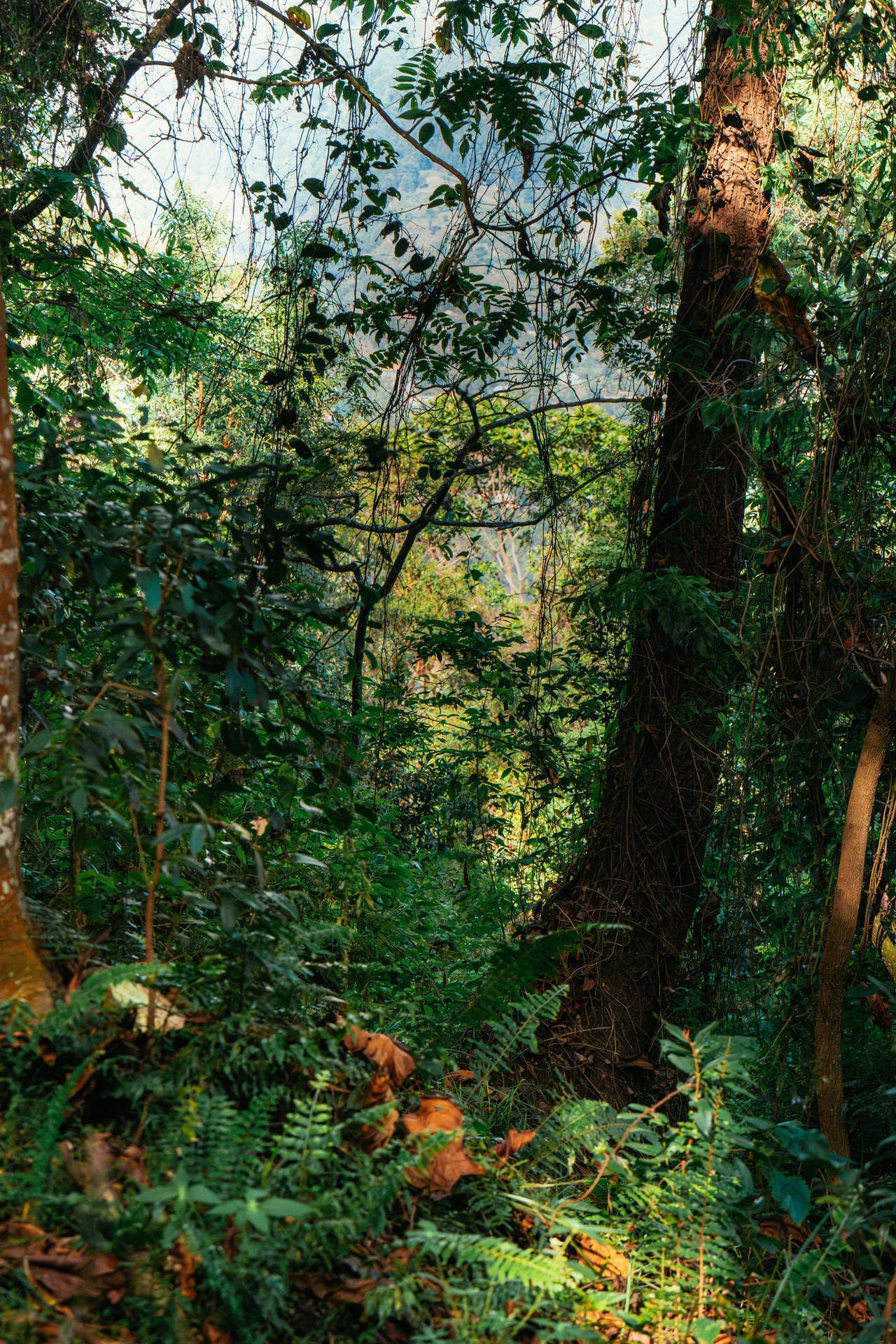
The steps leading from the guest rooms to the main building at Gorilla Bluff Lodge in Buhoma are steep and built from heavy timber — each one a reminder that this part of southwestern Uganda does not compromise on terrain. I climbed them on the morning of 12 January 2026, on the first of what became nine documented visits to Bwindi Impenetrable National Park Uganda between October 2024 and June 2026. The lodge sits directly above the forest edge, and the view from the upper terrace takes in the same community land where, a few hundred metres below, families in Buhoma were that morning navigating the practical reality of living alongside one of Africa's most intensively managed protected areas. Part of that reality, less visible to arriving tourists, is a formal complaint system: a set of Grievance Redress Committees designed to give those families a structured way to raise concerns about how the park and its associated conservation projects affect their lives.
Bwindi Impenetrable National Park Uganda is home to roughly half the world's surviving mountain gorillas and is the centrepiece of the World Bank-funded IFPA-CD project (Investing in Forests and Protected Areas for Climate Smart Development). That project, managed by Uganda's Ministry of Water and Environment and Uganda Wildlife Authority, operates with an explicit obligation to ensure that communities living near the park — including the Batwa, the park's original forest-dwelling inhabitants — have a functional channel for raising grievances. The mechanism that fulfils this obligation is the GRC system: a four-level pyramid of committees running from individual villages up to the Conservation Area (Park) level.
The Four-Level GRC Structure at Bwindi
The Project Grievance Redress Mechanism for national parks in Uganda, including Bwindi, is structured across four levels in addition to the national tier: Village (LC1), Subcounty, District, and Conservation Area. This hierarchy is not accidental — it reflects Uganda's existing local government architecture, which already uses the same ascending ladder of Local Councils (LC1 at village level through to higher administrative tiers) for a wide range of governance and dispute-resolution functions. Anchoring the GRC within this structure means that the people who manage complaints at the lowest level are already known to their communities, already embedded in local trust networks, and already operating within a recognised administrative role.
At the Village (LC1) level, the GRC consists of five members elected by the community itself. This is the entry point for almost all grievances. The village committee is the body that receives incoming complaints, opens a record in the complaint register, and attempts first-instance resolution. The design principle throughout the system is that disputes should be resolved at the lowest possible level, keeping proceedings local, fast, and free of the expense that court proceedings would impose on rural households with limited cash incomes.
The Subcounty GRC adds a layer of formal institutional representation: its composition includes an NGO or Community-Based Organisation (CBO) representative alongside local government members. This matters because NGOs working in the Bwindi area — including organisations focused on Batwa rights and livelihood support — have an established presence in Kanungu District and Kisoro District, the two districts where most of the park-adjacent communities live. Their seat on the Subcounty committee creates a direct link between the formal grievance process and the civil society layer that is often the first contact for vulnerable households.
The District and Conservation Area (Park-level) committees handle cases that have escalated from below, either because they were not resolved at lower levels or because their nature — involving multiple villages, or implicating park management decisions directly — requires a higher tier of authority. At the Park level in Bwindi, the GRC includes one dedicated seat for a Batwa representative. This seat is significant: it is the only level in the formal structure where the Batwa community has a named, non-negotiable position on the committee, rather than simply being eligible to submit complaints like any other group.
Complaint Registers, Logs, and Reporting Templates
Each GRC committee across all four levels has been provided with three core documentation tools: a complaint register, a complaints log, and a set of standardised reporting templates. These are not symbolic — they are actively in use, and their existence creates a verifiable paper trail that the project management structure can audit. Quarterly and annual progress reports for the IFPA-CD project include a dedicated section on grievances: how many were registered in the period, what types they were, how they were resolved, and what structural measures were taken in response.
The complaint register is the first point of contact for any incoming case. It is held by the committee chairperson — typically the LC1 chairperson at village level — who logs the date, the name of the complainant (if they wish to be identified), the nature of the complaint, and the relevant location or activity. From there, the complaints log tracks the status of each case over time: acknowledgement, steps taken, outcome, and whether the complainant accepted the resolution. This longitudinal record is what allows the system to demonstrate whether it is functioning or merely processing complaints without resolving them.
The reporting templates standardise how information flows upward through the hierarchy. A Village GRC chairperson who has handled three complaints in a given quarter can use the template to report this to the Subcounty level, which in turn consolidates across the villages in its area before reporting to the District and Park levels. This flow of information is what makes the system legible to external auditors — including the World Bank, which requires regular GRM reporting as a condition of project financing.
Batwa Participation and Access to the Mechanism
The Batwa are the indigenous forest-dwelling people who lived inside what is now Bwindi Impenetrable National Park before its formal gazettement in 1991. Their displacement from the forest was not accompanied by adequate resettlement support, and the decades since have been characterised by acute land insecurity, limited access to social services, and structural exclusion from the economic benefits of gorilla tourism. Understanding the GRC system at Bwindi requires understanding this context, because the mechanism was designed in part to give the Batwa a functional route for raising concerns that would otherwise go unheard.
The GRC composition at Bwindi explicitly takes account of the diverse stakeholder groups in the project area, including the Batwa communities adjacent to the targeted protected areas. The composition of committees at every level was designed with reference to both the stakeholder landscape and the local dispute management traditions already in use. At the Park level, the one dedicated Batwa seat reflects a recognition that Batwa interests are sufficiently distinct from those of other farming communities — in terms of historical dispossession, cultural relationship with the forest, and legal status as an indigenous people — to require named representation rather than inclusion by default.
Beyond this formal seat, a range of additional channels has been established to facilitate Batwa access. These include community-level communication methods that do not require literacy, outreach to Batwa settlements in areas such as Rubuguri in the south and Buhoma in the north, and coordination with organisations including the Batwa Development Organisation (BDO), the Batwa Indigenous Development Organisation (BIDO), and the Batwa Indigenous Empowerment Organisation (BIEO). These three organisations have been formally involved in VMGP consultations since 2021 and serve as intermediaries who can help community members understand and use the formal grievance process.
The Nkuringo Cultural Centre (NCC) near the southern sector of Bwindi also plays a supporting role, having a working relationship with Batwa communities around the Nkuringo and Rushaga areas. For communities in isolated settlements such as Batwa Sanaliro — a small Batwa community near Gulingo and Nkuringo with only a handful of households — the existence of a formal complaint channel is only useful if they know it exists and trust that using it will not generate repercussions. The July 2025 consultations for the VMGP revision directly addressed this trust question, with deliberate efforts to ensure that feedback from Batwa participants shaped the revised plan.
Training Status in 2025 and the Road to Early 2026
The GRC system is only as strong as the capacity of the people who sit on its committees. At the village level, that means the LC1 chairpersons — individuals who are elected by their communities to serve multiple administrative functions simultaneously and who do not necessarily have formal training in grievance handling, documentation, or conflict mediation. Recognising this, the IFPA-CD project included a dedicated training component for LC1 Chairpersons, targeted at equipping them with the skills needed to receive complaints, record them accurately, attempt resolution, and escalate cases when necessary.
As of the December 2025 revision of the Vulnerable and Marginalized Groups Plan, this training was not yet fully completed — full completion across all relevant villages was projected for early 2026. The training covers the use of the complaint registers and logs, the standardised templates, the escalation pathway, and the principles of fair and impartial case handling. It also addresses the specific needs of Batwa complainants and other vulnerable groups, including the cultural and linguistic considerations relevant to communities whose primary languages are Rukiga and Kifumbira rather than the more widely used Luganda or English.
The districts most involved in GRC training activities are Kanungu District, which covers the northern and eastern parts of Bwindi including the Buhoma and Ruhija sectors, and Kisoro District, which covers the southern sectors including Nkuringo and Rushaga. Both districts have Batwa populations living in the park buffer zone and experience regular interface with UWA rangers and project staff. The training timeline reflects the practical challenge of reaching dispersed villages across steep, partially accessible terrain — a challenge familiar to anyone who has driven the roads around Bwindi.
What the Mechanism Covers and Why It Matters for Visitors to Understand
For visitors to Bwindi Impenetrable National Park Uganda, the grievance mechanism is not immediately visible. The park presents its most polished face at the trailhead — ranger briefings, permit checks, the anticipation of the gorilla encounter described elsewhere on this site. But the communities through whose land you travel to reach that trailhead are navigating a complex set of relationships with the park and its management institution, Uganda Wildlife Authority, and a formal complaint process is one of the mechanisms through which those relationships are managed.
The types of grievances that reach GRCs at Bwindi cover a broad range. Crop damage from wildlife crossing the park boundary — elephants and other large mammals — is a recurring source of conflict. Between 2020 and 2025, Bwindi recorded between 20 and 60 incidents per year of non-timber forest product extraction, reflecting the ongoing economic pressure on communities who previously relied on the forest directly. Concerns about the distribution of revenue-sharing funds, access to the park for cultural or ceremonial purposes, and the conduct of conservation project activities are all within scope. So too are concerns about how Batwa groups are selected — or not selected — to receive support from IFPA-CD livelihood programmes.
The VMGP revision of December 2025, prepared jointly by the Ministry of Water and Environment and Uganda Wildlife Authority, was candid about the persistent challenges. It acknowledged that Batwa groups face structural barriers to participation — limited formal literacy, geographic isolation, limited financial resources for transport to committee meetings — and committed to addressing these through the revised plan. The grievance mechanism is explicitly integrated into the monitoring and evaluation framework: grievance data feeds into quarterly reports, which are reviewed by the project management unit and, ultimately, by World Bank supervision teams.
Observed in the Field: Community Governance at the Forest Edge
Across nine visits to Bwindi between October 2024 and June 2026 — including extended stays in January 2026 and May 2026 — what struck me consistently was the density of institutional activity in communities that appear, to a passing traveller, simply agricultural. Village meetings, committee sessions, training days run by NGOs and UWA extension staff: these are not unusual events. They are part of the regular rhythm of life in Buhoma, Nkuringo, Ruhija, and Rushaga. The GRC system exists within this existing culture of community governance, not separate from it.
That embeddedness is the mechanism's greatest practical asset. A complaint system that required community members to travel to a district capital, engage with an unfamiliar bureaucracy, and wait for an administrative response would be used rarely and distrusted widely. A system anchored in the LC1 chairperson — already a known figure, already trusted or not trusted on the basis of daily interaction — has a fundamentally different starting position. The quality of that chairperson, the completeness of their training, and the credibility of the committee they lead are therefore the variables on which the whole system turns.
For the Batwa specifically, the January 2026 consultations held as part of the VMGP revision process represented a moment when the formal feedback structure was genuinely used. BDO, BIDO, and BIEO raised specific concerns about how their communities were faring under the project, and those concerns were documented in Annex III of the revised VMGP — a summary of feedback received. Whether the GRC system at the village level provides the same level of responsiveness for individual households is a question that the monitoring data, collected through the complaint logs and reported quarterly, is designed to answer over time.
For travellers visiting Bwindi Impenetrable National Park Uganda, understanding the GRC system deepens the picture of what conservation actually involves in this landscape. The mountain gorillas that draw visitors from across the world exist within a web of human governance structures — revenue sharing, collaborative resource management agreements, community benefit programs, and formal complaint mechanisms — that together determine whether the park retains the support of the people who live alongside it. The GRC system is one of the less-photographed parts of that web, but it is not a minor one.