Bwindi Impenetrable National Park sits in the hills of southwestern Uganda, far from the national electricity grid and hours from the nearest urban centre. Yet the lodges clustered at its entrance gates have functioning lights, the Uganda Wildlife Authority ranger stations maintain radio communication equipment, and visitors return from gorilla treks to find their devices charged and their rooms lit. This is possible because of a network of small off-grid hydropower plants, solar arrays, and generator backup systems that together constitute the energy infrastructure of one of Africa's most visited conservation areas.
Understanding how Bwindi is powered matters beyond practical curiosity. The energy choices made at remote protected areas directly affect the forests they are designed to protect. An area that cannot meet basic electricity needs reliably is an area where alternative fuel sources — principally firewood and charcoal — face greater demand. Sustainable off-grid energy at Bwindi is therefore not a secondary infrastructure question but a frontline conservation issue.
Uganda's Hydropower Landscape
To understand why Bwindi operates the way it does, it helps to understand Uganda's broader energy picture. Hydropower accounts for approximately 88 percent of Uganda's electricity generation capacity, making the country one of the most hydropower-dependent in Africa. The major plants — including the Owen Falls complex at Jinja, and more recently the Karuma and Isimba dams on the Victoria Nile, operated by the Uganda Electricity Generation Company Limited — supply the national grid that serves Kampala, Entebbe, and the larger secondary towns.
The national grid, however, does not reach most of southwestern Uganda. The terrain is steep, the population density in some areas is high but scattered across many small villages, and the economics of grid extension to remote highland communities have historically not been compelling for utilities focused on larger urban markets. This gap between the national grid and the communities around Bwindi has persisted for decades, driving the development of off-grid solutions — both formal institutional schemes and informal private arrangements.
The rivers that descend from the Bwindi forest and from the surrounding Kigezi highland zone carry reliable year-round flow, fed by the consistently high rainfall that makes this part of Uganda one of its wettest landscapes. That reliable flow is the physical foundation on which small hydropower in this region is built.
The 0.1 MW Plant at Bwindi
The hydropower installation serving the immediate Bwindi area is a small run-of-river plant with an installed capacity of approximately 0.1 megawatts. Run-of-river means exactly what the name suggests: rather than impounding water behind a dam and releasing it in controlled pulses, the plant takes a portion of the river's natural flow, passes it through a penstock to a turbine, and returns it to the watercourse downstream. The physical infrastructure is correspondingly modest — an intake weir, a channel or pipe running along the hillside, a small turbine house, and a distribution network connecting to the immediate users.
At 0.1 MW, this is a micro-hydropower installation by the standards of grid-scale power engineering. It is not intended to supply a town or district. Its purpose is to meet the needs of the park's operational infrastructure and the cluster of lodges and guesthouses that have established around the Buhoma sector, which is the main access point for gorilla trekking on the northern side of Bwindi.
During visits in October 2024, January 2026, and May 2026, the consistency of electricity supply at the Buhoma gate area was apparent: lights in lodge dining rooms, security lighting at the Uganda Wildlife Authority offices, and charging facilities for visitors. The supply is not seamless — river levels fluctuate seasonally, and dry-season periods reduce output — but lodges supplement the hydro supply with solar panels and generator backup to maintain a functional service for guests. The system works well enough that most visitors are unaware of its off-grid character unless they enquire directly.
The ecological footprint of a small run-of-river scheme is substantially lower than either a reservoir dam or a diesel generator. There is no flooded valley, no fuel supply chain, and no exhaust emissions. The main ecological consideration is the effect of the water diversion on the river section between intake and turbine discharge — maintaining a minimum environmental flow through that reach is essential for aquatic life and for downstream water users. At the Bwindi scale, this is manageable with appropriate design.
Energy and Conservation: The Direct Connection
The relationship between reliable electricity and forest conservation at Bwindi is not abstract. When lodges and park staff lack access to electricity, the default fuel for cooking, lighting, and heating is wood. In a landscape where population pressure on the forest is already intense — between 2020 and 2025, non-timber forest product extraction incidents in the park were recorded at rates of up to 60 per year — adding institutional demand for firewood from the park or its buffer zone would increase pressure on the forest boundary.
Hydropower and solar electrification reduce this pressure directly by substituting for solid fuel in lodge kitchens, staff quarters, and park facilities. The effect is modest at the individual site level but cumulative across the multiple lodges, ranger camps, and community facilities that ring the park. Off-grid energy is therefore an integral part of the park's conservation strategy, even if it rarely appears in conservation reports under that heading.
Tourism infrastructure development does carry its own ecological costs, including disruption to wildlife corridors that connect forest blocks in the broader landscape. The trade-off between enabling sustainable tourism at Bwindi and minimising infrastructure impacts on surrounding habitats requires careful management — precisely the kind of planning that energy choices feed into. A lodge powered by hydropower and solar rather than diesel generators or firewood occupies a meaningfully smaller ecological footprint, giving planners more flexibility to site facilities close to the forest without compounding pressure on it.
Kisiizi: A Regional Model for Off-Grid Hydropower
Approximately 60 kilometres northeast of Bwindi, in Rukungiri District, the Kisiizi mission hospital has been generating its own electricity from a waterfall on the Kisiizi River for several decades. The Kisiizi scheme is small by any commercial standard, but it has supplied continuous power to a functioning hospital, staff residences, a school, and community buildings in an area that the national grid had not reached. It is one of the most cited examples in East Africa of institution-scale off-grid hydropower serving healthcare and education.
The Kisiizi model matters for Bwindi not because the two sites are directly connected but because they share a context: both are in the Kigezi highland zone, both exploit the reliable river flow that the wet climate produces, and both demonstrate that small-scale hydropower is technically and institutionally viable in this landscape. Kisiizi's decades of operation provide evidence that the technology can be maintained by local technicians without continuous external support — an important consideration for any off-grid energy installation in a remote location.
The waterfall at Kisiizi also has cultural significance for the Bafumbira people of the area and has become a minor tourism attraction in its own right, illustrating how hydropower infrastructure and natural heritage can coexist when the scale is appropriate. Visitors travelling between Bwindi and Kabale or Kisoro sometimes include Kisiizi as a stop, particularly those interested in rural development and sustainable energy.
Nyagak and the Broader Off-Grid Landscape
The Nyagak hydropower scheme in the West Nile region of northwestern Uganda operates at a larger scale than either Kisiizi or the Bwindi plant, feeding a mini-grid that connects multiple communities and district-level facilities across Zombo and neighbouring districts. While geographically distant from Bwindi, Nyagak is regularly discussed alongside the southwestern Uganda schemes in energy planning contexts because it represents the next step up in scale — from micro-hydro serving a single institution or lodge cluster, to a community mini-grid capable of powering a small town.
The Nyagak experience is instructive for Kanungu District, where Bwindi is located, and for Rukungiri District, home to Kisiizi. Both districts contain rivers with sufficient gradient and flow to support mini-grid hydropower at the Nyagak scale. Development organisations and government planners have identified several potential sites in southwestern Uganda where schemes modelled on Nyagak could extend reliable electricity to communities currently dependent on solar lanterns, dry-cell batteries, and generator-supplied power purchased at high per-unit cost.
For Bwindi, the relevance of a larger regional scheme would be transformative. A mini-grid supplying multiple communities around the park's perimeter would reduce household dependence on firewood, support small businesses and schools, and provide a more reliable and scalable energy base for tourism facilities than the current patchwork of site-level hydro and solar systems. Whether such a scheme is financed and built depends on investment decisions that are currently unresolved, but the technical feasibility is established.
What Visitors and Planners Should Know
For travellers arriving at Bwindi, the practical energy situation is manageable with modest preparation. Established lodges at Buhoma, Ruhija, Nkuringo, and Rushaga maintain electricity for guest use, supplementing hydropower with solar and generator backup. Charging devices overnight before departures for gorilla trekking is straightforward at any lodge with a functioning system. A portable power bank is nonetheless a sensible addition for multi-day stays in areas where supply can be interrupted by equipment maintenance or seasonal low water.
For researchers, planners, and development professionals interested in the energy dimension of conservation at Bwindi, the picture is more complex. The current off-grid arrangements function adequately for existing tourism volumes, but they are not well positioned to absorb significant growth in visitor numbers or expanded park operations without additional investment. The forest itself acts as a water tower, maintaining the river flows that make hydropower possible; any degradation of the catchment within the park would eventually affect the energy systems that the park's operations depend on. Conservation and energy infrastructure are here in a mutually reinforcing relationship, and protecting one means sustaining the other.
The broader context, in which Uganda relies on hydropower for roughly 88 percent of its national electricity generation while large parts of the country remain off-grid, frames Bwindi's situation as a concentrated version of a national challenge. The country has substantial untapped hydropower potential in its rivers, and schemes like those at Kisiizi, Nyagak, and Bwindi demonstrate that this potential can be realised at a range of scales. What they also demonstrate is that sustainable energy development and conservation of the river catchments are not competing goals but deeply interdependent ones — a lesson that the forests of Bwindi Impenetrable National Park teach in unusually vivid terms.
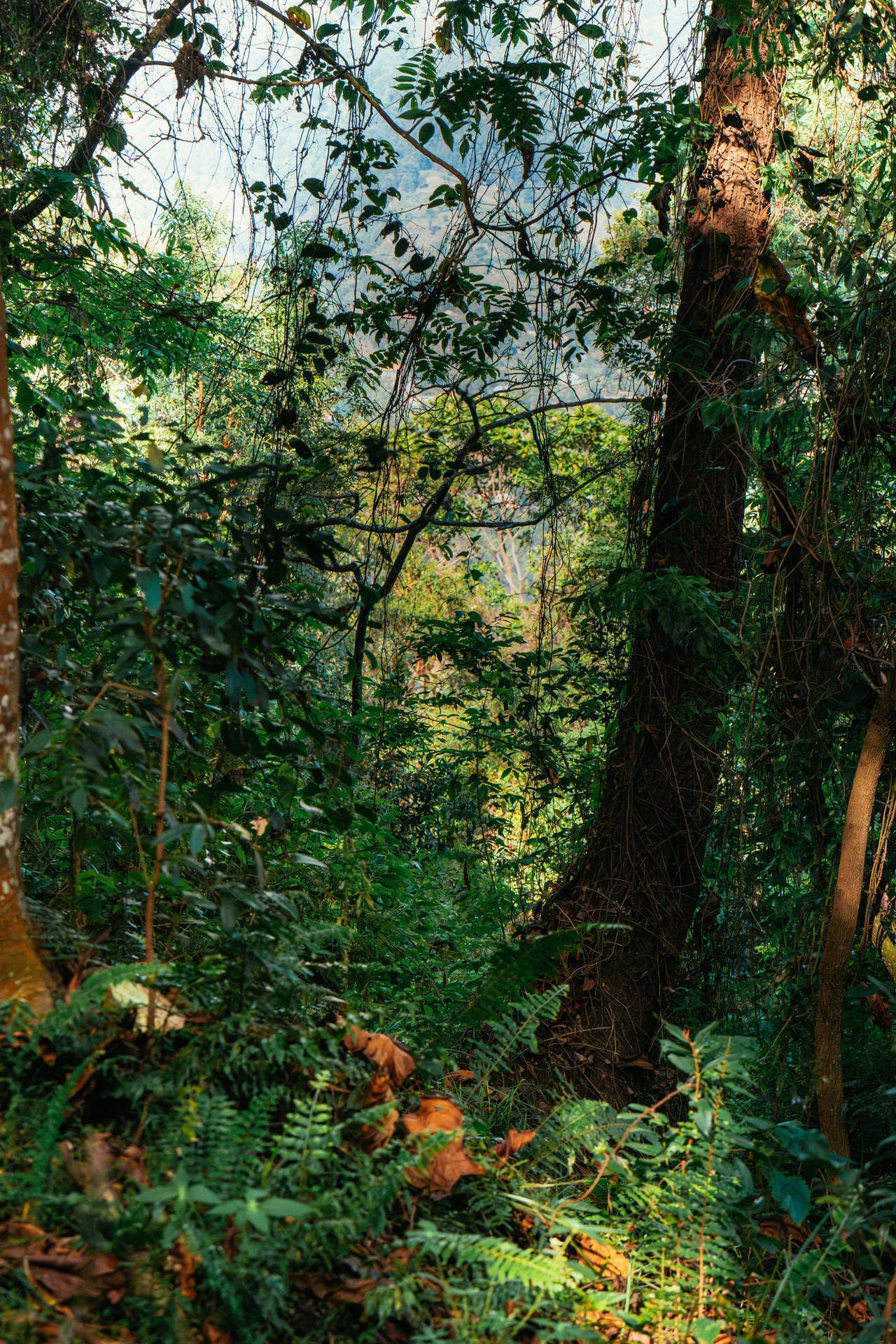
Dense jungle at the start of the gorilla trekking trail

Gorilla trekking in Bwindi: the path through the rainforest
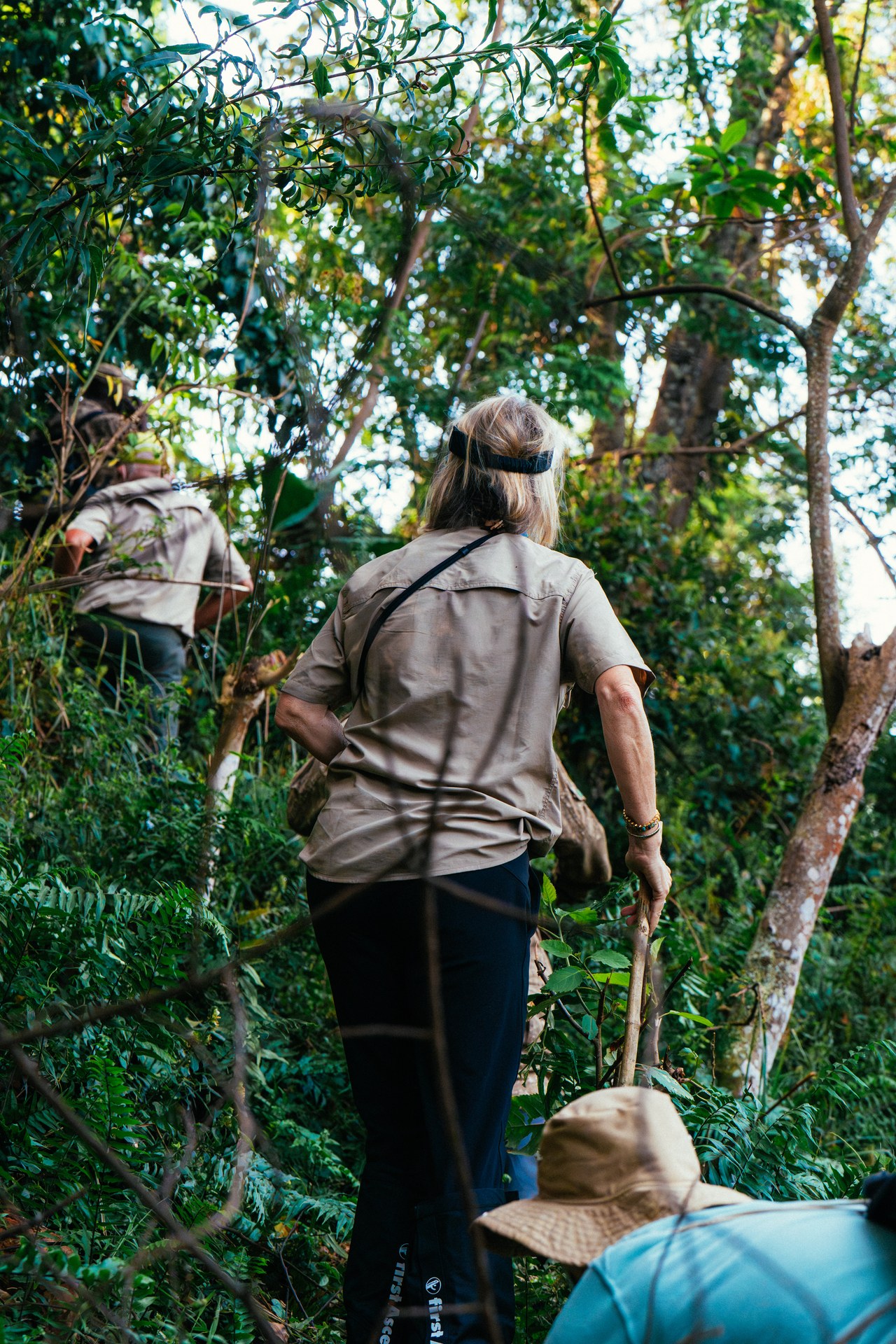
Through Bwindi forest on the trail of gorillas
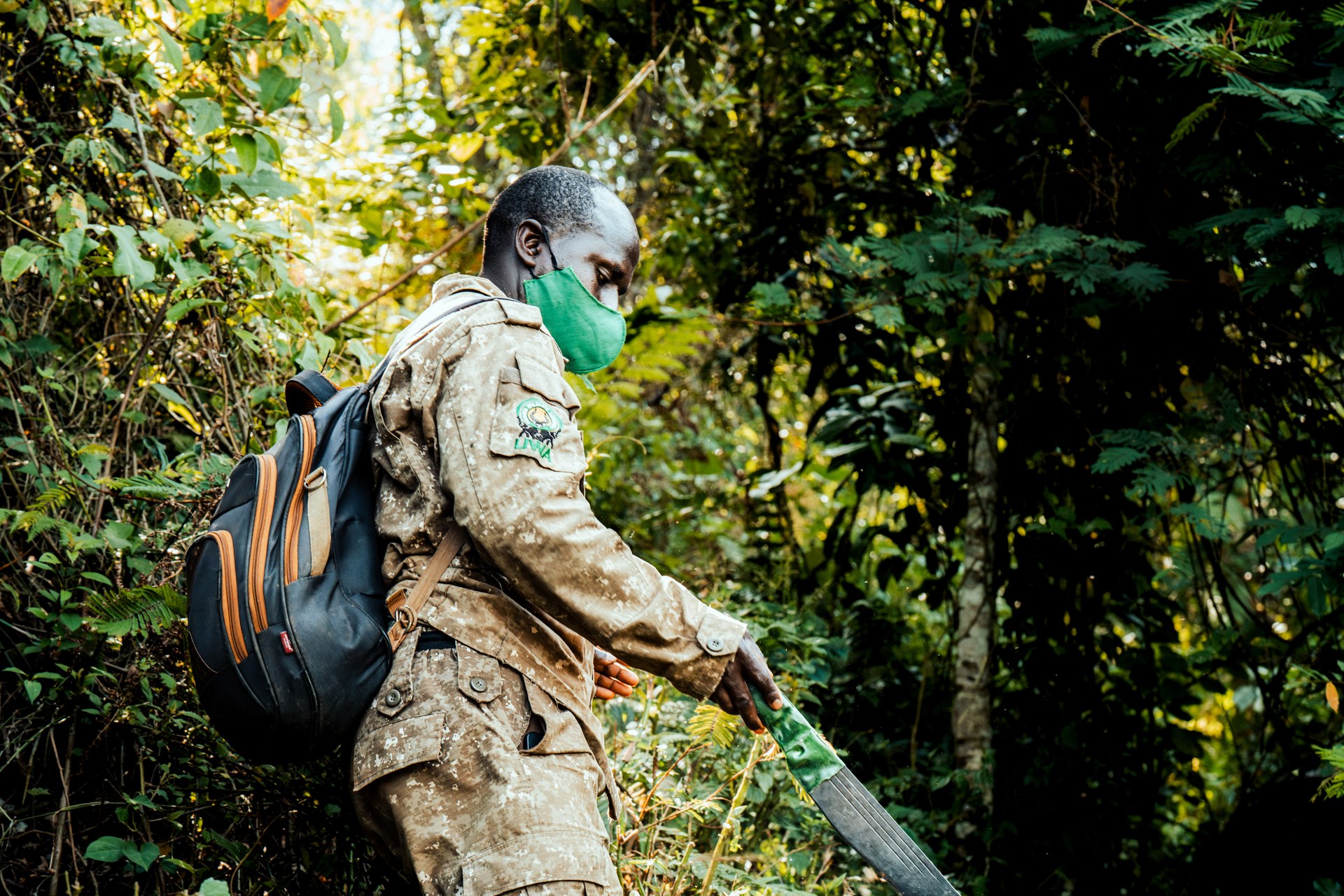
Ranger in Bwindi forest on the way to the gorillas

Preparing for the adventure: gorilla trekking in Bwindi

Mountain Gorilla Peering Through Dense Forest Foliage
Mountain Gorilla