Bwindi forest national park is one of the most important protected areas in Africa, sheltering more than half of the world's remaining mountain gorillas within its 321 square kilometres of ancient rainforest. That protection does not exist in isolation. It is underpinned by a national legal and policy framework that Uganda built over decades, culminating in the National Forestry Policy of 2001 and the National Forestry and Tree Planting Act of 2003. Understanding that framework helps explain not only how Bwindi is protected today, but also why reforestation and afforestation programmes across Uganda matter for the park's long-term future.
During thirteen days on site in May 2026, and across repeated visits since October 2024, we observed directly how the boundary between the park and surrounding farmland is managed, where restoration planting is active, and how community-based forest governance plays out in practice. The policy documents describe intentions; the forest edge reveals what is actually happening.
The National Forestry Policy 2001
Uganda's National Forestry Policy of 2001 represents the first comprehensive statement of how the country intends to manage its forest estate in the modern era. It replaced older colonial-era forestry rules with a framework designed for a post-independence Uganda grappling with rapid population growth, accelerating deforestation, and mounting pressure on protected areas.
The policy rests on three core commitments. The first is conservation: certain forests are to be maintained in their natural state because their ecological, hydrological, and biodiversity values outweigh any productive use. Bwindi Impenetrable National Park sits squarely in this category, along with Kibale Forest, Queen Elizabeth National Park's forests, and Uganda's other major protected forest blocks. For these areas, the policy establishes an expectation of strict protection — no logging, no agricultural conversion, no extraction beyond the tightly controlled research and community programmes that existed prior to the policy.
The second commitment is sustainable production: Uganda's Central Forest Reserves, managed by what would become the National Forestry Authority, are to supply timber, fuelwood, and other forest products in a manner that does not deplete the resource base. This distinction between conservation forests and production forests is one of the policy's defining contributions — it provides a legal basis for arguing that exploitation of one type of forest does not justify encroachment on another.
The third commitment is restoration. The policy set a target of maintaining at least 21 percent of Uganda's land area under forest cover — a figure that was already being undershot when the policy was adopted and that has continued to require active effort to approach. This target drove the reforestation and afforestation programmes that have since been implemented across the country, including in degraded areas near Bwindi.
The National Forestry and Tree Planting Act 2003
The policy's principles became law two years later with the National Forestry and Tree Planting Act of 2003. This legislation did several things simultaneously. It established the National Forestry Authority as an autonomous body responsible for managing Uganda's Central Forest Reserves, replacing the older Forest Department with an institution that had greater operational independence and clearer mandates. It set out the legal basis for licensing timber harvesting and charcoal production, imposing enforceable limits on what had previously been poorly regulated industries. And it created a framework for community forest management agreements — formal legal instruments through which local communities can take on stewardship roles in return for defined rights to specified forest products.
For bwindi impenetrable forest national park specifically, the 2003 Act matters primarily through its management of the surrounding landscape. The park itself is governed under the Uganda Wildlife Act, which prohibits all extractive activities within its boundaries. But the Central Forest Reserves that border Bwindi in some areas, and the buffer zone lands where community forestry agreements operate, fall under NFA jurisdiction. The Act ensures that these adjacent areas are managed in ways that support rather than undermine the park's ecological integrity.
The Forestry Act also provided for the protection of specific tree species. Certain commercially valuable species that were being selectively logged to depletion in forest reserves can be listed for protection, restricting or prohibiting their harvest. This matters for Bwindi because the same species are found within the park, and legal protection in neighbouring reserves reduces the incentive to target them through poaching inside park boundaries.
Conservation Targets and the Pressure of Population Growth
Uganda's forests face a structural challenge that no policy document can fully resolve: one of the highest population growth rates in the world, a predominantly rural economy that depends on agriculture and biomass energy, and a forest estate that is both ecologically irreplaceable and immediately useful to millions of people who need land and fuel. The 21 percent forest cover target in the 2001 policy reflects an aspiration; the reality on the ground is that natural forest cover has declined significantly over the past two decades even as plantation forestry has expanded.
What has held at Bwindi and at Uganda's other major national parks is the strict protection afforded by both the wildlife and forestry legal frameworks working in combination. During our visits to the park boundary, particularly around the Buhoma and Nkuringo sectors, the contrast between the dense interior forest and the agricultural land beginning at the park fence is stark and immediate. The policy has held the line, even if the broader national targets remain aspirational.
Beyond the park boundary, reforestation programmes funded by a combination of government resources, international conservation organisations, and carbon credit mechanisms have planted trees on degraded hillsides and along stream banks throughout southwestern Uganda. These efforts matter for Bwindi because they reduce erosion, maintain watershed functions, and in some cases begin to restore ecological connectivity between the park and forest fragments in the broader landscape.
Afforestation and the Carbon Dimension
Uganda's forestry policy predates the current global focus on carbon markets, but the country has since positioned its reforestation commitments within its national climate obligations. Forests are recognised both as carbon stores that must be preserved and as carbon sinks that plantation and restoration programmes can expand. Bwindi itself represents an enormous standing carbon stock — centuries of accumulated biomass in its ancient trees and root systems — whose preservation under the forestry and wildlife legal frameworks has a value that extends well beyond Uganda's borders.
Afforestation programmes around Bwindi have sometimes been linked to payment for ecosystem services arrangements, where communities or landowners receive compensation for maintaining or planting trees on private land. These programmes sit alongside the formal NFA framework, providing additional incentives for tree retention in a landscape where the economic pressure to convert land to agriculture is constant.
Community Forest Management Around Bwindi
The 2003 Forestry Act's provision for community forest management agreements has been implemented in several areas around Bwindi, most notably in the buffer zones where compatible land use activities are permitted. Under these agreements, community organisations take on defined responsibilities — monitoring forest health, controlling invasive species, reporting illegal activities — in return for rights to harvest specific products such as medicinal plants, building poles, and dead wood.
The practical effect of these arrangements, observed over multiple visits, is that the boundary between the park and surrounding farmland is monitored far more effectively than park rangers alone could achieve. Community members with a legal stake in the adjacent forest reserves have reasons to report encroachment and to police the boundary informally. [QUOTE: local guide on first impressions]
The limitation of community forest management around Bwindi is that the pressures are intense. Population density in the districts surrounding the park is among the highest in Uganda. Land is scarce and valuable. The buffers created by NFA-managed reserves and community agreements are narrow in places, and the incentives to encroach remain significant for households without alternative sources of income. The policy framework creates the conditions for effective management; whether those conditions are realised depends on sustained investment in enforcement, alternative livelihoods, and community benefit-sharing from park revenues.
The Layered Legal Framework
Bwindi Impenetrable National Park is protected by multiple overlapping legal instruments. The Uganda Wildlife Act governs the park itself, prohibiting all forms of exploitation within its boundaries. The National Forestry Policy 2001 and the Forestry and Tree Planting Act 2003 govern the surrounding forest reserves and establish the principles of sustainable management for production forests. The National Environment Act 2019 adds environmental impact assessment requirements for any development activity near protected areas. And Uganda's commitments under international conventions — the Convention on Biological Diversity, the Ramsar Convention, and the World Heritage Convention — create additional obligations that national law must honour.
This layered structure is both a strength and a complexity. The strength is that no single legal gap can undermine protection: even if one instrument fails, others remain in force. The complexity is that multiple agencies — the Uganda Wildlife Authority, the National Forestry Authority, and the National Environment Management Authority — share jurisdiction over different aspects of the landscape, and coordination between them is not always seamless.
What holds the system together, in the end, is the ecological reality of the forest itself. Bwindi's value — to gorillas, to the watershed, to tourism, to the global carbon budget, and to the communities that depend on clean water flowing from its catchments — is tangible and measurable. The National Forestry Policy of 2001 and the legislation that followed it gave that value a legal form. The ongoing task, repeated across every visit to the park boundary, is ensuring that the legal form translates into genuine protection on the ground.
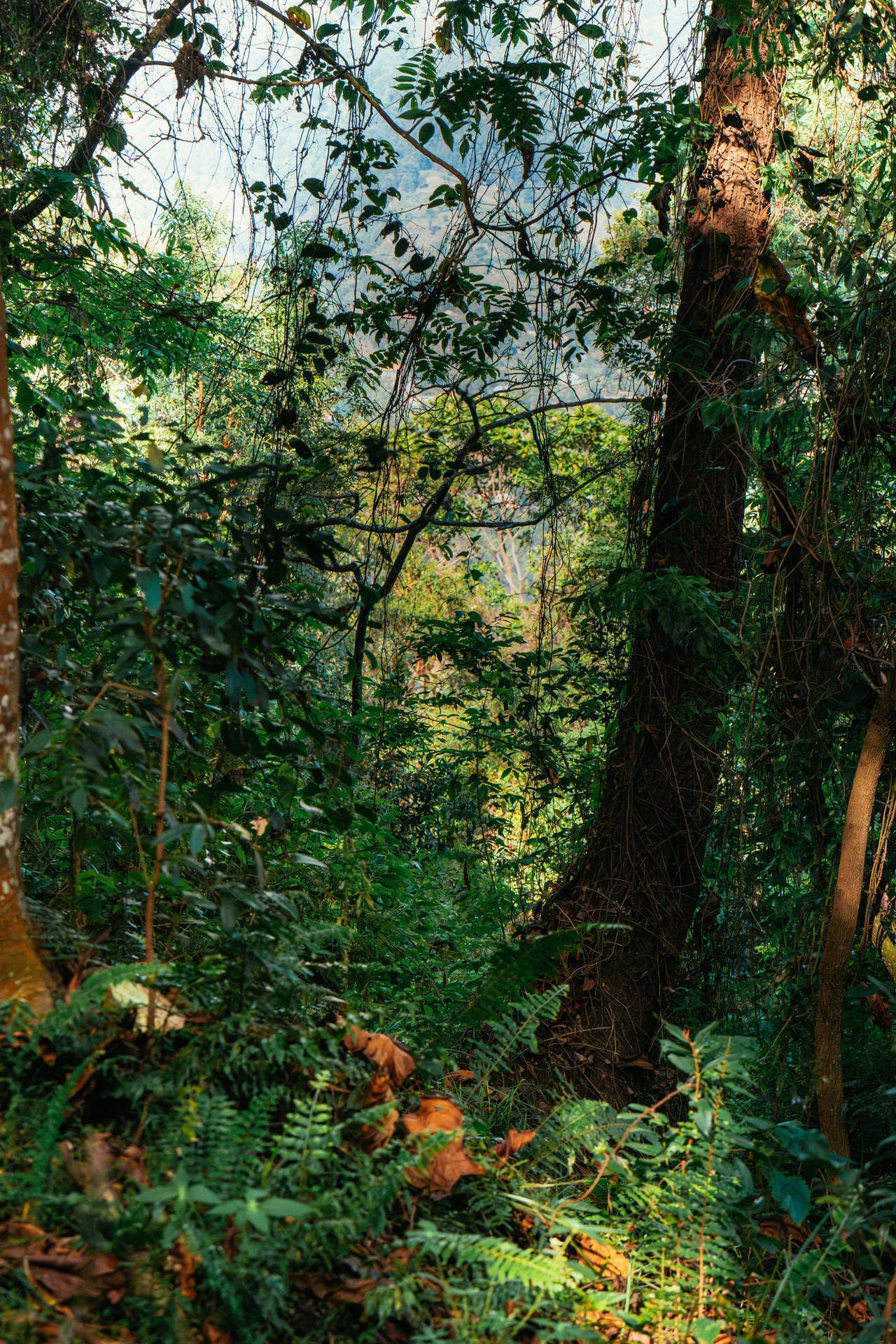
Dense jungle at the start of the gorilla trekking trail

Gorilla trekking in Bwindi: the path through the rainforest

Through Bwindi forest on the trail of gorillas

Ranger in Bwindi forest on the way to the gorillas

Preparing for the adventure: gorilla trekking in Bwindi

Mountain Gorilla Peering Through Dense Forest Foliage
Mountain Gorilla