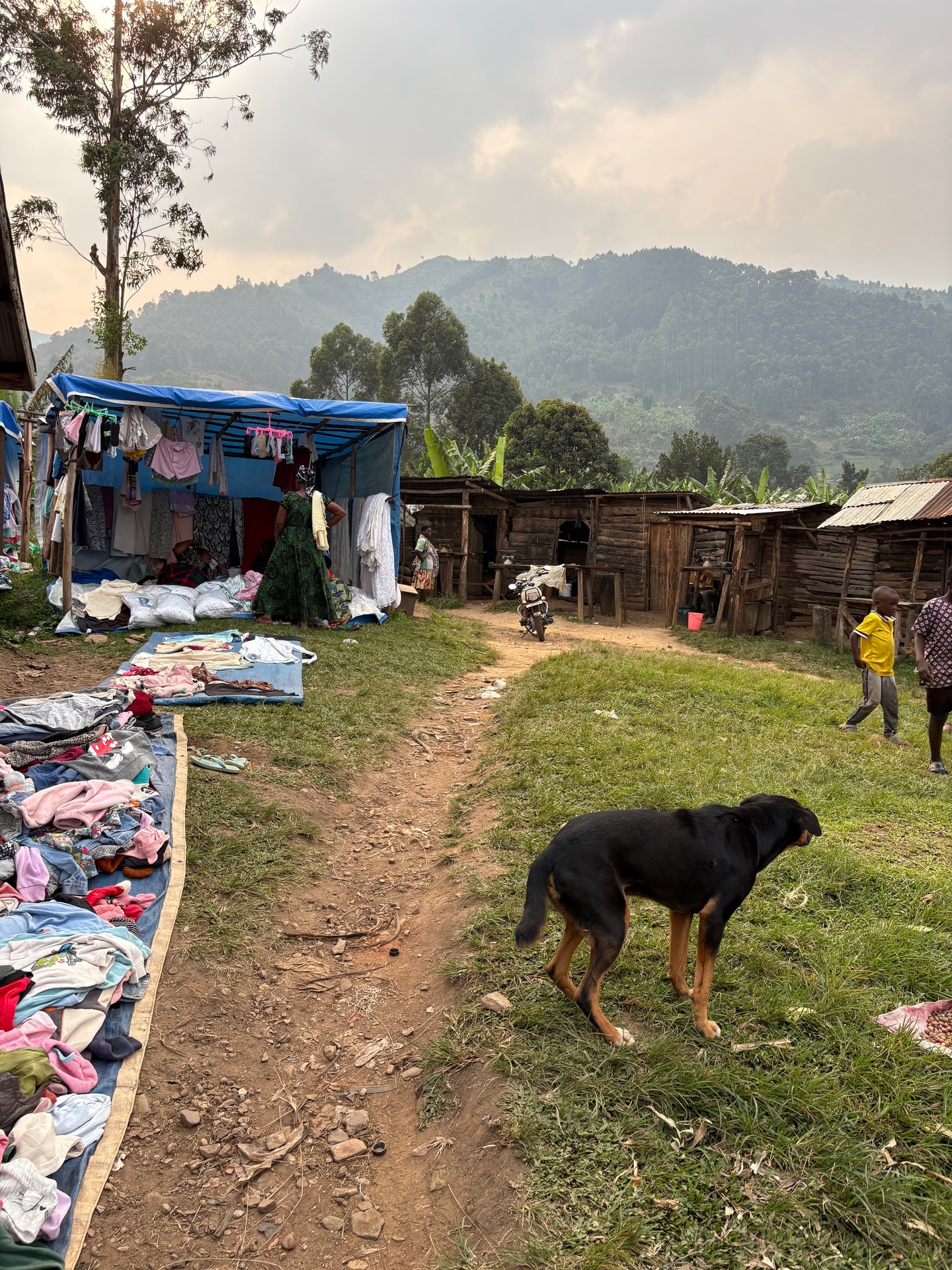
The local market in Buhoma was busy when we arrived on a January morning in 2026 — clothing stalls spread along the roadside, food vendors working from low tables, and the general movement of a community transacting the ordinary business of a week. A dog stood in the middle of it, watching. There were fruits, vegetables, household goods, second-hand garments. Everything a family in a rural Ugandan community needs on a regular basis was available within a short walk. GPS-tagged photos from that morning place us at -0.9671°N, 29.6138°E — at the edge of the village, a few hundred metres from the park gate.
What is easy to miss when walking through that market is the infrastructure question underneath it. Every phone in a vendor's pocket needs charging. The small refrigerator behind one of the shop counters needs a stable current to keep drinks cold through the heat of midday. The solar lantern hanging above a stall allows trading to continue after dark. Rural electrification is not a theoretical development priority in places like Buhoma — it is the practical underpinning of daily commerce. In January and again in May 2026, across two separate stays totalling more than two weeks in and around Bwindi, I saw that shift happening in increments that are easy to overlook individually but add up to something substantial.
Buhoma sits at the northern gate of Bwindi Impenetrable National Park in Kanungu District, south-western Uganda. It is the longest-operating gorilla trekking gateway in the country — the Buhoma sector has been open since 1993 — and it is also, in parallel with that tourism history, a community that has been building its physical infrastructure across three decades of incremental investment. The tarmac road that the Uganda National Roads Authority planned to lay through the main street in 2026 is one signal of that trajectory. Solar electrification is another.
The Energy Baseline: What Life Without Reliable Power Looks Like
To understand what solar electrification means for Buhoma, it helps to start with what came before it. The national grid in Uganda has extended into Kanungu District, and portions of Buhoma proper — particularly the lodges, the UWA sector headquarters, and some larger commercial premises — draw from that connection. But grid reliability in rural south-western Uganda is not comparable to what the same specification would mean in an urban Ugandan context. Power cuts are regular. Voltage fluctuations damage equipment. The cost of a grid connection is prohibitive for most households.
For cooking, firewood and charcoal remain the dominant fuels across virtually all households in the Buhoma area, as in rural Uganda generally. This has a direct environmental consequence. Between 2020 and 2025, Bwindi Impenetrable National Park recorded between 20 and 60 incidents per year of non-timber forest product extraction, according to the State of Wildlife Resources in Uganda 2026. Forest product extraction — including firewood collection — is one of the documented pressures on the park boundary. The firewood economy and the energy access deficit are connected: communities without reliable and affordable alternatives to wood fuel continue to draw on forest resources, regardless of park boundaries. This dynamic is not unique to Bwindi; it is a pattern across Uganda's protected area boundary zones.
For lighting and device charging, however, the picture has changed faster. The dramatic reduction in the cost of solar panels and battery storage globally — roughly an eighty percent reduction in photovoltaic module costs between 2010 and 2024 — has made standalone solar systems accessible at price points that were not possible a decade ago. A basic solar lantern that charges during the day and provides LED lighting for four to six hours at night now retails in Ugandan towns for the equivalent of a few days' casual wages. This is not a trivial shift. In communities where kerosene lamps were the previous alternative, solar lanterns provide better light, no fumes, and no ongoing fuel cost.
Solar in Practice: Small Shops and the Commercial Case
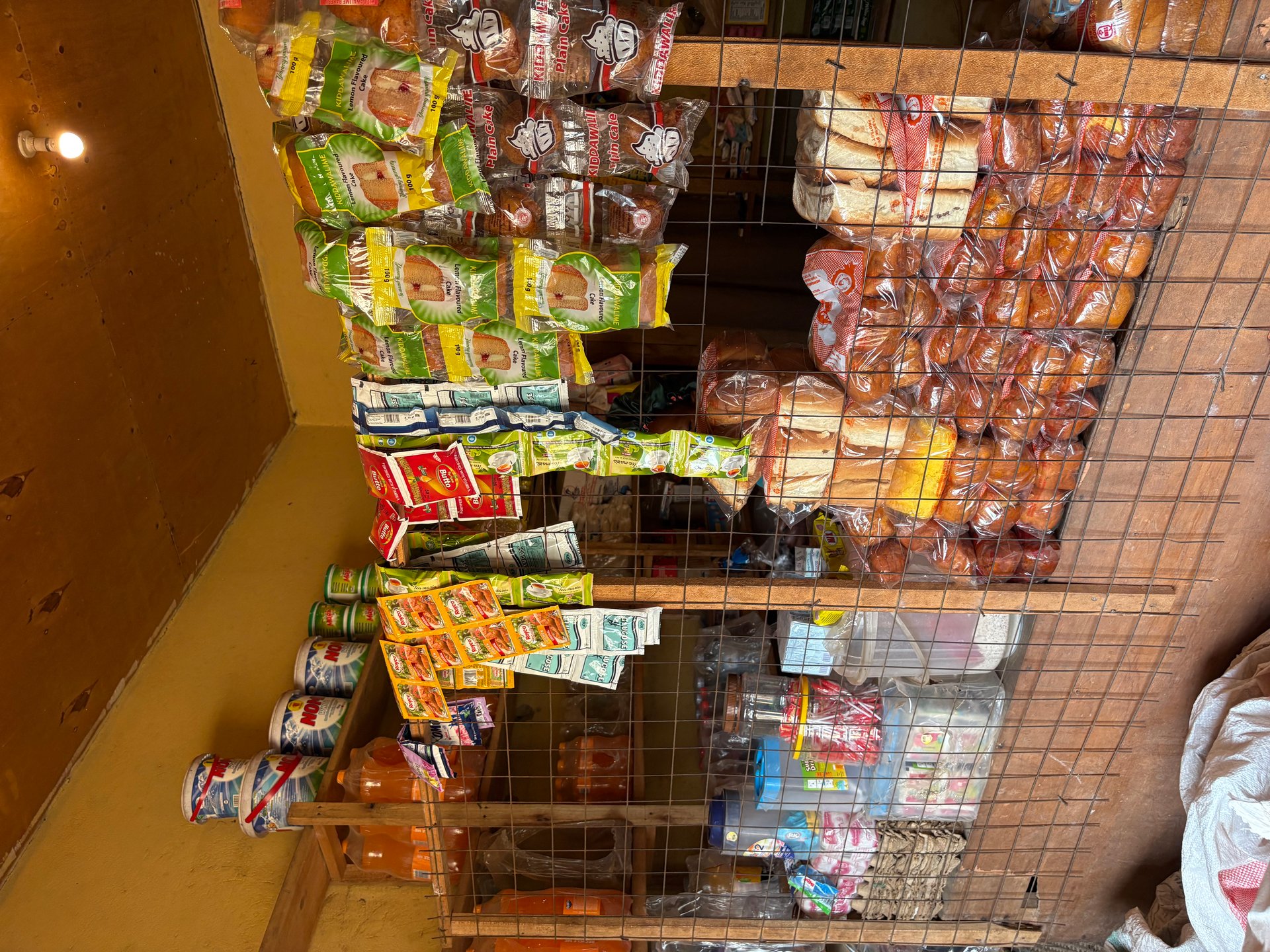
On the main street in Buhoma, I walked into one of the small general stores in January 2026. The shop was perhaps twenty square metres — a metal grille at the front, shelves of packaged goods behind it: snacks, sweets, bottled drinks, soap, small household items. This kind of store, typically owner-operated and often run by a woman, is the basic retail unit of the Buhoma commercial economy. We bought water and sweets for children outside. The transaction was quick and ordinary. What made it worth thinking about was the overhead: a solar panel on the roof, a small battery unit behind the counter, and a strip of LED lighting that kept the interior visible through the afternoon shade.
For a business like this, electricity has a concrete commercial value that is easy to enumerate. Evening trading hours — when lodge workers, guides, and porters return from the forest after afternoon treks — represent meaningful revenue that a store closing at dusk cannot capture. A cold storage unit, even a small one, allows stocking cold drinks at a price premium over warm equivalents: a distinction that matters in a village with a significant tourist and hospitality workforce passing through daily. Mobile money terminals — now the standard mechanism for cash transfer and payment across rural Uganda — require a charged device. None of this functions without power. Solar enables it.
The women who operate these stores — and the Uganda National Household Survey 2023/24, which covered socio-economic, labour force, and community modules, provides a national statistical backdrop to what is visible on the ground — tend to operate without formal credit, without business registration, and without the kind of asset base that would qualify them for bank loans. The solar panel above the shop is often one of the most significant capital investments a small trader has made. It is purchased outright, or on a pay-as-you-go basis that has become the standard commercial model for off-grid solar providers in East Africa. The provider installs the panel and battery, the customer makes regular mobile money payments, and access is maintained or suspended based on payment status. It is a financing model that has worked precisely because it does not require the kind of formal financial history that rural Ugandan small traders do not typically have.
Mini-Grids and Community Infrastructure
Beyond standalone panels, solar mini-grids — small power generation and distribution systems that serve a cluster of households or a community facility — have been expanding into rural areas of south-western Uganda. A mini-grid differs from a standalone installation in that it provides shared generation infrastructure: a larger solar array, a battery bank, and local distribution lines that connect multiple users. For communities the size of Buhoma and its surrounding sub-counties, mini-grids offer a route to reliable power that the national grid timeline has not yet delivered.
In the Bwindi region, health centres are among the highest-priority recipients of solar installations. A health facility without reliable electricity cannot refrigerate vaccines, cannot perform procedures at night, and cannot run the diagnostic equipment — blood pressure monitors, microscopes, oxygen concentrators — that basic primary care requires. Parish councils and community development committees in the Kanungu District area have consistently identified health facility electrification as a priority in local development plans. NatureUganda, which has operated monitoring programmes in the Bwindi region, works within a community and institutional landscape in which energy access underpins the ability of local organisations to function effectively. Project Management Committees supporting district-level development projects in the area typically include electrification components in multi-sector infrastructure plans.
Schools present a similar case. A primary school with solar power can hold evening study sessions for students who do not have light at home. Computer labs — increasingly relevant as Uganda's education system extends digital literacy curricula — require stable power. STEM education programmes for rural students depend on the physical infrastructure to deliver science and technology instruction: laboratories need refrigeration for samples, electronics equipment needs charging, and the teachers delivering the curriculum need to be able to prepare materials outside school hours. All of this is enabled by electrification that the grid has not yet consistently provided to communities at Bwindi's boundary.
Energy Access Around Bwindi: Key Facts
Forest Extraction Incidents
Between 2020 and 2025, Bwindi recorded 20 to 60 non-timber forest product extraction incidents per year (State of Wildlife Resources in Uganda 2026). Reduced firewood demand from solar adoption directly eases this pressure.
Road Upgrade, 2026
The main street through Buhoma is scheduled for tarmac surfacing in 2026 — the same infrastructure cycle that is expanding solar mini-grid feasibility by lowering the logistics cost of equipment delivery to the area.
Pay-As-You-Go Solar
The dominant commercial model for off-grid solar in rural Uganda requires no upfront capital: households make regular mobile money payments and access is managed remotely by the provider.
Conservation Link
Bwindi and Echuya are classified as critical habitat for an endangered cat species on the Uganda Red List (State of Wildlife Resources 2026). Forest integrity — supported by reduced extraction pressure from solar adoption — directly protects this habitat.
Construction, Change, and the Longer View from Buhoma
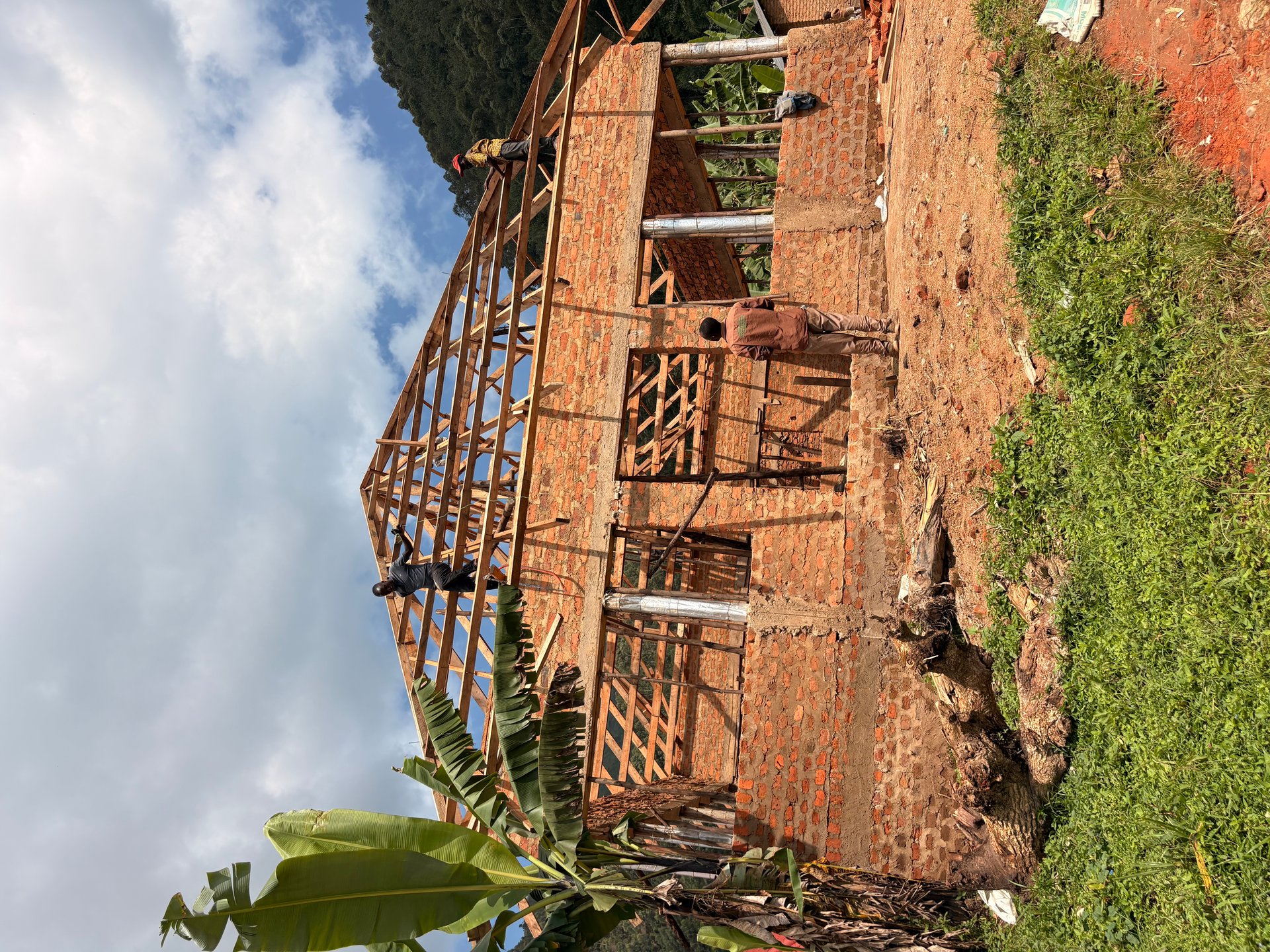
In May 2026, I visited the HopeKitchen construction site at -0.9622°N, 29.6107°E — a community building project on a hillside above Buhoma. The clay-brick walls were already standing when I arrived, and the timber roof frame was almost complete. The next stage was the corrugated metal roof sheeting, already on order. Standing in the open frame of the building, you could see the full Buhoma valley: banana terraces stepping down the hillsides, the red-soil road below, and the mountains that mark the western extent of the park on the horizon. It is an extraordinary view, and it will be visible from the dining and gathering area when the building is finished.
A building project of this kind — using local materials, local labour, and a straightforward structural approach — does not advertise itself as an energy story. But the planning decisions that go into it are energy decisions. Will the kitchen have solar panels for cooking appliances? Will the dining area have LED lighting for evening use? Will the facility have a mobile phone charging point that can serve both residents and visitors? These are practical questions that community builders in Buhoma now ask as routine parts of construction planning — not because they are making a statement about sustainability, but because solar is increasingly the most practical and cost-effective answer to the question of how to power a building in a location where grid reliability is limited.
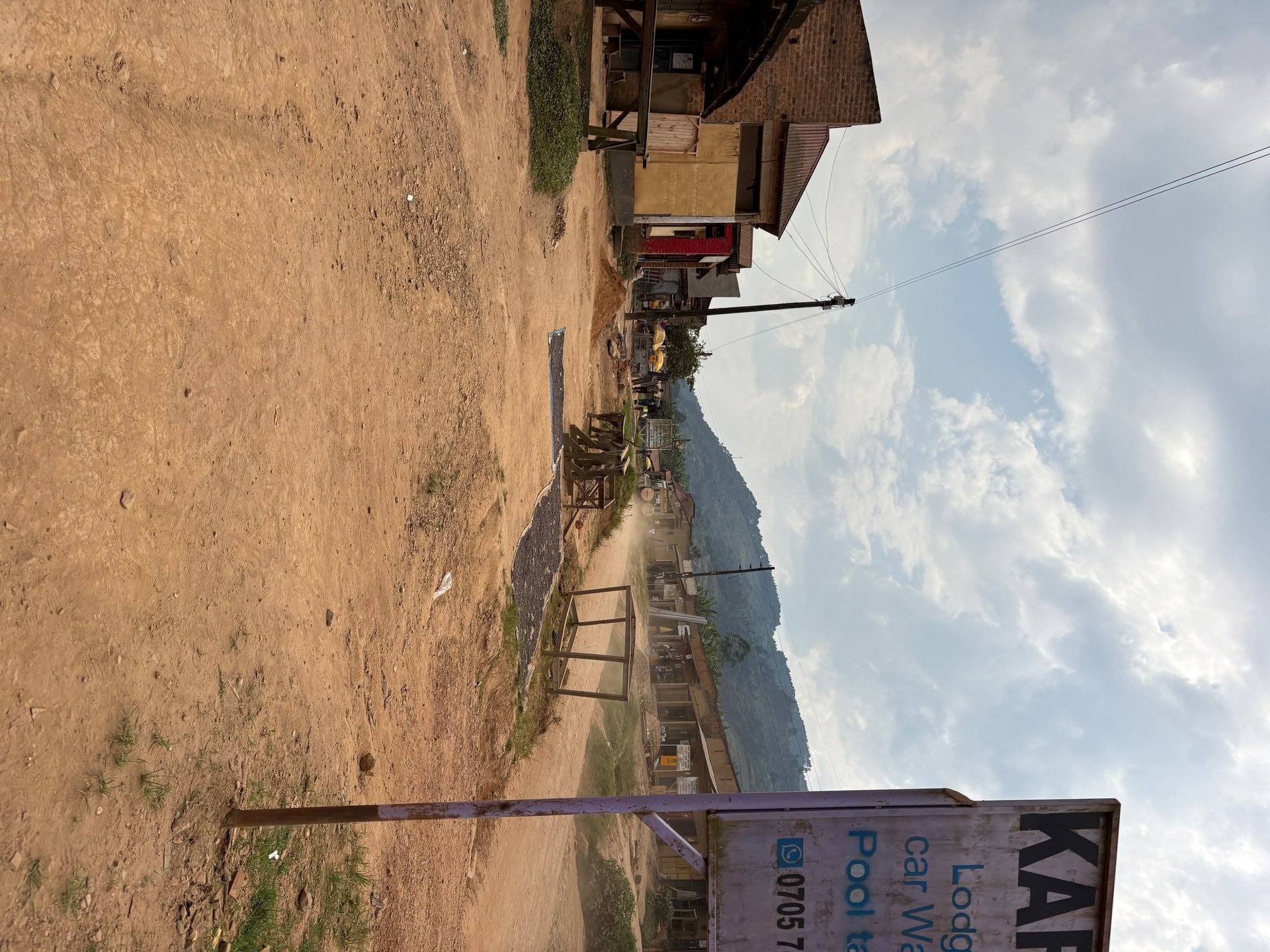
The main street itself — stony, dusty, and animated by small shops and foot traffic when I photographed it in January 2026 — is due to be tarmacked in 2026. A sealed road changes the logistics of everything: faster transport times, lower vehicle maintenance costs, and reduced barriers to equipment delivery. A solar panel array that takes three days to move over rough tracks costs more to install than one that arrives in four hours on tarmac. Infrastructure improvements compound. The road, the solar, and the community buildings are not separate development stories — they are the same story, playing out across the same landscape at the same time.
[QUOTE: local guide or shopkeeper in Buhoma on the difference electricity has made to running a business or household in the village]
Solar Electrification as a Conservation Tool
The connection between rural energy access and forest conservation is not always made explicit in the conversation about Bwindi, which tends to focus on gorilla trekking revenues, community benefit-sharing, and anti-poaching operations. But the energy dimension sits underneath all of those conversations. Communities that depend on firewood as their primary fuel have a continuing material interest in forest access. This is not a moral failing — it is a structural consequence of energy poverty. A household with a reliable cooking fuel alternative has less reason to collect wood from the forest. Repeated across thousands of households in the park boundary zone, this difference in behaviour is measurable in the forest.
Bwindi and Echuya, its sister reserve to the south, together represent the most significant stronghold for an endangered cat species documented on Uganda's Red List, according to the State of Wildlife Resources in Uganda 2026. The forest that protects this biodiversity — mountain gorillas, rare primates, and a documented threatened felid — is exactly the forest that boundary communities use for firewood, building materials, and other daily needs. The line between conservation success and conservation failure in this landscape runs, in part, through the question of whether people have alternatives. Solar is one of those alternatives — imperfect, partial, and still expanding, but real.
Uganda Wildlife Authority's community revenue-sharing programme, which returns a portion of park entry fees to boundary households as block grants, has funded boreholes, classrooms, and health infrastructure in Buhoma and surrounding communities. Some of that investment has gone toward electrification components — solar panels for schools and health posts. The EU has supported rural energy access programmes in Uganda through development partnerships that include off-grid solar components. NatureUganda has operated in the Bwindi region across multiple conservation monitoring programmes that depend on community relationships maintained in part through the kinds of shared infrastructure — electrified meeting rooms, charged communication devices — that solar makes possible.
None of this is a simple or finished story. Firewood remains the cooking fuel of choice across most of rural south-western Uganda because the alternatives for cooking — solar cookers, LPG, improved cookstoves — face adoption barriers that lighting and device charging do not. Mini-grids require maintenance capacity that does not always exist at community level. Pay-as-you-go solar can be interrupted by income shocks that disconnect households exactly when they most need the service. The progress is real and it is partial.
What is visible from a week spent in Buhoma and the surrounding villages — from the market stalls with their overhead LEDs to the shops with their rooftop panels and the construction sites with their planning for electrified kitchens and gathering spaces — is that the energy transition in this corner of south-western Uganda is underway. It is not dramatic. It does not happen all at once. It happens one rooftop panel, one battery unit, one mobile money payment at a time. But the direction is clear, and the effect — on commerce, on health services, on schools, and on the forest boundary — is compounding.