The storeroom at the Buhoma orphanage is a single room. When I looked inside in January 2026, it held a few sacks of beans and grain — enough to feed the children for approximately one week. That is the planning horizon: seven days. Beyond that, the next delivery depends on donations that have not arrived yet, money that has not yet been raised. Nicholas, the pastor who manages the orphanage, works under a form of financial pressure that does not resolve — it simply requires perpetual management. Every week, the question of whether the children eat next week is open.
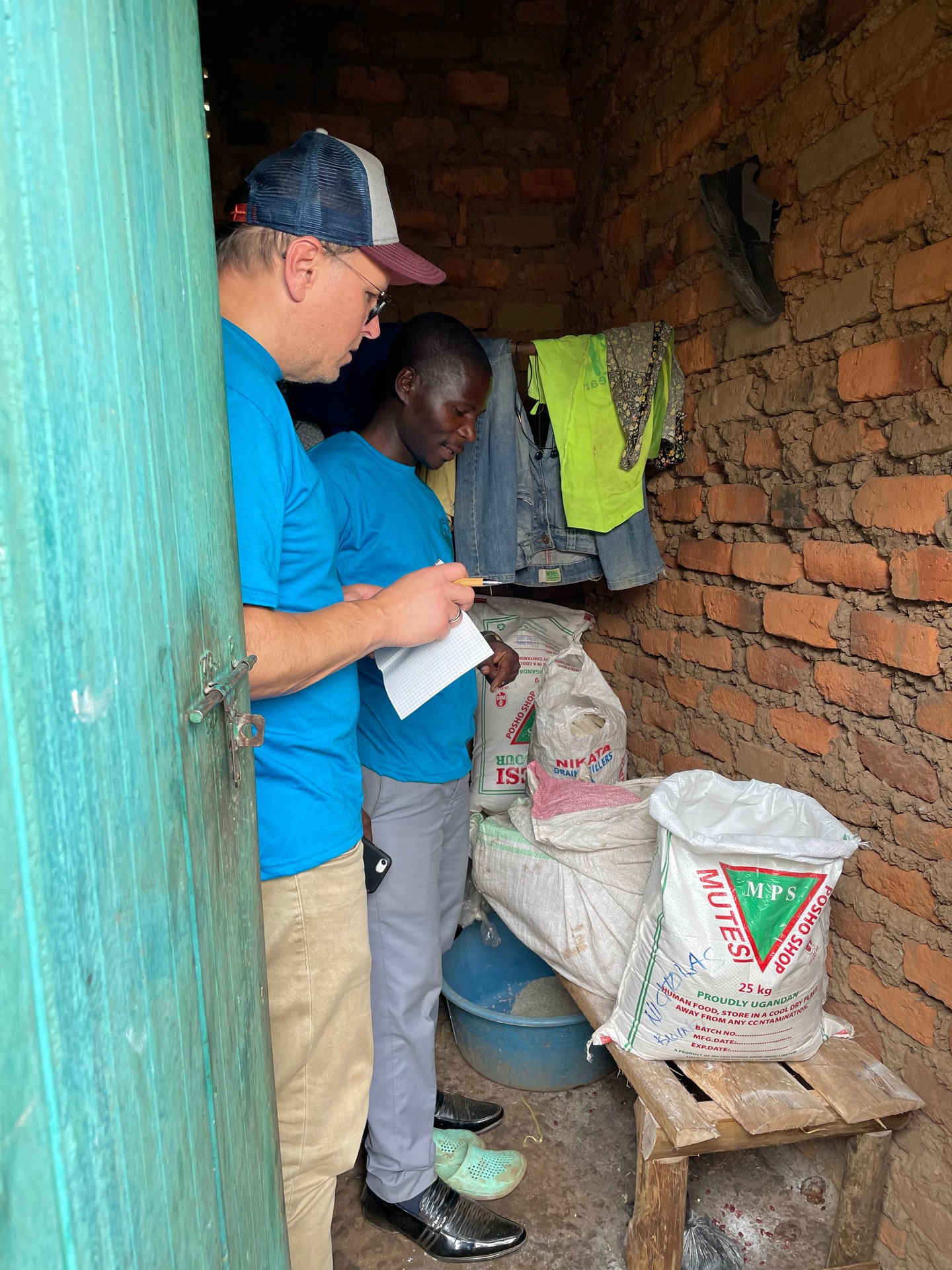
This is Buhoma, Kanungu District, south-western Uganda — the village at the northern gate of Bwindi Impenetrable National Park. The village has been the primary entry point for gorilla trekking at Bwindi since UWA opened the sector in 1993 — the longest-running gorilla tourism operation in Uganda. There is a lodge sector, a community rest camp, a craft cooperative, a primary school, a health post, and a functioning road. There is also an orphanage run by a man with no particular funding stream who has decided, as a practical matter of faith and community obligation, that the children need to be fed and housed. Both things are true at once: Buhoma has more institutional infrastructure than many comparable villages in south-western Uganda, and that infrastructure routinely operates right at the edge of its capacity.
I visited Buhoma across three separate stays — in October 2024, January 2026, and May 2026 — spending a total of around five days in and around the village. What follows is drawn from those visits: the food store, the children, the construction site on the hillside, and the wider terrain of a community that exists in a complex relationship with one of the world's most economically significant wildlife populations.
Nicholas and the Orphanage
Nicholas works from a small office adjacent to the orphanage's main building — a modest room with whitewashed walls where documents and certificates are pinned in the available space. The office is functional: a desk, the documentation of an operating facility, the visible evidence of administrative work that keeps the orphanage registered, accountable, and in contact with the organisations and individuals who occasionally provide support.
The orphanage building itself has three rooms, electricity, but no running water. Day-to-day water comes by boda boda — motorcycles carrying plastic jerricans fetched from a source a kilometre or so away. During January 2026, the courtyard in front of the building was where most of daily life took place: meals prepared outdoors, children moving between the main building and the annex that holds the dormitory. The space was in use throughout the day in the way that small institutions are when space is limited and the outdoors is mild. January in Bwindi's northern foothills is not harsh — temperatures sit in the mid-twenties during the day, the air is clear, and the courtyard in afternoon light is pleasant.
The weekly food supply constraint is the most acute operational challenge Nicholas manages. There is no buffer stock, no contract with a supplier, no guaranteed incoming donation schedule. There is, in most weeks, enough — but the margin between enough and not enough is thin. This is not unusual for community-run orphanages in rural Uganda, where operating costs are real but formal funding mechanisms are underdeveloped. What makes Buhoma's situation notable is the juxtaposition: a few kilometres down the road, trekkers are paying $800 per person to spend one hour with a gorilla family, and those trekkers walk past the village on their way to the sector headquarters. The economic geography of the place is stark.
The Stone Economy — Children at Work in Buhoma
At the roadside in Buhoma, in January 2026, I came across a ten-year-old boy sitting on a pile of stones and breaking them. He was there with other children, and the work was what it looked like: using a hammer to crack larger stones into smaller gravel pieces, which the family would then sell. The crushed stone serves as aggregate for house foundations — the raw material for the most basic level of construction in a community that is, building by building, incrementally improving its housing stock. The boy was immediately cheerful, curious, and entirely unselfconscious about the work he was doing. He had been at it for some time. The pile he was sitting on had been significantly reduced.
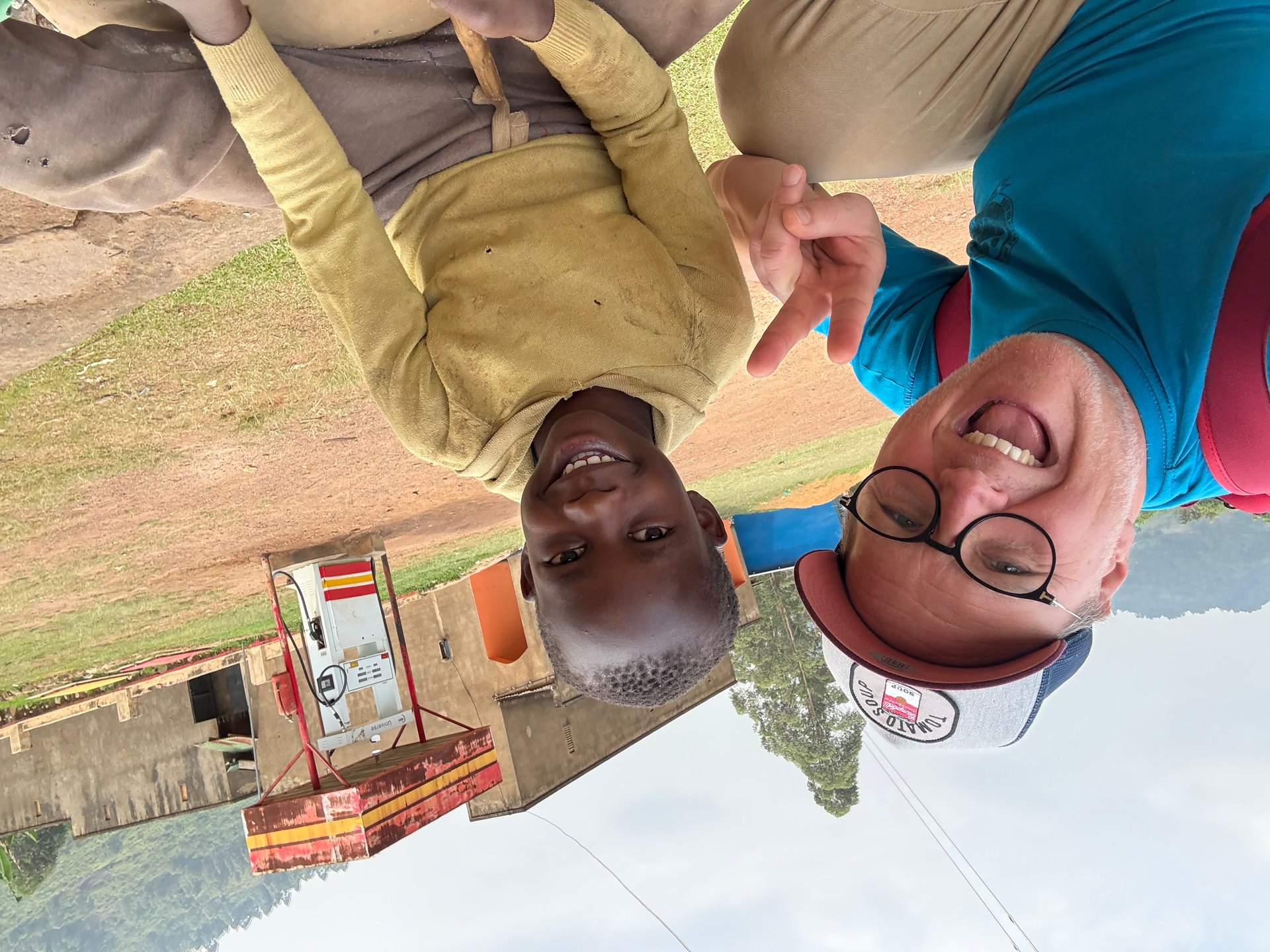
Stone-breaking is not specific to children in Buhoma. Adults do the same work, at the same roadside sites, producing the same material for the same construction purposes. It is landestypische Arbeit — a phrase one uses in Ugandan community contexts to describe work that is simply part of how the local economy functions, across age groups. The stones come from the hillsides. The gravel becomes foundations. The foundations become rooms, which become buildings, which become the slowly accumulating housing stock of a community that has been growing since gorilla tourism brought stable employment to the area.
The environmental dimension of this is worth noting. Uganda's hilly terrain — and the Bwindi region specifically, where altitude ranges from around 1,160 to 2,607 metres — is susceptible to soil erosion from both water and wind. Uganda's National Agricultural Research Laboratories at Kawanda (NARL) provide soil classification and erosion assessment data used in national land-use planning. Research cited in Uganda's 2018 Multi-Hazard Risk and Vulnerability Profile found that human activities have elevated global soil erosion rates by a factor of ten to forty compared to natural baseline rates. On steep slopes at the Bwindi boundary — where communities farm right up to the park fence — sustainable land management is an active rather than theoretical concern. The stone itself, extracted from hillsides over time, is part of that landscape dynamic.
The boy on the stone pile was unsentimental about all of this. He had a job to do, he was doing it, and when a stranger walked past with a camera he grinned and was genuinely curious. Children in Buhoma are accustomed to being photographed — it is one of the visible effects of years of gorilla tourism traffic through the village. They are not shy of cameras or foreign visitors. They are also not romanticised by them; they continue working while being friendly about it.
The View from HopeKitchen
In May 2026, during a third visit to Buhoma, construction was underway on a building at GPS coordinates -0.9622°N, 29.6107°E — a project called HopeKitchen, which is planned to include a communal eating and gathering area for the community. From the construction site — specifically from what will become the dining and common room — the view across the Buhoma valley is exceptional. The hillsides run down in terraces of banana plantations, the characteristic green of matoke gardens, and the rust-brown of tilled earth. In the distance, the mountains that form the backdrop to Bwindi's western and southern extent are visible across multiple ridgelines. It is the kind of landscape that photographs well but is more substantial in person — the air is clear, the scale is large, and the sense of being in a genuinely productive agricultural landscape rather than a postcard version of one is present throughout.
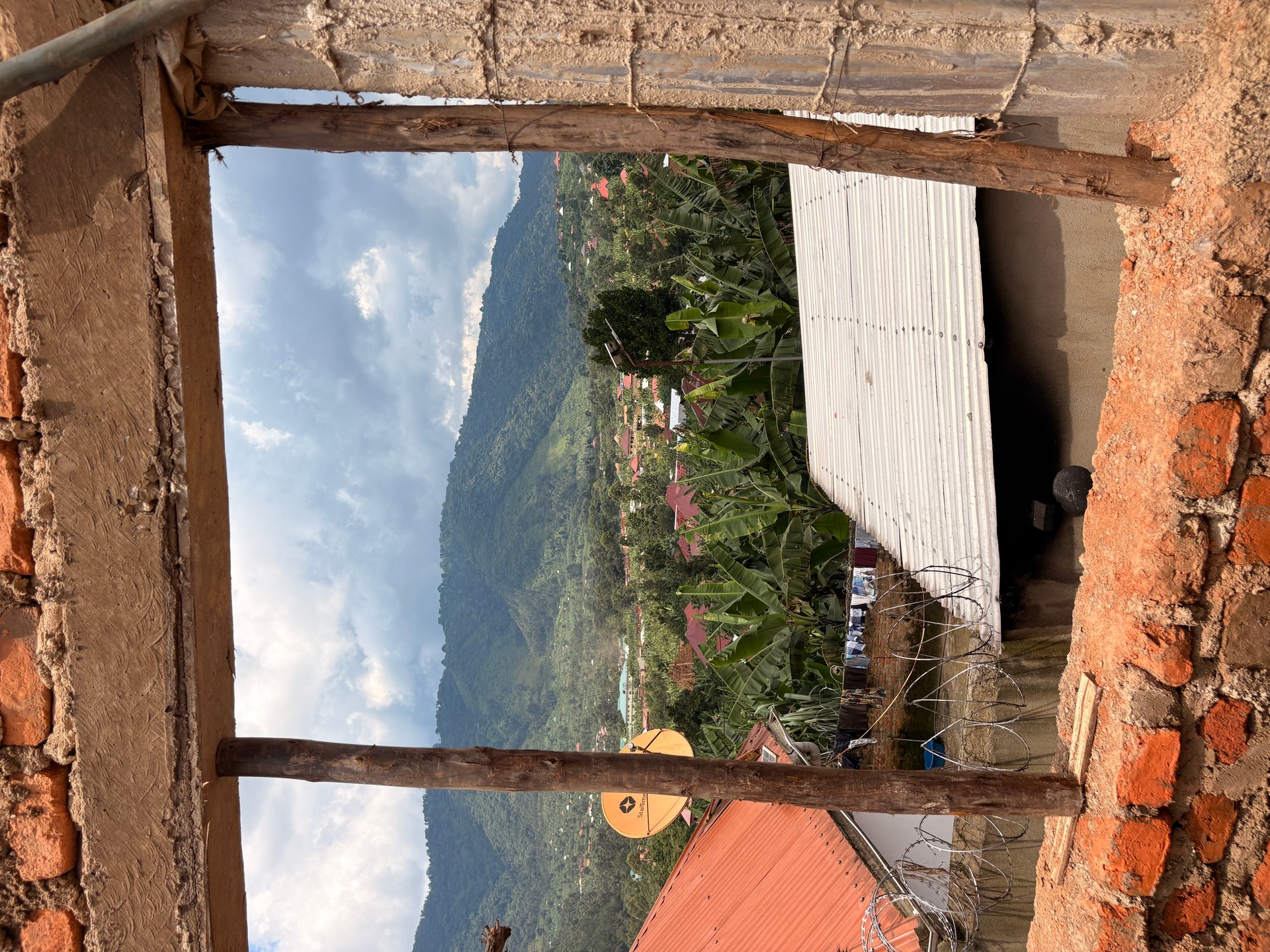
The HopeKitchen construction is a community-anchored project connected to the Hope on the Road initiative that has been active in Buhoma across multiple visits. The building, in mud-brick and timber, uses local materials and labour. The corrugated metal roof is standard in the region — practical given the rainfall in Bwindi's northern foothills, where the altitude and proximity to the forest means significant precipitation in the rainy seasons. From within the open frame of the construction, the view functions almost like a framing device: the mountains are visible through the gaps where windows will be placed, and the landscape that will be visible from the finished eating area is one of the more striking aspects of the building's location.
Community facilities of this kind — beyond the core gorilla-tourism infrastructure of lodges, trailheads, and rangers' posts — accumulate slowly in a place like Buhoma. The school, the health post, the craft cooperative, and now the HopeKitchen represent layers of community investment built over decades on the economic base that gorilla tourism provides. None of these facilities was built by gorilla tourism directly; all of them are possible, in part, because the community has had a stable economic platform to work from.
Ngamba Island — Uganda's Other Primate Sanctuary
In October 2024, during an earlier trip to Uganda that preceded the Bwindi visits, I spent time on Ngamba Island in Lake Victoria. Ngamba Island Chimpanzee Sanctuary is a wildlife rehabilitation facility that provides refuge for chimpanzees rescued from captivity or poor conditions — animals that cannot be returned to the wild but require long-term care in a structured environment. The sanctuary is reached by a one-hour boat ride from Entebbe and is operated by the Chimpanzee Sanctuary and Wildlife Conservation Trust.
The perimeter fence at Ngamba Island is substantial — robust metal fencing that marks the boundary between the visitor area and the sanctuary proper. Looking at the fence from outside in October 2024, the initial impression was institutional. But behind the fencing is a forested area of the island that functions as a semi-wild habitat for the chimpanzees — dense enough that the animals can move, forage, and behave in ways that approximate their natural patterns. The fence is the boundary between a facility and a forest; on the far side, the chimpanzees have something that functions, practically, as freedom within defined limits. It does not look beautiful from the perimeter. Inside, it is a different experience.
Ngamba Island and Bwindi represent two different models of primate conservation. At Bwindi, mountain gorillas live entirely in the wild — in-situ conservation, where the protection of the habitat is the protection of the species. The gorillas have never been in captivity; the entire conservation effort is organised around maintaining and expanding their wild habitat and reducing human-wildlife conflict at the boundary. At Ngamba Island, the approach is ex-situ rehabilitation — caring for individual animals that have already been removed from the wild, giving them the best available approximation of natural conditions within a managed facility.
Both approaches are necessary. The mountain gorillas of Bwindi exist because their forest habitat has been protected and because the communities around it have been given economic reasons to support that protection. The chimpanzees at Ngamba Island exist because Uganda's wildlife law enforcement and the sanctuary network provide an endpoint for rescued animals that would otherwise have no place to go. Uganda's chimpanzee population — estimated at several thousand individuals, primarily in Kibale National Park, Budongo Forest Reserve, and the Kaniyo Pabidi area — is larger than its mountain gorilla population but faces comparable threats from habitat loss and illegal trade. The two conservation models, in-situ and ex-situ, address the same underlying problem from different directions.
Uganda Primate Conservation: Two Models
In-situ — Bwindi
Wild populations protected through habitat conservation, anti-poaching, and community revenue-sharing. Mountain gorillas (459 individuals in Uganda, 2018–2020 census) live entirely in the wild; no captive individuals exist.
Ex-situ — Ngamba Island
Rescued chimpanzees from captivity or illegal trade are rehabilitated in a managed sanctuary environment. Semi-wild island habitat allows natural behaviour within a secure perimeter. Operated by the Chimpanzee Sanctuary and Wildlife Conservation Trust.
The Arithmetic of Living Beside Bwindi's Gorillas
The paradox of Buhoma is quantifiable. A gorilla trekking permit in Uganda costs $800 per person (UWA, 2026). The Mubare group — the first gorilla family habituated for tourism in Uganda, now well-established at the Buhoma sector — receives a maximum of eight visitors per day, every day of the year. That is a daily revenue ceiling, for a single gorilla family, of $6,400 in permit fees alone. Over the course of a year, accounting for some days when the family is inaccessible or the weather prevents trekking, the Mubare group generates somewhere in the range of $1.8 to $2 million annually in permit fees. Buhoma has three habituated families.
The orphanage, a kilometre away, runs on enough food for one week at a time. The gap between these two numbers — the per-day permit revenue from a single gorilla family and the cost of feeding a dozen children for a week — is a real and uncomfortable feature of the landscape here. It is also a misreading of how the money flows, or rather does not flow, directly from the trekking economy to community facilities.
A significant share of permit revenue goes to UWA operations — paying the rangers, the tracking teams, the veterinary monitoring staff, and the administrative overhead of running a national park system across Uganda's 54,000 square kilometres of protected land. Another share, through the community revenue-sharing programme, is returned to boundary communities in the form of block grants that fund school construction, boreholes, and health infrastructure. This money is real and significant — without it, Buhoma's school would be less equipped and the health post would not exist. But the grant mechanism does not extend to operating costs for informal community facilities like Nicholas's orphanage, which depends on individual donations and the pastor's own ability to raise funds from local churches and occasional international supporters.
This is not a failure of the gorilla conservation model. It is an accurate description of what that model is: a wildlife-funded public infrastructure programme that builds schools and health centres but does not replace the full range of social welfare functions that a community needs. Nicholas fills one of those gaps, with the resources he has, operating a week at a time. This is what village life at Bwindi's gate actually looks like when you spend time in it rather than passing through on the way to a morning trek.
[QUOTE: local community member or Nicholas on what tourism means for Buhoma]
The stone-breaking boy at the roadside, the food sacks in the storeroom, the half-built dining room with its view over the banana terraces — these are not evidence that gorilla conservation has failed the community. They are evidence that the community exists at multiple registers simultaneously: beneficiary of one of Africa's most successful conservation-funded economies, and also a village in south-western Uganda where a ten-year-old contributes to his family's income by breaking gravel at the roadside. Both are true. Buhoma is not a success story or a failure story. It is a place.