The orphanage in Buhoma is larger from the outside than it is inside. The main building has three rooms, electricity connected, but no running water. A second structure behind it holds a dormitory and an office. Because there is not enough space indoors for daily life, most of what happens at the orphanage happens outside — meals on the courtyard, homework in the shade at the side of the building, the younger children playing between the two structures. In January 2026, water was being brought to the orphanage by boda boda — motorcycle taxis carrying plastic jerricans strapped to the back, fetched from a source roughly a kilometre away. This is an ordinary logistics problem in this part of Buhoma, not an emergency.
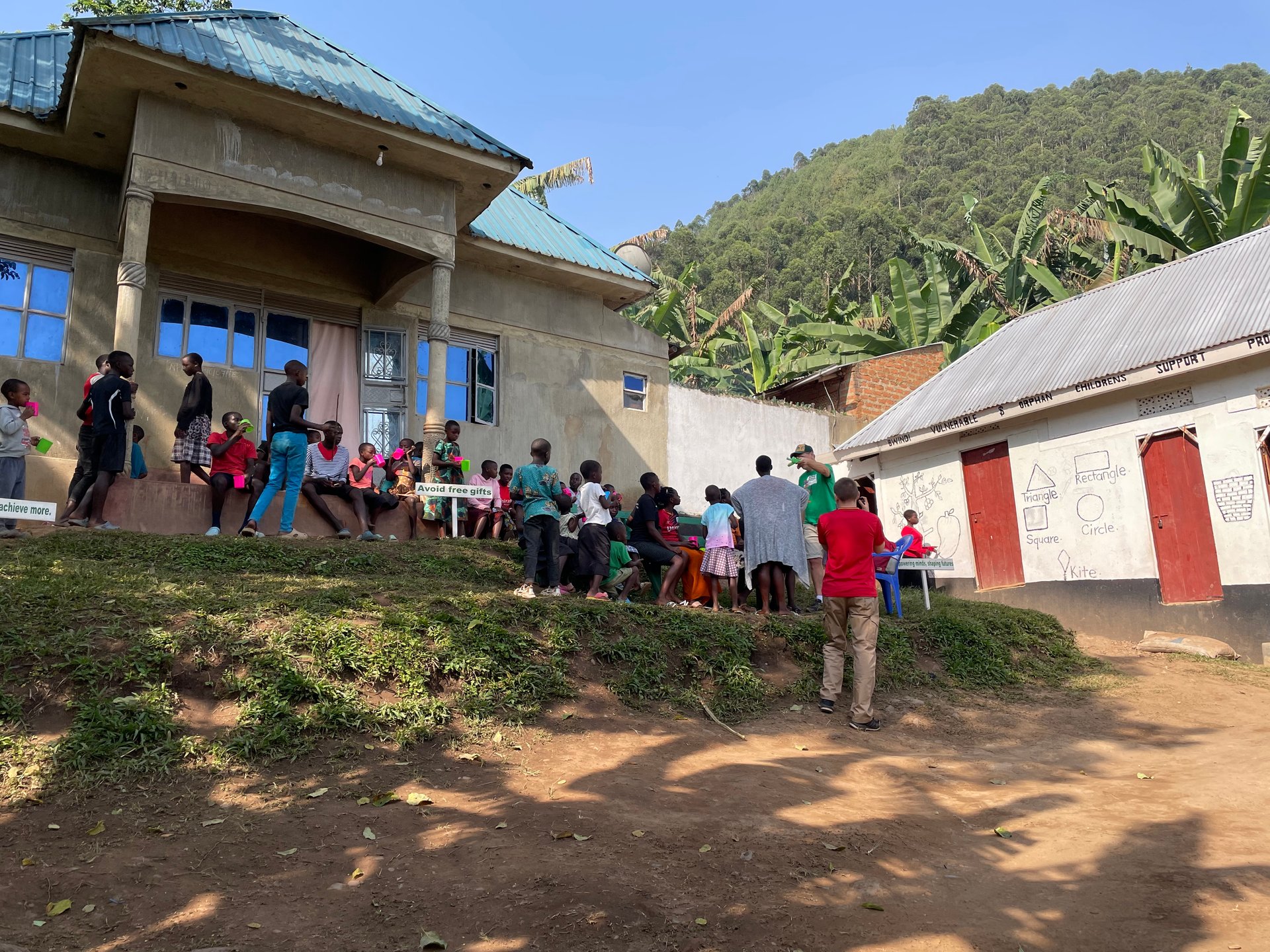
The orphanage is run by Nicholas, a pastor and one of the recognisable figures in Buhoma's small but active community. It sits within a few kilometres of where some of the most significant wildlife on Earth lives. The Bwindi gorillas — the mountain gorilla population of Bwindi Impenetrable National Park, accounting for more than half the world's remaining individuals — move through the forest whose edge begins at the park boundary behind the village. The gorillas do not appear in Buhoma. But the economy that surrounds them does.
What the Gorilla Economy Means on the Ground
Buhoma has been the northern gateway to Bwindi's gorilla trekking since 1993, when Uganda Wildlife Authority (UWA) opened the sector to visitors for the first time. In the decades since, the village has developed a full support infrastructure around that activity: accommodation ranging from community-run budget camps to mid-range lodges, craft cooperatives, a community health centre, an established primary school, and employment for rangers, tracking teams, guides, and porters.
UWA's community revenue-sharing programme returns a defined percentage of park entry fees to households in the boundary zone — a mechanism that makes conservation economically legible to communities who live alongside Bwindi's restrictions. For the families around Nicholas's orphanage, the gorilla trekking economy is not an abstraction: it is part of the economic logic that determines whether a school operates, whether water infrastructure gets built, whether there is a health worker available in the village.
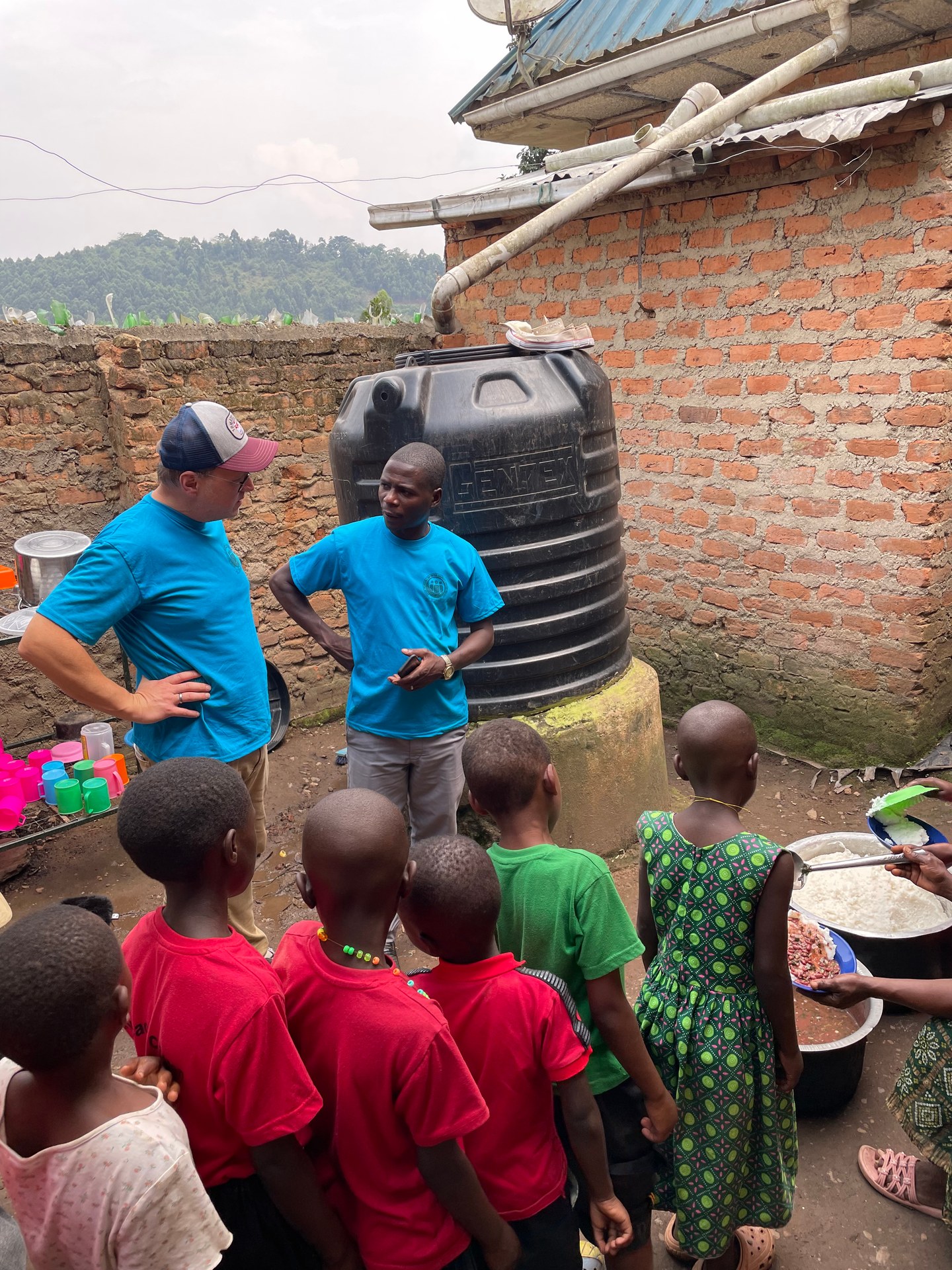
In January 2026, during the visit to the orphanage, several of the older children helped distribute the day's food — a combination of beans and potato porridge, prepared in the outdoor kitchen area beside the main building. The meal was straightforward; the distribution was organised; the children who received it ate quietly. It was unremarkable in the way that ordinary daily sustenance is unremarkable, which was itself the point. This is what functioning community infrastructure looks like in a place that has had thirty years of consistent, regulated tourism to build it.
Clinton: Selling Gorilla Paintings at Gorilla Bluff Lodge
Opposite the entrance to Gorilla Bluff Lodge in Buhoma, in January 2026, a seventeen-year-old named Clinton was selling paintings. The work was his own: hand-painted images of gorillas, forest scenes, and landscapes of the Bwindi area, displayed in a rack beside the road. Clinton had been selling there for some time. His goal, he said, was to become a tour guide.
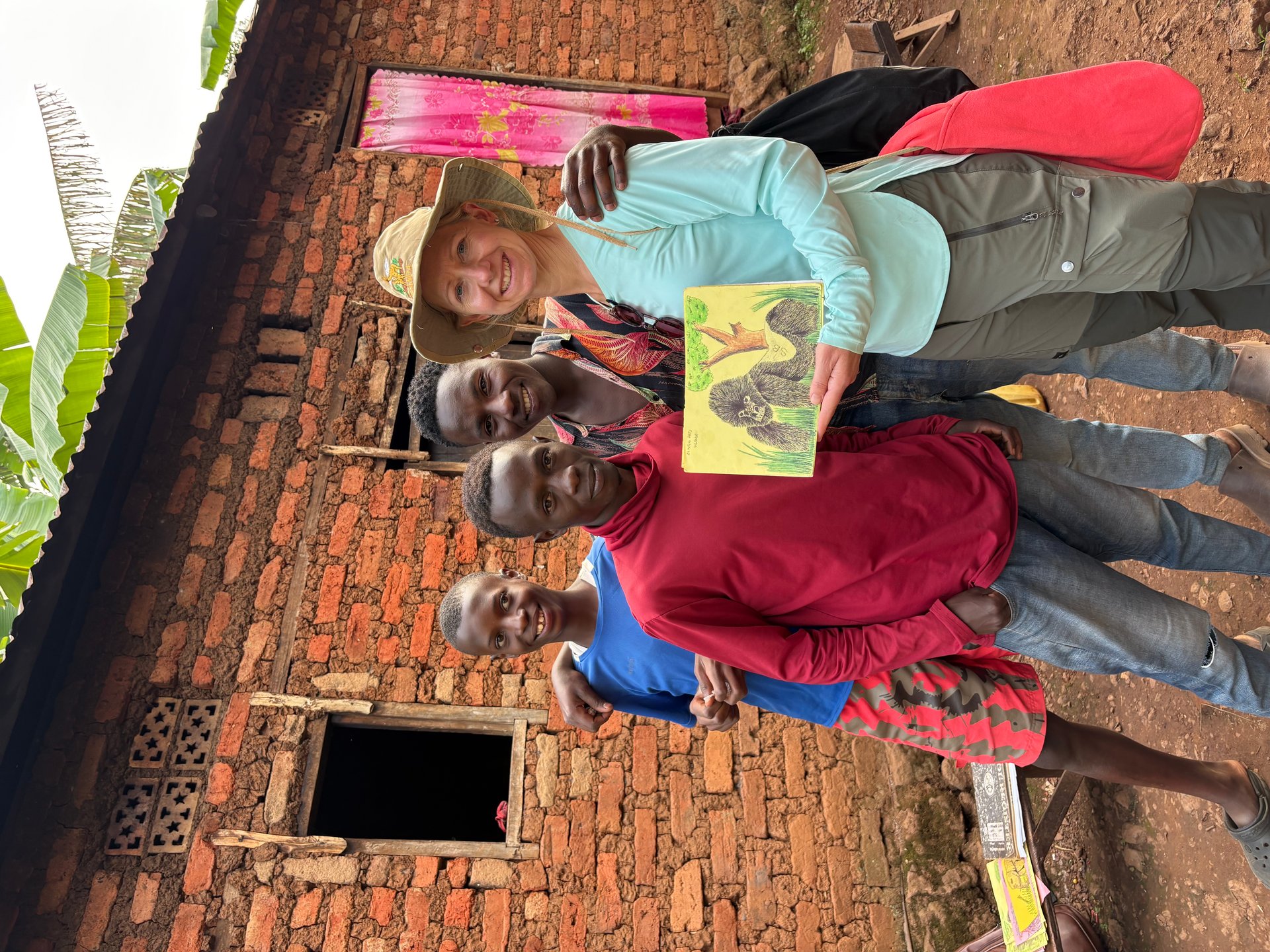
Clinton's paintings are entirely of gorillas. Every subject in his rack was drawn from the animal that brings visitors to Buhoma. He had never trekked to see the gorillas himself — the permit costs $800 — but he had grown up a few kilometres from where they live, and they are the most economically significant thing in his environment. His paintings are, in a precise sense, what the gorilla economy looks like at its most individual scale: one person, self-taught, producing work that would not exist and would find no market without the trekking visitors who pass through.
The informal sector around gorilla trekking — the craft sellers, the food stalls near the trailhead, the boda boda operators who carry luggage and occasionally tourists, the young men who wait near the sector headquarters for day labour — is not captured by UWA permit statistics or by official tourism numbers. But it represents the width of the economic footprint that gorilla tourism actually has in Buhoma. The United States was Uganda's largest source of international tourists in 2016, with 49,414 arrivals — and the primary draw for long-haul visitors from North America and Europe is gorilla trekking. Each of those visitors passes through communities like Buhoma. Some of them buy paintings from Clinton.
Bwindi's Biodiversity Beyond the Gorillas
Bwindi Impenetrable National Park is recognised as one of Africa's most biodiverse ecosystems. Its 331 square kilometres hold more than 120 species of mammals, over 350 bird species (including 23 Albertine Rift endemics), approximately 200 species of trees, and more than 100 species of ferns. Bwindi is classified as critical habitat for multiple endangered species beyond mountain gorillas — including the African forest elephant and the spectacled weaver. The forest is one of Africa's few ancient tropical rainforests, estimated to have existed continuously for over 25,000 years.
For most visitors, the gorillas are the sole reason to come to Bwindi. They are the flagship species — the animal that generates the permit revenue, funds the park staff, and gives the conservation programme its financial logic. But the conservation of Bwindi's gorilla habitat is simultaneously the conservation of a forest ecosystem that supports hundreds of other species, many of them endemic or globally threatened. The gorillas are what makes the ticket price legible; the biodiversity they inhabit is what the ticket price actually protects.
Bwindi is a listed UNESCO World Heritage Site, recognised for its exceptional biodiversity and for the mountain gorilla population specifically. This status adds an international governance layer to UWA's national protection framework, requiring Uganda to report on the state of the property and to maintain its outstanding universal value. In practical terms, this creates an additional disincentive to boundary encroachment or development that would degrade the forest — a protection that directly benefits every species in the park, including the gorillas and the communities whose economy depends on them.
Responsible Tourism at Bwindi: Waste, Compliance, and What Visitors Can Do
Uganda's National Environment (Waste Management) Regulations, S.I. No. 49 of 2020 — which entered into force with 109 regulations and 16 schedules — govern waste disposal practices across Uganda, including in and around protected areas. For visitors to Bwindi, this regulatory framework has practical implications.
Uganda banned single-use plastic bags in 2009. This applies to tourists as it does to residents. Arriving at Bwindi with plastic shopping bags will result in confiscation at the border — a rule enforced at national park entry points as well as at major road crossings from Rwanda. Carry reusable bags. Reusable water bottles are strongly preferred over single-use plastic; most lodges in the Buhoma area provide safe drinking water for refilling.
During the gorilla trek itself, the rule is straightforward: nothing enters the forest and nothing is left behind. No food is opened near the gorillas — respiratory disease transmission is the primary health risk to gorilla populations, but proximity to food waste also attracts animals to the boundary zone in ways that increase human-wildlife conflict. Rangers enforce this. Any waste generated at the trailhead goes into the designated bins at the sector headquarters before the trek begins. If you carry snacks in your daypack, finish them or put them away before the briefing.
Lodges and tented camps near Bwindi are required under S.I. No. 47 of 2020 to submit environmental compliance audits every three years, including waste management plans. When selecting accommodation, it is worth asking whether the lodge composts organic waste, what its solar or generator policy is, and whether it uses locally sourced food — not as a condition of booking, but as questions that reward properties doing the work of operating responsibly in a sensitive landscape.
The larger point is that responsible tourism at Bwindi is not a set of rules external to the experience — it is structurally identical to the experience. The regulations exist because the gorillas are genuinely vulnerable to respiratory disease from humans and to habitat degradation from unmanaged waste. The community revenue sharing exists because without a financial reason to conserve the gorillas, the forest boundary would face greater pressure. Clinton's paintings exist because tourists who take the experience seriously enough to pay $800 also tend to be the kind of visitors who buy a painting from a teenage artist at the side of the road. It is all the same system.