Norman Noel parks his motorcycle on the red-dirt verge outside Buhoma and talks about his plans the way men who live at the edge of extraordinary places often do — with matter-of-fact ambition and a long view. "If I can get a chance of getting a driving license, I will have to expand my business of driving. At least I advance from a motorcycle to a car. I meet my friends from USA, UK, Germany, everywhere. I start exploring Uganda as my dream for exploring." Norman has been riding boda-boda at the gate of Bwindi Impenetrable National Park long enough to know that tourism shapes everything here — jobs, income, even the question of whether the forest survives. He also knows what happens when it stops. "Uganda discovered a border case, and we as people here in Buhoma, we survive on tourism, and we have got a problem here. Tourists are few because of the Ebola, and as me, Norman, I was hustling... If I get money, I advance. I get from boda-boda, I join tourism, I also become like a tour guide. And I lack enough capital to start with, because I have no support at all."
That gap between aspiration and infrastructure — the motorcycle and the car, the generator and the solar panel, the grid that reaches Kabale but falters ten kilometres further west — runs through every practical question visitors ask about arriving at Bwindi Impenetrable National Park Uganda. What will the power be like at my lodge? Can I charge my camera? Is there hot water? These are not trivial questions when you have a 7:00 AM gorilla trekking briefing to wake for and a battery that drained overnight.
During visits to Bwindi in October 2024, January 2026, and June 2026, the picture that emerged was consistent: electricity near the park is available, but it works differently from what most visitors from Europe or North America expect, and understanding those differences makes the experience considerably smoother.
Uganda's Energy Mix: Hydropower at the Core
Uganda sits on one of the most significant freshwater resources in Africa. The Nile begins its journey northward from Lake Victoria, and the country has built its electricity generation system around that flow. Hydropower accounts for the substantial majority of Uganda's electricity generation, with major installations on the Nile at Jinja and Nalubaale providing the backbone of the national grid. Additional capacity comes from smaller run-of-river schemes, and the country has significant potential for further expansion.
The strength of this system is its renewability and low operating cost once infrastructure is in place. The vulnerability is its dependence on rainfall. Lake Victoria's water level fluctuates with the seasonal rains across its vast catchment basin. During dry years, reduced inflow constrains generation capacity, and the national grid operator responds with scheduled load shedding — rotating power cuts across regions. Western Uganda, including the towns and villages that serve as gateways to Bwindi, sits at the end of a long transmission line from the central grid, which means that voltage fluctuations and outages are more common there than in Kampala.
This is the grid reality that lodges near Bwindi Impenetrable National Park have had to work around, and most of them have done so by building independent energy systems rather than depending on what arrives down the line.
How Lodges Near Bwindi Handle Power: A Practical Comparison
There is a clear division in the energy approach of different accommodation types near Bwindi. Understanding where your lodge sits in this spectrum tells you what to expect when you arrive.
| Accommodation type | Typical power source | Reliability | Limitations |
|---|---|---|---|
| Budget guesthouse / community rest camp | National grid + generator backup | Moderate — grid outages possible | Generator may run on limited hours (evenings only) |
| Mid-range lodge | Solar + battery bank; grid supplement | Good — basic needs covered reliably | High-draw appliances (hair dryers) often restricted |
| Upmarket forest camp / tented lodge | Full off-grid solar with large battery capacity | Very good — independent of national grid | Charging may be centralised; no power-intensive appliances |
The pattern that emerges is counterintuitive to many visitors: the more remote and expensive the lodge, the more reliable its electricity tends to be. Upmarket camps in positions without grid access have invested heavily in photovoltaic systems precisely because they had no alternative. A lodge perched on a ridge above Nkuringo with no grid connection and a bank of lithium batteries will often deliver more consistent lighting and charging than a budget guesthouse in Buhoma that relies on a grid line that drops during storms.
What none of these properties reliably provide is electricity for high-draw appliances. Hair dryers, electric hair straighteners, and travel kettles are not appropriate for solar-powered lodge environments. Bringing these items and expecting to use them creates frustration and, at some properties, damages battery systems that are sized for low-consumption use. Pack light on electrical needs, and your experience will be smooth.
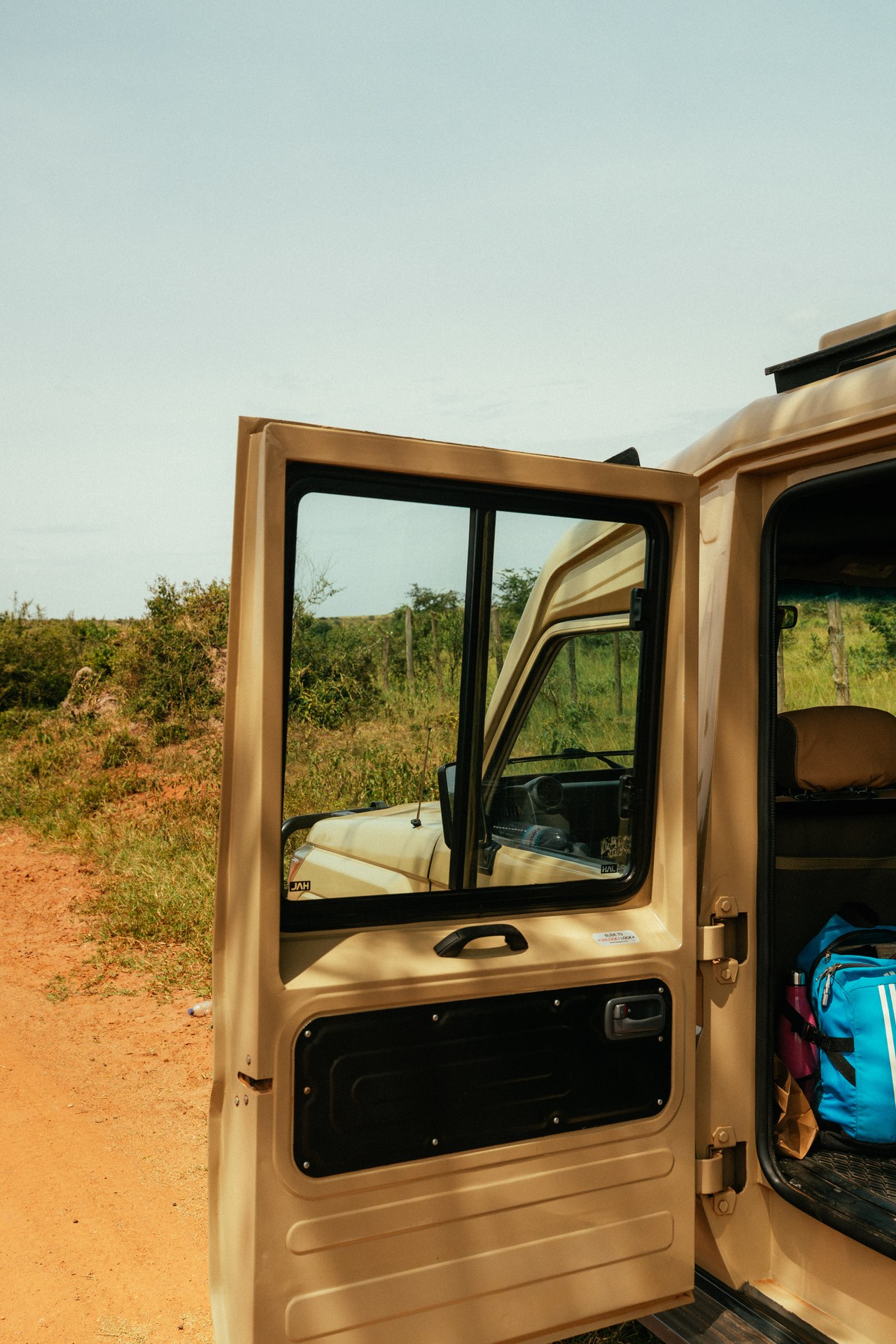
Open safari door: into the Ugandan wilderness
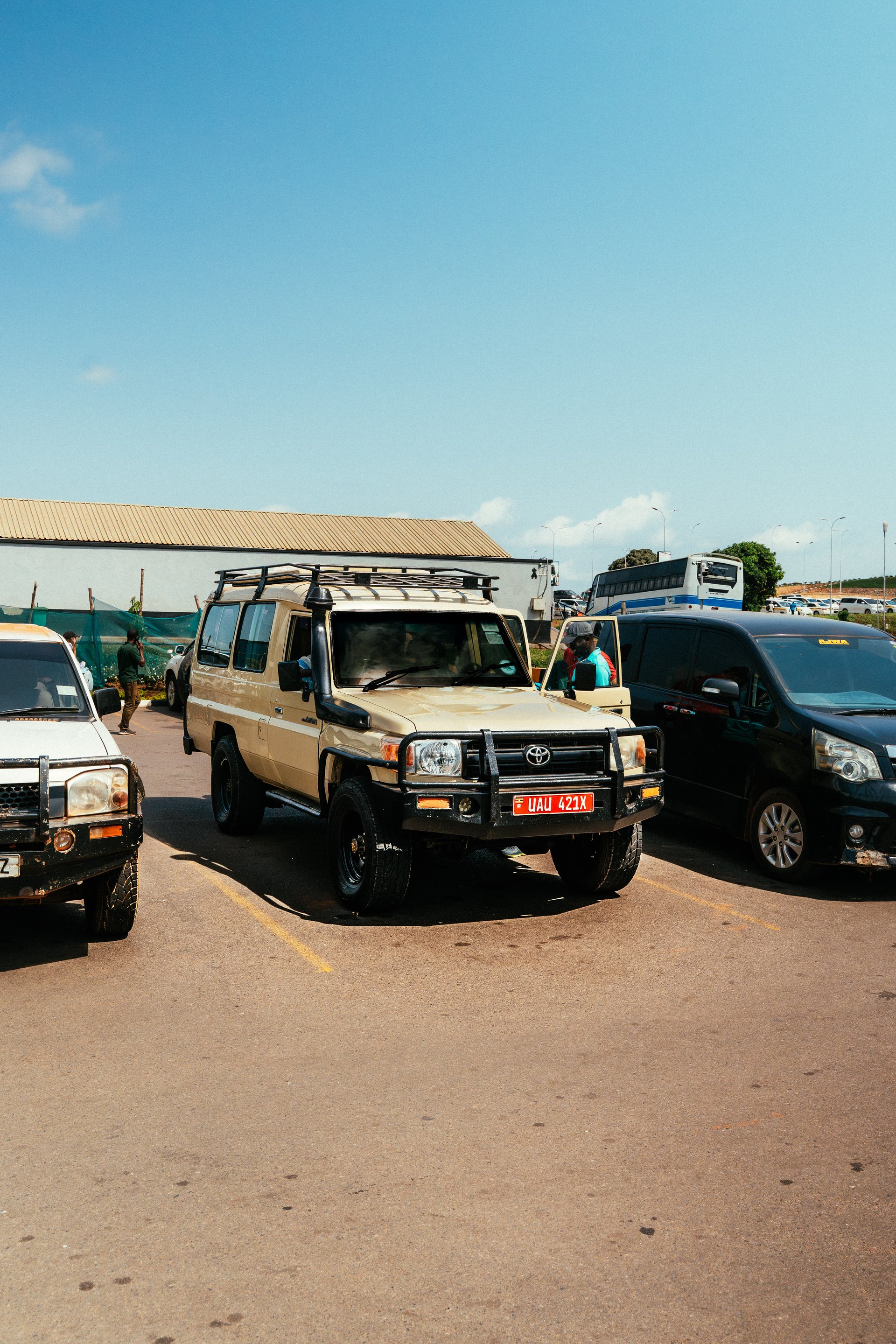
Toyota Land Cruiser Safari Vehicle Parked in Ugandan Lot
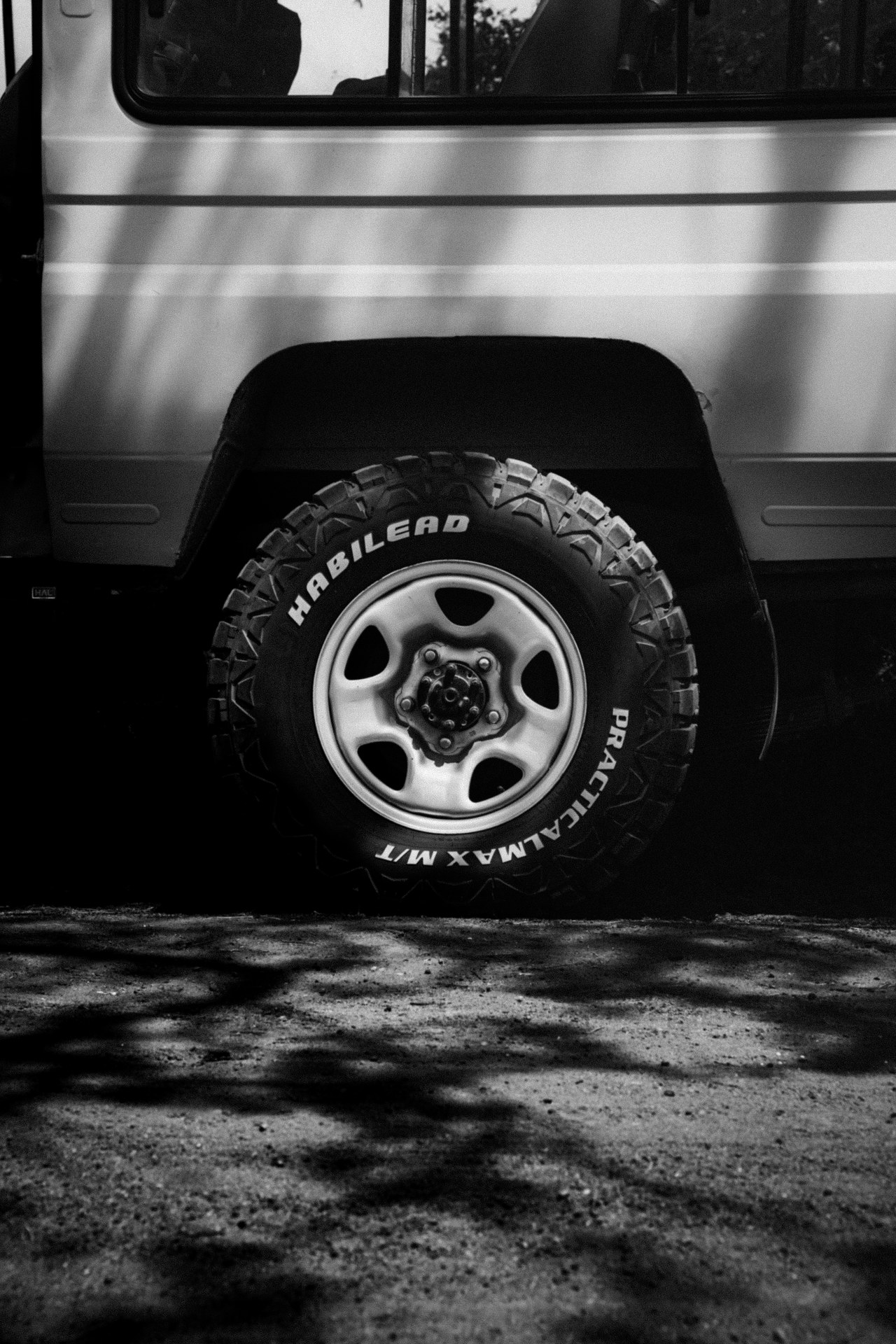
Off-road tyres in the shadow of a safari bus
Solar Power and Gorilla Conservation: The Connection
The energy question near Bwindi Impenetrable Forest National Park Uganda is not merely logistical. It is woven into the conservation challenge that defines this landscape. The communities living on the park's boundary — in villages like Buhoma, Nkuringo, Rushaga, and Ruhija — depend on biomass energy for cooking and heating. Firewood collection and charcoal production are the dominant household energy sources, and this dependency creates ongoing pressure on the forest edge.
When households gain access to affordable electricity, the incentive to harvest wood from near the park boundary decreases. Conservation organisations working around Bwindi have recognised this link and some distribute solar cookers and subsidised solar panels to households in the buffer zone communities. Reducing firewood collection directly reduces the human pressure on the habitat that supports the mountain gorilla population. Energy access, in this context, is a conservation intervention.
For travellers, understanding this connection adds dimension to the experience. When your upmarket lodge runs entirely on solar and heats your water from the sun, that is not just a marketing convenience — it reflects a broader shift in how this landscape is managed. Lodge operators who have invested in solar infrastructure typically extend that thinking to other sustainability practices, and many partner directly with community energy programmes around the park.
Practical Advice for Travellers: Power at Bwindi
Arrivals into southwestern Uganda typically come through Kabale, the regional town four to five hours from Kampala by road. Kabale is on the national grid and has reliable enough power for hotel stays and resupply, though short outages do occur. Banks, ATMs, and phone charging shops in Kabale operate normally. This is the right place to charge everything before heading further into the mountains toward the park.
Once at your lodge near Bwindi, the practical rules are straightforward. Charge camera batteries, phones, and headlamps on the first evening and again each time you return from a trek. Do not wait until the morning of the trek to discover that a device did not charge overnight. Ask lodge staff whether there is a centralised charging station or whether in-room sockets are available, and confirm what hours power is available if the lodge uses a generator rather than solar.
A portable power bank with sufficient capacity to charge a smartphone twice is strongly recommended. On a gorilla trek, you will be in the forest for anywhere between two and eight hours, and conditions can include rain, mud, and steep terrain that makes every piece of equipment work harder. A power bank means that even if your morning charge was interrupted, you go into the forest with a full phone battery.
Uganda uses Type G plugs, the same three-pin standard as the United Kingdom. Travellers from continental Europe, the United States, or Australia will need a universal adapter. The voltage is 240V, which is compatible with most modern electronics that support 100–240V input (check the label on your charger). Voltage regulators are not generally necessary for standard travel electronics.
Staying in January 2026 and again in June 2026, the solar systems at mid-range and upmarket lodges near Buhoma and in the southern sectors performed consistently. Room lights, USB charging, and electric showers were available without interruption. The one exception was during an overcast period in January when a tented camp recommended using the central charging lounge rather than tent sockets, to conserve battery capacity. That kind of communication from lodge staff is the norm rather than the exception — properties that operate well-designed solar systems understand their own capacity and manage guest expectations accordingly.
Road Infrastructure and Getting There: The Energy of Movement
The journey to Bwindi Impenetrable National Park Uganda is itself a study in Ugandan infrastructure. Uganda has roughly four passenger cars per thousand inhabitants, among the lower ratios in East Africa, which means road transport is dominated by motorcycles, minibuses, and trucks. Norman Noel's boda-boda is the default short-distance transport for Buhoma village and the immediate surrounds. For journeys to Kabale or the trekking trailheads, visitors typically use lodge vehicles or hired 4x4s.
The road from Kabale to Buhoma is paved for most of its length but transitions to unpaved sections approaching the park. The southern sectors at Rushaga and Nkuringo are accessed from Kisoro, which also has a generally good paved connection to Kabale but rougher final approaches. In the wet season — April through May and October through November — these final unpaved stretches require high-clearance 4x4 vehicles. Self-drive visitors should confirm road conditions with their lodge before setting out from Kabale, particularly after heavy overnight rain.
Uganda's air network provides an alternative. Charter flights operate between Entebbe and small airstrips at Kihihi (for the northern sectors) and Kisoro (for the southern sectors), reducing the travel time from Kampala from five to eight hours by road down to approximately one hour in the air. For visitors combining Bwindi with other parks or Rwanda, the airstrip option is often worth the cost. Ground fuel availability at these airstrips is managed by the operators, so visitors on fly-in packages do not need to concern themselves with it separately.
Frequently Asked Questions
Related Articles
Travel Overview: Planning Your Bwindi Visit
Where to Stay Near Bwindi National Park
Climate Change and Conservation at Bwindi
How to Reach Bwindi National Park
Gorilla Trekking Permits: How to Book
Packing for Bwindi: What to Bring
Bwindi in the Low Season
Western Uganda: Attractions and Regions