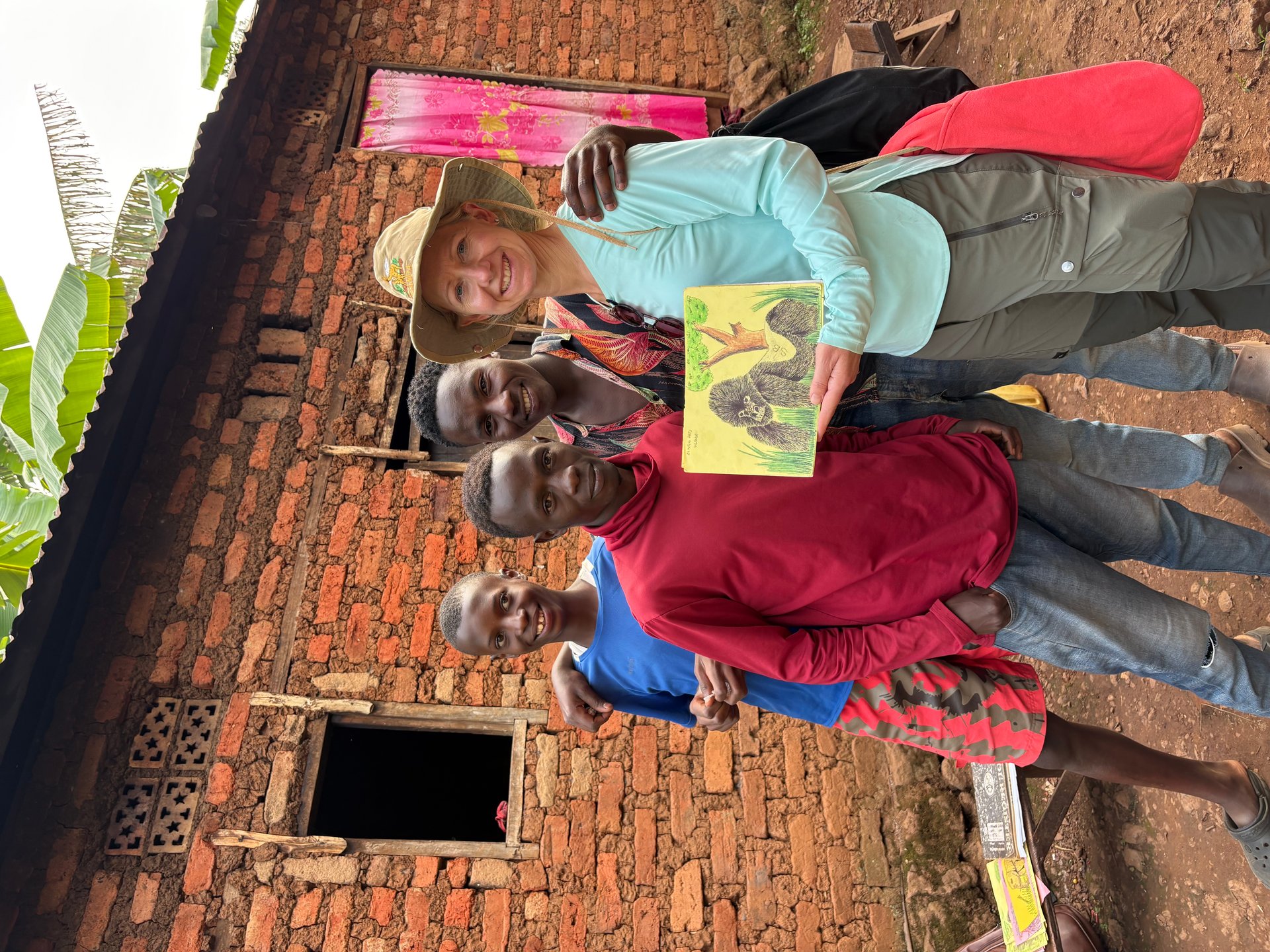
The evening before our Bwindi gorilla trek, on the street outside Gorilla Bluff Lodge in Buhoma, we met Clinton. He was 17, standing on the pavement with a small stack of hand-painted pictures — gorillas, forest scenes, village life — selling them as he did most days. His father had died and he was the main earner for his mother, two brothers, and a younger sister with a disability. His dream, he told us, was to become a tour guide. He spoke English carefully and well. We bought a painting. I thought about it the next morning, somewhere in the middle of the forest, while watching a large gorilla sit in a tree and eat leaves with no particular concern for our presence forty metres below.
The encounter with the Bwindi gorillas and the encounter with Clinton are part of the same story. Neither makes complete sense without the other. Clinton's painting of a mountain gorilla has value in the first place because the real animals exist sixty metres up the hill, accessible to paying visitors, protected by a system that channels permit fees into ranger salaries and community revenue that partly reaches households like his. This is not a hypothetical chain. It is the operational reality of gorilla conservation at Bwindi, and the full-day experience of being a visitor at Buhoma — from evening arrival to post-trek afternoon — makes this chain visible in ways that no conservation report quite captures.
This account covers the experience as it actually unfolds: what happens the evening before, the morning briefing, the walk into the forest, the hour with the gorillas, and what the afternoon in Buhoma looks like afterwards. It draws on visits in January 2026, with GPS-verified photographs taken at the trailhead (GPS -0.9762°N, 29.6282°E) and at the gorilla location (GPS -0.9735°N, 29.6281°E).
The Evening Before: Buhoma as a Village
Most guides to gorilla trekking at Bwindi begin with permit logistics. The experiential reality begins earlier — specifically, with arriving in Buhoma the afternoon before your trek and walking around the village for an hour.
Buhoma is a working village, not a tourist enclave. The road running through it connects the Uganda Wildlife Authority headquarters and ranger post to a loose collection of lodges, small shops, boda-boda stages, and community facilities. Children walk home from school, women carry produce from the market, boda-boda drivers wait for passengers. The tourist presence is entirely visible — there are no illusions about what brings outside money here — but the village functions independently of it and has done for generations.
The evening street is where the informal economy of gorilla tourism is most directly visible. Young people like Clinton position themselves outside the main lodges with paintings, carvings, beadwork, and other items that connect, however loosely, to the gorilla imagery that visitors come to see. Clinton's paintings were careful and detailed — animals from the forest, the landscape of the Bwindi ridge — the work of someone who had been practising. His English was functional and confident. When he said he wanted to be a tour guide, he did not say it tentatively. He said it the way people state a plan they have thought through.
The morning routine at Gorilla Bluff Lodge reinforces the same sense of the village functioning at its own pace. Coffee and African Tea arrived on the room terrace at first light — a quiet ritual looking out over the tree canopy, the forest audible below. The Gorilla Bluff Lodge is built into the steep hillside; the path from guest rooms to the main building descends a timber staircase cut directly into the slope, the kind of practical construction that steep, forested mountain terrain requires. By 07:00 the light was already on the ridge opposite. By 07:30 we were driving the short distance to the UWA headquarters for the briefing.
The Morning Briefing: What UWA Tells You Before You Enter the Forest
The morning briefing at the UWA Buhoma headquarters starts at 08:00 and lasts around thirty minutes. All permit holders for that day gather in an open-sided briefing structure near the main ranger post. A senior ranger leads the session in English.
The content covers: the seven-metre minimum distance from the gorillas, the prohibition on flash photography, the requirement to whisper and to turn away from the animals if you need to cough or sneeze, what to do if a silverback charges (crouch, avoid eye contact, do not run), and the hand signals the lead ranger will use during the walk. The briefing also covers health requirements — anyone visibly ill with respiratory symptoms is turned back, because mountain gorillas share approximately 98 per cent of their DNA with humans and are susceptible to human respiratory pathogens.
At the briefing, the day's groups are finalised: the ranger team will have already received that morning's tracking report from the trackers who entered the forest before dawn to locate where each gorilla family has moved since its previous evening's nesting site. Buhoma has three habituated gorilla families: Mubare (the first habituated group in Uganda, established in the early 1990s), Habinyanja, and Rushegura. Eight visitors per family, per day, is the hard limit. You will be told which family you will trek to and an approximate estimate of distance. The estimate is usually honest about its uncertainty — gorillas move, and the number the ranger gives is based on the previous evening's location.
Porters are available at the trailhead if you have not arranged one at the lodge. On our January 2026 trek from Buhoma, we were accompanied by a lead guide, two armed UWA rangers, and a porter. The rangers were armed — rifles visible, standard UWA protocol — but their manner was entirely professional and calm. The weapons serve two purposes: wildlife encounters (forest elephants and buffaloes share the same terrain) and, as a historical legacy of the park's security history, a general deterrent function. Within twenty minutes of entering the forest the armed escort stopped feeling unusual.
The Forest Walk: An Hour Inside the Impenetrable
The trail from the Buhoma sector trailhead into Bwindi Impenetrable National Park is steep from the first steps. The vegetation closes around you quickly — the "impenetrable" designation is literal in the undergrowth, which is densely layered with ferns, vines, and low shrubs that fill every gap between the trees. The trail itself is cleared and maintained; without it, moving through this forest at any pace would require cutting.
The rangers move quietly and efficiently, reading the forest as they go — occasional signs of gorilla presence (bent vegetation, knuckle prints in soft soil, the smell of a nearby group) that the trackers will have radioed in as the morning progressed. The group's role is to follow and to keep up. The conversation, such as it is, stays in whispers. The forest is loud: birds, insects, the drip of moisture from the canopy, the deep sounds of something large moving in the undergrowth ahead.
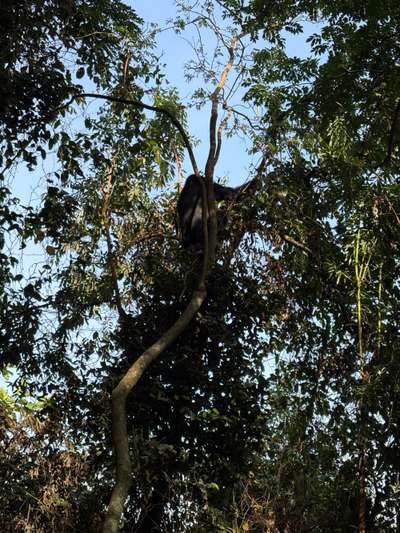
On our January 2026 trek, the first gorilla family appeared after approximately one hour of walking. Not dramatically — there was no announcement, no pause for effect — the ranger stopped, pointed upward, and there was a large male sitting in the canopy of a substantial tree, eating leaves methodically, at GPS coordinates -0.9735°N, 29.6281°E. He was perhaps fifteen metres above us and perhaps eight metres horizontal distance — well within the seven-metre rule, which is why the rangers positioned the group carefully and began timing. The gorilla was entirely unbothered. He ate, shifted position, ate again.
The sensation of proximity is genuinely difficult to describe. The animals are large — a mature silverback weighs 160 to 200 kilograms — and the scale does not register properly until you are underneath one looking up. They smell distinctly, a rich animal scent that is unlike anything in a zoo because it is mixed with the forest and the damp soil. The gorillas, for their part, show a studied indifference: awareness of the group's presence but no agitation, no flight, no display unless provoked by movement that the ranger will prevent before it happens.
The Hour with the Gorillas: What Actually Happens
The one-hour limit is strictly enforced — the lead ranger starts a timer when the first gorilla is found and calls time when the hour ends, regardless of what the animals are doing. This is a conservation rule, not a visitor services rule. Extended daily contact beyond the managed protocol has measurable effects on gorilla behaviour, feeding patterns, and social dynamics. The discipline of the limit is part of what makes the encounter possible at all.
What you see during that hour depends entirely on what the family is doing. On the January 2026 visit, the group we found was feeding — the large male in the tree, several other individuals visible in the understorey below, including younger animals whose movements were more energetic than the adults. A juvenile moved through a patch of low vegetation at ground level, pulling at stems. Another sat and watched the watching humans with what looked like mild curiosity and then turned away. There was no dramatic event. There rarely is. The extraordinary quality of the encounter is precisely that it is ordinary from the gorillas' perspective: these are animals going about their morning, and you are a briefly tolerated but irrelevant feature of it.
The mountain gorilla's situation is unusual among the world's great apes. There are approximately 1,000 mountain gorillas globally — 459 of them in Uganda (source: National Status of the Environment Report 2024, 2018–2020 census) and the remainder in the Virunga Massif shared between Rwanda and the DRC. For comparison, Western Lowland Gorillas number approximately 361,000 individuals distributed across six countries in western and central Africa. The rarity of the mountain gorilla — roughly 0.27 per cent of all gorillas on Earth — is what makes the encounter at Bwindi consequential in a way that few wildlife experiences match.
Mountain gorillas have never survived in captivity. Unlike Western Lowland Gorillas, which are present in zoological collections worldwide, mountain gorillas exist only in the wild — in Bwindi, in the Virunga Massif, and nowhere else. The habituated families at Buhoma are therefore not a managed zoo population visited in a forest setting; they are genuinely wild animals whose continued existence depends on the functioning of a conservation and tourism system that the permit fee directly funds.
When the ranger calls time at sixty minutes, the walk back to the trailhead follows the same path through the forest. It is faster — downhill, the sense of purpose resolved — but the forest still deserves attention. By the time the trailhead reappears, the combination of the physical effort and the encounter has produced something like a reset of perspective. The drive back to the village happens in relative quiet.
The Afternoon in Buhoma: The Nicholas Home Orphanage
After the trek, the conventional advice is to rest and drive out the next morning. A better use of the afternoon is to stay in Buhoma and visit the Nicholas Home orphanage, which is located within the village, a short walk from the lodge accommodation.
The Nicholas Home does not look large from the road. The main building has three rooms, electricity, and no running water; there is an attached structure with a dormitory and office. Because indoor space is limited, most of the day's activities happen outside on the sandy courtyard: meals, homework, games, the general organisation of children's time. On the afternoon of our January 2026 visit, a group of teenagers was gathered in the yard — some posing with the exaggerated confidence that photographs invite, some watching more cautiously, most simply going about what they were doing before visitors arrived. Smartphones are not common among Buhoma's young people, and a camera attracts attention as a novelty.
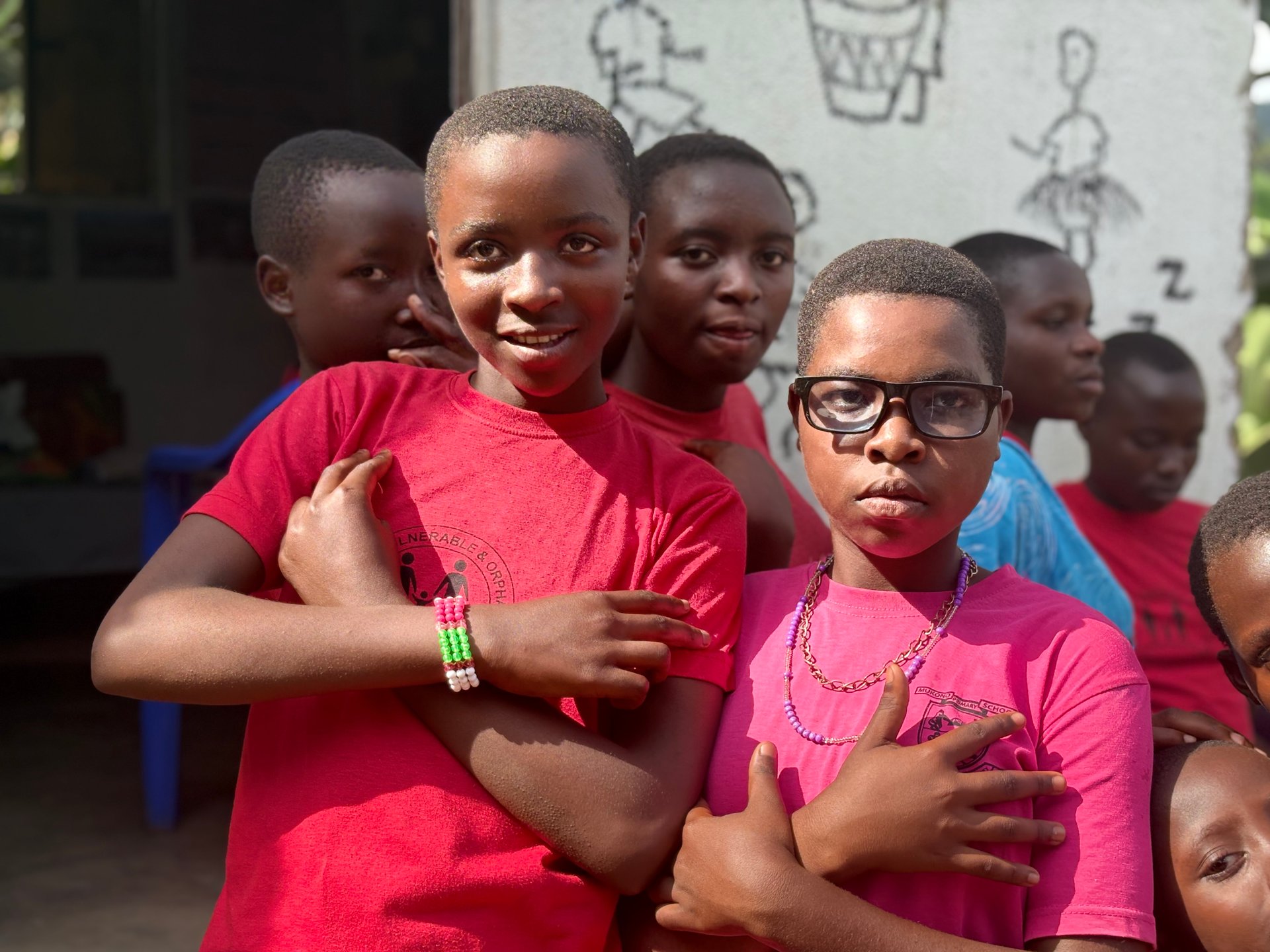
The Nicholas Home is a working facility in a resource-constrained environment. The connection to gorilla tourism is indirect but real: the same economic activity that employs guides, rangers, lodge staff, and porters, and that gives Clinton a market for his paintings, also funds the community revenue-sharing programme that supports facilities like this. When 10 per cent of national park entry fees flow back to boundary communities under the Uganda Wildlife Act, some portion of that reaches schools, health centres, and community projects in parishes adjacent to Bwindi. The orphanage is not a beneficiary of gorilla tourism in the direct sense that a lodge employee is — but the two are part of the same economic ecosystem.
Visitors who stop at the Nicholas Home can bring practical items: notebooks, pens, soap, dry food staples. A small financial donation to the facility is more useful than purchasing crafts from the premises, since it reaches the orphanage directly. The facility does not have a regular income stream from tourism — it depends on irregular donations from passing visitors and from development organisations.
[QUOTE: Nicholas Home staff member on what a typical week looks like and what the children most need]
Uganda's Biodiversity: Why Bwindi's Gorillas Are the Flagship
The gorillas at Bwindi sit at the apex of an extraordinarily rich ecosystem. Uganda is one of the most biodiverse countries on the African continent, holding a disproportionate share of the continent's species in a relatively small territory. Bwindi Impenetrable National Park alone records 347 bird species — including 23 Albertine Rift endemics found nowhere else on Earth — more than 200 tree species, 120 species of mammals, and 310 butterfly species within its 321 km².
Bwindi is a critical component of Uganda's biodiversity estate, anchored within the Albertine Rift — the western arm of the East African Rift System, which is recognised as one of the most species-rich regions on the African continent. The Albertine Rift endemic species — birds, plants, fish, primates — exist nowhere outside this narrow north-south corridor, and Bwindi holds a significant proportion of them within a single protected area.
Mountain gorillas are the flagship species for this entire ecosystem: the charismatic, photogenic, emotionally compelling animal that generates the permit revenue, the international attention, and the political will to maintain the park boundary and fund the ranger force. Everything in Bwindi's 321 km² benefits from the conservation infrastructure built around the gorillas — the 347 bird species, the forest elephants, the chimpanzees, the endemic plants — because the permits that pay for gorilla rangers also pay for the patrol infrastructure that protects them all.
Uganda's non-resident visitors are predominantly from Africa itself: approximately 78.1 per cent of arrivals come from other African countries, reflecting Uganda's position as a regional destination alongside its international wildlife tourism profile. Bwindi's gorilla trekking, priced at USD 800 per permit, draws primarily from the international high-value segment — the 21.9 per cent of non-resident visitors who generate a disproportionate share of tourism revenue. Both streams matter: the regional visitors sustain urban tourism infrastructure, and the international visitors fund the national park operations.
The connection between the gorilla in the tree, Clinton on the pavement with his paintings, and the teenagers in the orphanage courtyard is not metaphorical. It is a functional economic chain that conservation tourism at its best creates — and that the full day at Buhoma makes tangible in a way that a permit-and-trek alone cannot.