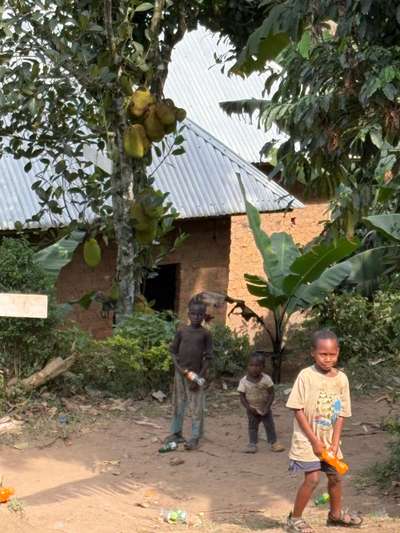
The children from the neighbourhood around the orphanage in Buhoma were slightly shy when they appeared that morning. Three of them, standing in front of a simple mud building with a corrugated iron roof — their clothes worn, their posture carrying a quiet kind of weight. During my visit to Bwindi in June 2026, GPS still active on my camera from the walk through the village at coordinates -0.9617°N, 29.6109°E, it took less than a moment to understand that the right response was a simple one: we invited them to sit down and eat with us.
That morning also happened to be the morning before a gorilla trek. The contrast between the hour spent with those three children and the hour later spent watching a silverback feed twenty metres away in the forest underscores something true about Bwindi as a place: the gorillas and the people who live alongside them are both part of the same landscape, and neither story can be told honestly without the other.
This is an attempt to tell both stories — a portrait of mountain gorilla life and behaviour set inside the full reality of the place where it happens. It draws on nine visits to the Bwindi area, the most recent GPS-verified at -0.9617°N, 29.6109°E on June 21, 2026.
Mountain Gorillas in Bwindi: The Last Forest Stronghold
Bwindi Impenetrable National Park holds one of the most significant concentrations of mountain gorillas anywhere on earth. Unlike many wildlife destinations where animals move across open savannah, Bwindi's mountain gorillas live in dense montane rainforest rising from around 1,160 to 2,607 metres above sea level. This forest is genuinely impenetrable in stretches — a tangle of ancient hardwoods, hanging vines, ferns, and moss-covered boulders that has remained ecologically intact for millennia.
What distinguishes Bwindi from every other protected area in the world is a single biological fact: it is the only place where mountain gorillas and chimpanzees share the same habitat. This overlap of two great ape species in one ecosystem is ecologically extraordinary. Uganda's mountain gorilla population stood at 459 individuals between 2018 and 2020, representing a meaningful share of the entire global population of the subspecies.
The mountain gorilla as a subspecies is geographically restricted to two areas: the Virunga volcanic massif shared between Uganda, Rwanda, and the Democratic Republic of Congo, and Bwindi. Conservation programmes operating across these borders — most notably the International Gorilla Conservation Programme — have worked for decades to stabilise and gradually increase the population. Bwindi received its UNESCO World Heritage Site designation in recognition of both its biodiversity and its irreplaceable role in the survival of a species that came close to disappearing entirely in the twentieth century.
Uganda Wildlife Authority manages the national parks under the broader framework of the Tourism Development Programme. The country maintains twelve national parks and three active game reserves, with mountain gorilla viewing standing as the flagship wildlife product that defines Uganda's international tourism identity.
A Portrait of Mountain Gorilla Society
Mountain gorillas live in stable family groups, typically ranging from five to thirty individuals, structured around a dominant silverback male. The silverback's authority rests not on constant aggression but on experience, reliability, and physical presence built over years of leadership. Younger males — known as blackbacks — remain in the group until they are old enough to either challenge the silverback or disperse to form their own families.
Females form the social core of gorilla life. They choose their silverback based on his demonstrated capacity to protect the group, and they invest heavily in each offspring. A mountain gorilla female typically gives birth for the first time between the ages of ten and twelve. She will raise only a small number of young over her lifetime, and infant mortality remains a genuine constraint on population growth — which is precisely why every individual in a population of 459 carries demographic weight.
Bwindi's habituated gorilla families are distributed across the park's four trekking sectors and vary considerably in size and character. The Rushegura group, based in the Buhoma sector, comprises around fifteen individuals. The Nkuringo group — opened for tracking in 2004 in the area south of Buhoma — has around fourteen members, though this family is notable for spending more than seventy percent of its time outside the national park boundary, on surrounding agricultural land, which creates particular challenges for both crop protection and disease transmission management. Bitukura, in the Ruhija sector, has eleven members and opened to visitors in December 2008. The Nshongi group, with seven members, opened in September 2009 near Rushaga in the southern sector. Each family is monitored daily by a dedicated team, and individual animals are identified through nose-print records — the unique wrinkle patterns on the nasal ridge that serve as a biological fingerprint.
The daily rhythm of a gorilla family is shaped entirely by the forest. The majority of waking hours are spent foraging — moving through a home range in search of leaves, stems, roots, bark, and occasional fruit. Unlike chimpanzees, mountain gorillas rarely climb into the high canopy; they spend almost all their time at ground level or in the lower shrub layer. As afternoon fades, each individual bends branches and leaves into a fresh sleeping nest, and the family settles in before dark.
Vocalisations carry significant social information. The chest-beating display of a silverback — a rapid, hollow drumming produced with cupped hands — is perhaps the most recognisable, carrying through the forest to signal both dominance and territorial boundaries. Gorillas also use soft belch vocalisations to communicate contentment during feeding, and a range of grunts and screams to signal alarm or social tension. Every habituated individual is identified by rangers using nose print records — unique wrinkle patterns on the broad nasal ridge, documented in monitoring files built up over years of observation.
The genetic closeness of mountain gorillas to humans — sharing well over ninety percent of DNA sequence — is made tangible in the encounter. Their hands are recognisably hands. The way a mother watches her infant, or the way a juvenile tests the patience of an adult male, reads across the species boundary without difficulty.
The Trekking Experience: Three Hours Into the Forest
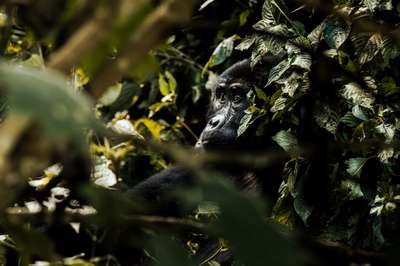
After three hours of walking through Bwindi's forest, the moment of encounter arrives without ceremony. During my visit in June 2026 — GPS coordinates confirmed at -0.9617°N, 29.6109°E — our small group moved quietly through dense undergrowth before the ranger tracker stopped and pointed. Through the layered foliage, a mountain gorilla looked directly back at us.
The encounter lasted approximately one hour, the standard permitted time with a habituated family. The gorillas paid minimal attention to the human observers. A juvenile played in the branches overhead. The silverback sat and fed, occasionally casting an appraising glance before returning to his vegetation. The closeness was extraordinary: at moments the animals were within a few metres, separated only by the natural spacing of the forest floor.
“[Quote from local Bwindi ranger or tracker guide on what he watches in the gorillas' body language before leading the group forward to close the distance — to be collected on next visit.]”
All trekking at Bwindi begins from one of the park's four sectors — Buhoma, Rushaga, Ruhija, and Nkuringo — and requires a valid permit purchased through Uganda Wildlife Authority. Permits exist specifically to cap the number of visitors a habituated family receives each day, protecting gorillas from disease transmission and behavioural disruption. Groups are limited to eight visitors per family per day, accompanied by a ranger guide and a dedicated tracker team.
The walk itself varies substantially by sector and by where the gorilla family slept the previous night. Gorillas do not return to the same location; they follow food availability within their home range. Some treks require less than an hour; others demand four to five hours of physically demanding movement on steep, muddy trails. The difficulty is honest and worth knowing before arrival: Bwindi is a mountain rainforest, and the terrain is uneven, slippery, and sometimes very steep even during the dry season. The reward at the end of the walk is in direct proportion to the effort the forest demands.
Conservation Numbers and the Role of Tourism Revenue
The argument for gorilla trekking as a conservation mechanism rests on a straightforward principle: the revenue generated by visitors who pay to spend an hour with a habituated family funds the rangers, infrastructure, and anti-poaching operations that keep the population alive. The relationship between permit income and gorilla survival is direct and documented.
Visitor numbers to Uganda's national parks rose 41 percent between 2009 and 2013, growing from 151,818 to 213,950 visitors annually. Of those visitors, 47 percent were foreign non-residents — precisely the category most likely to purchase gorilla trekking permits at the premium rate charged to international tourists. This revenue stream flows from permit sales through the Uganda Revenue Authority and into park management budgets.
The habituation process that makes trekking possible takes years. A gorilla family is considered habituated when it can be approached to within a safe and non-disruptive distance without displaying flight or defensive behaviour. Uganda Wildlife Authority currently manages multiple habituated families across Bwindi's four sectors. A separate product — the Gorilla Habituation Experience — allows a small number of visitors to spend four hours with a family still in the habituation process, functioning as a research-adjacent permit that generates additional revenue while contributing to the monitoring record.
The Dian Fossey Gorilla Fund International, the International Gorilla Conservation Programme, the Frankfurt Zoological Society, and the Jane Goodall Institute represent the international conservation architecture that has supported mountain gorilla protection across Uganda, Rwanda, and the Democratic Republic of Congo for decades. This cross-border coordination is essential: gorilla home ranges do not respect national boundaries, and a population of 459 individuals distributed across two countries requires monitoring and protection frameworks that operate at the landscape scale.
Conservation is not only about what happens inside the park. The forest immediately surrounding the protected area matters equally, and so does the relationship between the park administration and the communities living on its boundary. Revenue-sharing arrangements that return a percentage of park income to surrounding communities — funding schools, health facilities, and local infrastructure — form a structural part of the long-term protection model. Without genuine local benefit, pressure on the forest from agriculture, charcoal production, and opportunistic poaching would be significantly harder to manage.
Bwindi and Its Bordering Communities
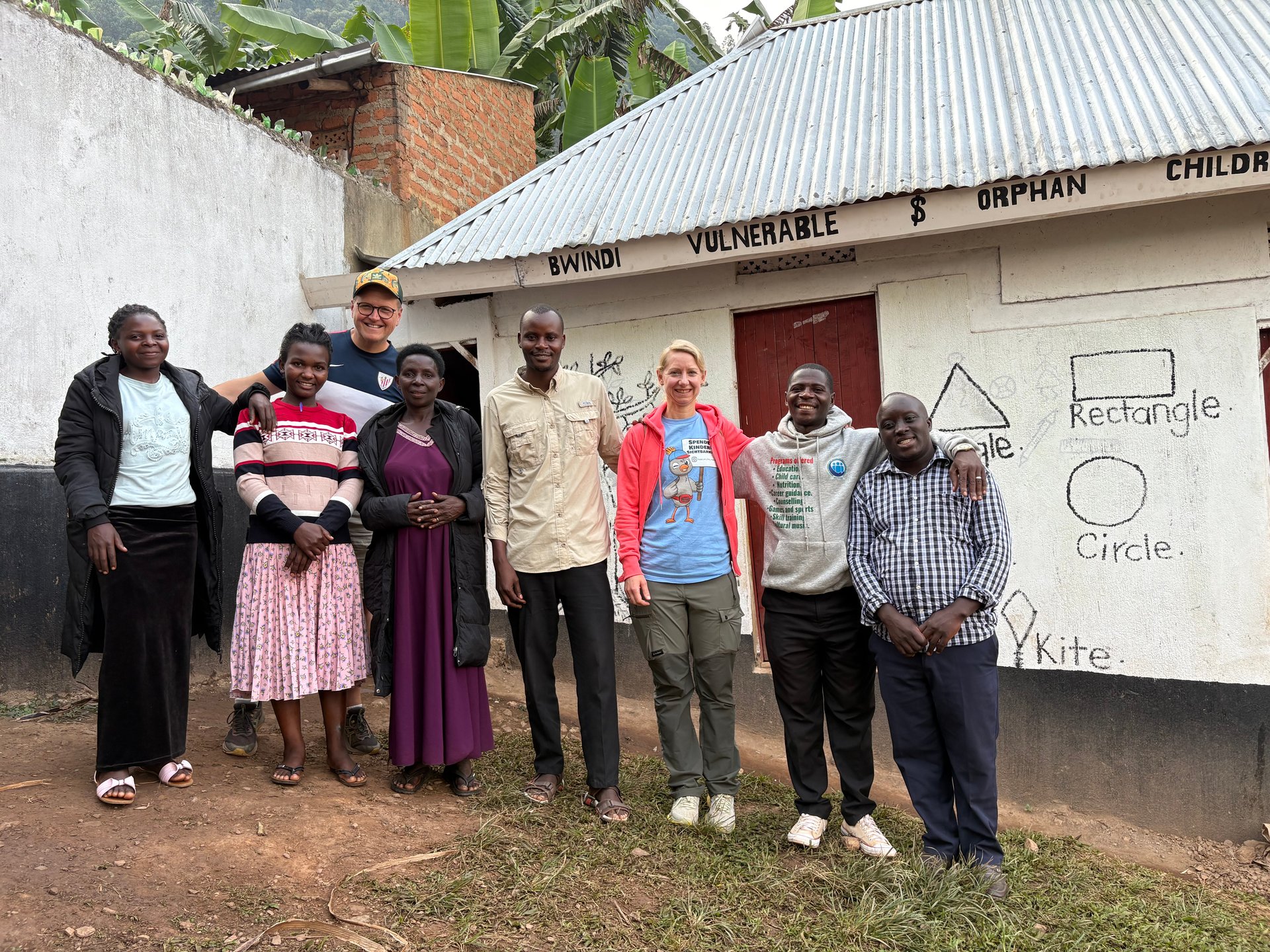
The village of Buhoma sits at the northern boundary of Bwindi near the Buhoma sector gate, where most visitors to that sector base themselves. It is also where the day-to-day reality of life on the park boundary is most immediately visible. Simple buildings with corrugated iron roofs, small kitchen gardens, children moving between homesteads along red-earth paths — this is the texture of ordinary life in a community that lives alongside one of the most visited national parks in East Africa.
On the morning of June 21, 2026, near the orphanage in Buhoma at GPS coordinates -0.9617°N, 29.6109°E, I encountered three children from the neighbourhood who were clearly navigating genuinely difficult circumstances. Their clothes were worn; their demeanour was quiet and slightly withdrawn. We did what felt entirely natural: we invited them to sit with us and eat. That photograph — taken at 06:32 that morning — is GPS-verified proof of exactly the kind of encounter that does not appear in the promotional materials for gorilla tourism but is as real as any silverback.
The Batwa — the indigenous forest people who lived inside Bwindi before it was gazetted as a national park in 1991 — remain part of the landscape around Bwindi's boundary communities. Displaced from the forest with inadequate resettlement support, many Batwa families live in conditions of significant economic marginalisation even as the park their ancestors inhabited generates millions of dollars annually in tourism revenue. Some Batwa work as trackers and cultural performers for the tourism sector; the broader question of restorative justice and meaningful benefit-sharing remains unresolved.
Understanding Bwindi as a complete place — rather than simply a destination for a single wildlife experience — means holding both the gorilla family in the forest and the children in the village in view at the same time. The conservation success represented by 459 mountain gorillas in Uganda is real and hard-won. It was achieved in a landscape shared with farming families, market communities, school children, and historically displaced peoples. That complexity does not diminish the gorillas; it is the actual context in which they survive.
What a Gorilla Portrait Reveals
A photograph of a mountain gorilla looking directly into the lens contains more information than it first appears to carry. The face is structurally distinctive among great apes: a pronounced brow ridge, a broad nose with individualised wrinkle patterns, deep-set eyes that communicate social awareness and something that resists easy categorisation. Rangers identify each habituated individual by these nose prints, building records over years of continuous monitoring.
The original photograph taken during the trekking excursion in Bwindi — a mountain gorilla peering through dense forest foliage, partially obscured by layered leaves — captures the essential quality of the encounter accurately. The animal was not performing. It was present, living its life in the forest where it has always lived, temporarily sharing space with eight human observers who had walked three hours to reach it. The direct eye contact of that moment carries a recognition that is difficult to describe to someone who has not experienced it: a sense of meeting across a biological distance of several million years of separate evolution.
The mountain gorilla is classified as endangered on the IUCN Red List. Its population trajectory has been cautiously positive in recent decades — the result of sustained, coordinated, cross-border conservation effort. The entire global population lives in two locations. Every birth is documented. Every death is investigated. The species exists within a monitoring framework more intensive than almost any other wild animal on earth, a consequence of how close it came to disappearing in the latter half of the twentieth century.
That closeness to extinction, and the recovery that followed it, is arguably the most important fact in a gorilla portrait. What the photograph shows — an animal looking back, present, alive in its forest — is not simply a compelling wildlife image. It is evidence of what sustained conservation effort, community engagement, and responsible tourism can accomplish when they are aligned over decades. The face looking back through the leaves is the result of choices made by rangers, researchers, governments, communities, and tourists across thirty years.
Frequently Asked Questions
Related Articles
Gorilla Trekking in Bwindi: Permits, Preparation, and What to Expect
Mountain Gorilla Facts: Biology, Population, and Conservation Status
Buhoma Sector: The Northern Gateway to Bwindi
Endangered Species in Uganda: What Is at Stake
Mountain Gorilla Behavior: Social Structure and Daily Life