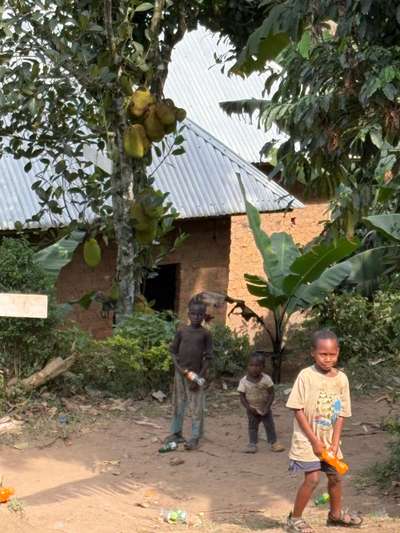
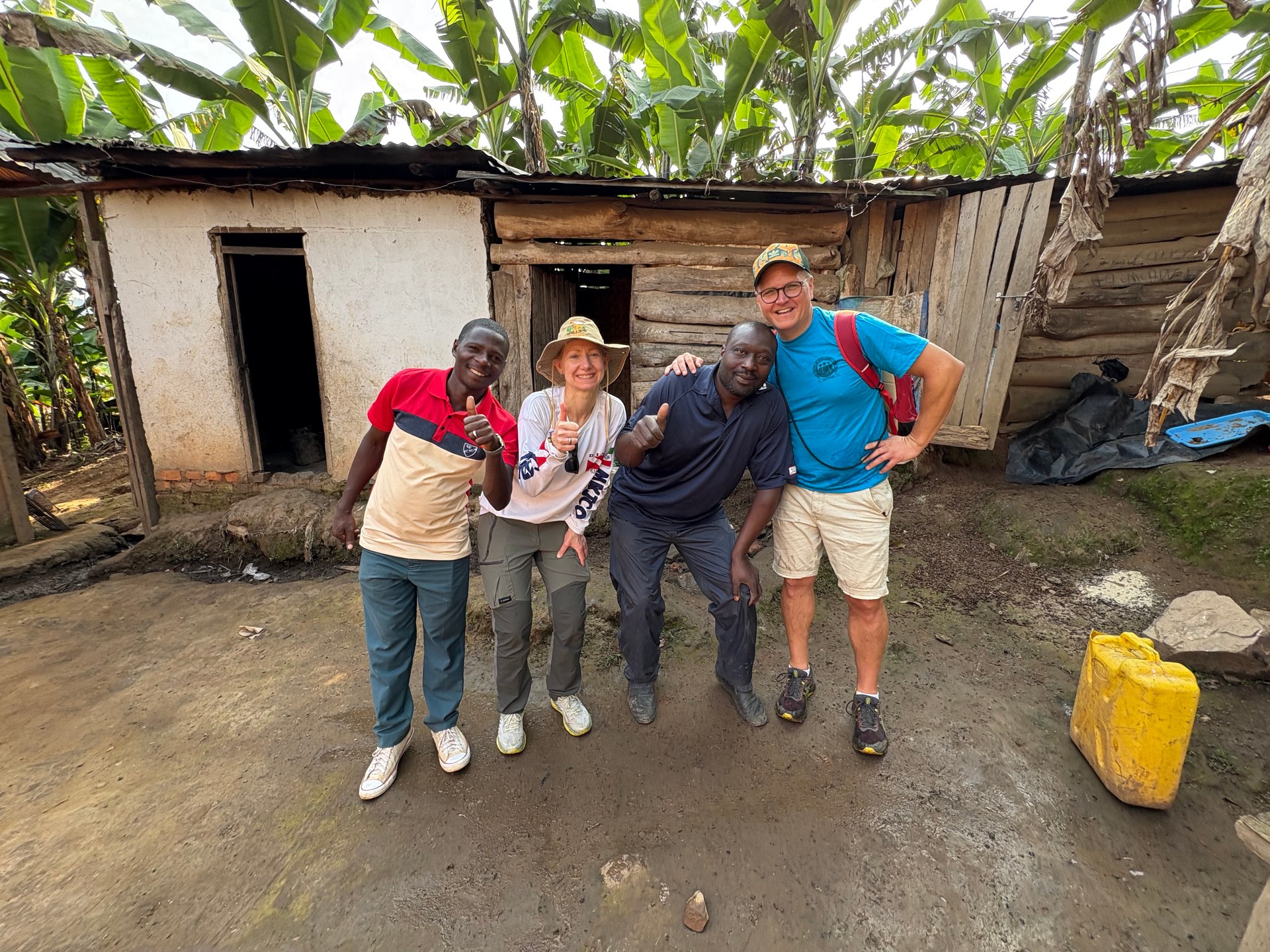
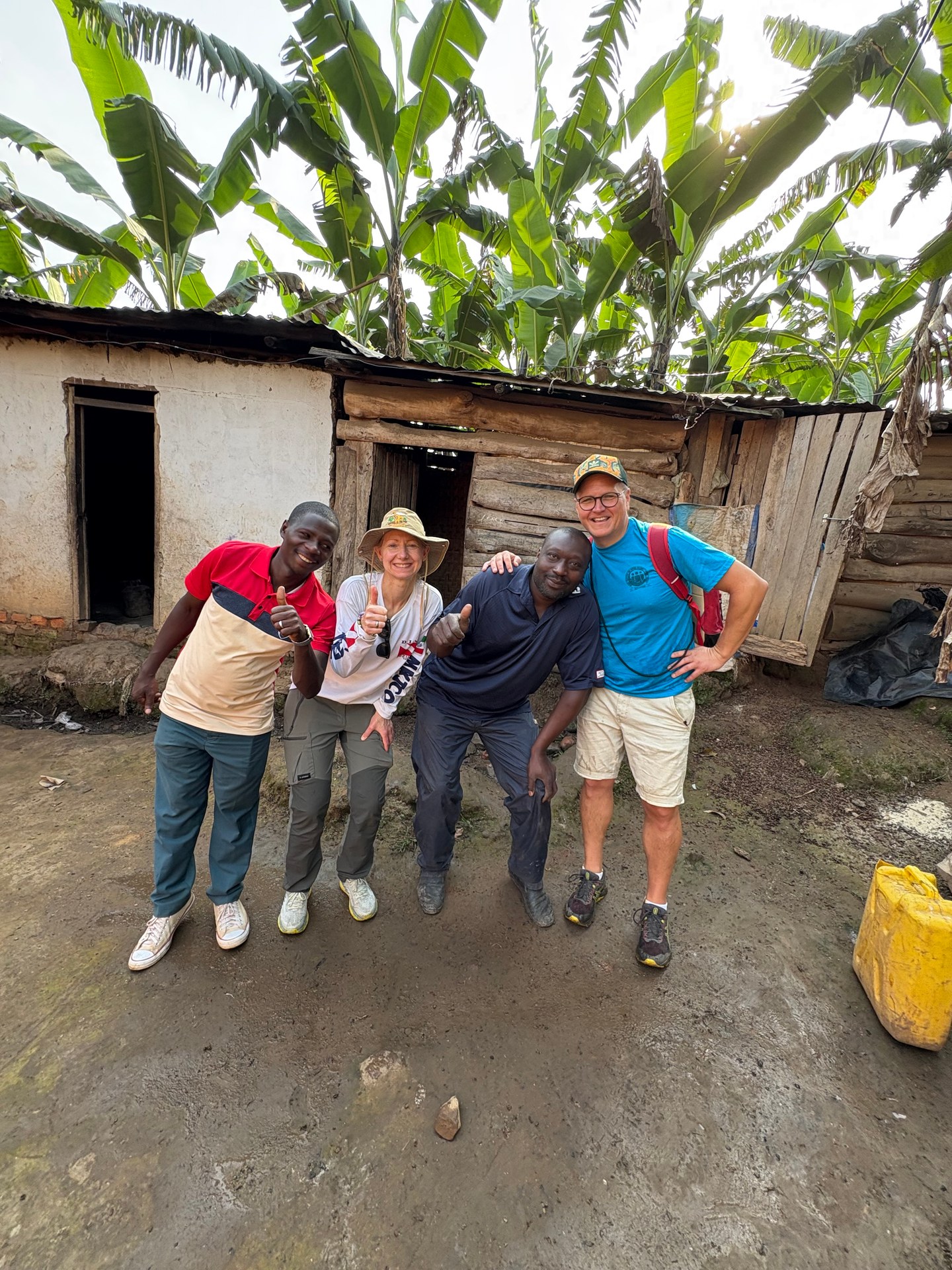
On the morning of 21 June 2026, I walked with a small team to visit a chicken farmer just outside Buhoma, at GPS coordinates 0.9713°S, 29.6142°E, a few hundred metres from the boundary of Bwindi Impenetrable National Park. We had come to see how he raises his chicks — and the visit stayed with me. This man is deeply committed to his animals, handling each bird with genuine care and attention. Over multiple trips to the area, we have purchased chicks from him for the local orphanage; the birds are raised for eggs and occasionally for meat, the latter a rare and celebrated occasion in this community.
It struck me how tightly human life and animal life are woven together here. The same forest that shelters roughly half the world's remaining mountain gorillas shapes the daily reality of every family in Buhoma. Understanding Bwindi's wildlife means understanding that relationship — not just the dramatic, permit-regulated encounter with a gorilla family, but the whole living system of forest, farmland, bird, beast, and person that makes this corner of southwestern Uganda unlike anywhere else on earth.
Mountain Gorillas — Half the World's Population in One Forest
Bwindi Impenetrable National Park shelters approximately 459 mountain gorillas, a figure recorded during the 2018–2020 population census. That number represents roughly half of the entire global mountain gorilla population, which means this single forest in southwestern Uganda carries a disproportionate share of responsibility for the species' survival. The gorillas live in habituated family groups that have been carefully accustomed to human presence over many years — a process managed by the Uganda Wildlife Authority (UWA), which has administered the park since its formal gazettement.
Mountain gorilla trekking is the primary reason most international visitors travel to Bwindi. Permits are issued in limited daily numbers and the revenue feeds directly back into conservation and community development. Uganda's visitor data shows that national park arrivals grew by 41 percent between 2009 and 2013, rising from 151,818 to 213,950 annually, with Bwindi's gorilla permits a significant driver of that growth. In 2013, 47 percent of all national park visitors were foreign non-residents, confirming how much international tourism anchors conservation funding here.
What distinguishes Bwindi from Rwanda's Volcanoes National Park is not the gorillas themselves but the forest. Bwindi is genuinely impenetrable: steep, densely vegetated ridgelines draped in ancient montane growth where trails disappear and the canopy closes overhead. A gorilla trek can take anywhere from forty-five minutes to seven hours depending on where the family has moved overnight. The effort is inseparable from the experience.
I have visited Bwindi across multiple trips — October 2024, January 2026, May 2026, and most recently June 2026. Across all those visits the forest has felt consistently wild. There is nothing manicured about it. Even the road into Buhoma reminds you that this is the edge of something large and uncompromising, and that the gorillas living inside it are not performing for visitors but simply going about lives that predated tourism by millennia.
African Elephants and Other Large Forest Mammals
Uganda supports approximately 7,975 African elephants according to wildlife survey data, and a portion of that population ranges through and around Bwindi. Forest elephants in Bwindi behave differently from the savanna elephants visitors might expect from East Africa's better-known parks. They move through dense vegetation, rarely appear in open ground, and tend to be heard — branches cracking, undergrowth shifting — more often than they are seen. An encounter is not guaranteed on any single visit.
Forest elephant sightings in Bwindi tend to come as surprises, often along the park boundary where forest gives way to farmland, or during early morning nature walks near Buhoma. Rangers in the northern sector have noted elephant movement particularly in areas where the forest edge meets agricultural land — a corridor that is among the most ecologically sensitive boundaries in the park, and one where human-wildlife coexistence requires ongoing management.
Beyond elephants, Bwindi supports buffalo, bushpig, giant forest hog, and several duiker species. These animals rarely headline a Bwindi itinerary but they are present throughout the park's four management zones. The collaborative management zone in particular — where community members may access forest resources under UWA authorization — creates a transitional space where encounters with medium-sized mammals are relatively common during guided community walks.
The park's General Management Plan, which covers the period 2014–2024 and has been extended to 2025 while a new plan for 2026 onwards undergoes validation, provides the framework for managing wildlife across all zones. Investment in park infrastructure — bridge maintenance, entrance facilities, ranger support — directly underpins the capacity to monitor and protect large mammal populations.
Chimpanzees and Other Primates — A Globally Unique Habitat
One of Bwindi's least-discussed distinctions is that it holds both mountain gorillas and chimpanzees within the same habitat. No other location in the world shares this combination of the two largest great apes in a single continuous forest. While chimpanzees are not a primary trekking activity at Bwindi in the way they are at Kibale National Park to the north, their presence here is a marker of the exceptional ecological depth of this forest.
In addition to gorillas and chimpanzees, Bwindi supports at least seven other primate species including the black-and-white colobus, the red-tailed monkey, the olive baboon, and the L'Hoest's monkey. The L'Hoest's monkey is particularly associated with montane forest in western Uganda and is a reliable sighting on the nature walks departing from Buhoma in the early morning hours. These smaller primates are active during daylight and can be encountered along forest trails without a gorilla permit.
“Most visitors come expecting gorillas and leave amazed by everything else — the forest is so dense and alive, the diversity goes far beyond what people imagine before they step inside.”
Local ranger guide, Buhoma sector, Bwindi Impenetrable National Park
The park's zoning structure shapes where these animals are most accessible. The tourism zone around Buhoma, Ruhija, Rushaga, and Nkuringo contains the trail network used by most visitors. The wilderness zone, which functions as a strict conservation core with minimal human disturbance, provides the undisturbed interior that sustains the full primate community. This zoning approach has been central to the gorilla recovery programme by maintaining core areas free from disturbance while channelling visitor activity through designated corridors.
Birds of Bwindi — An International Bird Area with 350 Species
Bwindi Impenetrable National Park holds approximately 350 bird species, placing it among the most significant birding destinations on the African continent. Its formal designation as an Important Bird Area (IBA) reflects a global assessment that this forest is critical habitat for bird populations that are restricted in range or threatened at the international level.
The bird life is concentrated in the mid-altitude montane forest zone and includes a number of species endemic to the Albertine Rift — the chain of mountains and valleys running along Uganda's western border with the Democratic Republic of Congo. Among the most sought-after species are the African green broadbill, Shelley's crimsonwing, Grauer's rush warbler, and Chapin's flycatcher. For birders targeting these rarities, Ruhija sector in the eastern part of the park is generally considered the most productive entry point, offering access to specialist montane habitat along accessible forest tracks.
Even visitors who arrive primarily for gorilla trekking tend to find the birding in Bwindi a welcome secondary discovery. The dawn chorus from any accommodation near the Buhoma park boundary is dense, layered, and unlike anything found at lower elevations. On my visits across October 2024 through June 2026 I have regularly watched sunbirds, hornbills, and weavers from lodge verandahs before breakfast — the birdlife begins before sunrise and sustains through the morning hours.
For dedicated birding, the most effective strategy is an early start paired with a local guide who knows the calls. Many of Bwindi's most valued species are heard in dense cover before they become visible, and the difference between a productive morning and a frustrating one is almost entirely a matter of patience, silence, and local knowledge.
Conservation and the Batwa — The Human Dimension of Wildlife Protection
Bwindi's conservation story cannot be separated from the people who lived inside its boundaries before the park was formally established. The Batwa are former forest dwellers who inhabited the montane forests of the Great Lakes region as hunter-gatherers for centuries. When the Bwindi Mgahinga Conservation Area was created in 1991, the Batwa were formally displaced from their forest homes — a process that had actually begun in the 1930s with the initial gazettement of these protected areas. Families ended up settled on adjacent farmland, with some land purchases made by external organizations over the following decades.
The Batwa's situation represents one of the most complex human dimensions of conservation in the entire region. Various programs have worked to secure land and livelihoods for Batwa communities outside the park, though progress has been uneven and the process remains ongoing. Several community tourism experiences in and around Buhoma engage Batwa guides and cultural practitioners, creating an economic connection to the forest and its visitors that acknowledges their historical relationship with the land.
The Uganda Wildlife Authority manages the park under a structure designed to balance strict conservation with community needs. The collaborative management zone — one of four park zones — allows community members access to specific forest resources under agreed conditions and UWA authorization. This is a practical response to the reality that hundreds of thousands of people live immediately adjacent to the park boundary and depend on forest edge resources for daily life.
Revenue from gorilla trekking permits, nature walk fees, and bird guiding flows through UWA and funds both park operations and community development initiatives in adjacent villages. Uganda has twelve national parks and three game reserves in total; the permit-funded conservation model pioneered at Bwindi has influenced protected area management across the region.
Planning a Wildlife Visit to Bwindi — Sectors, Seasons, and Practical Advice
Bwindi Impenetrable National Park is accessed through four main entry sectors. Buhoma in the north is the most established, hosts the park headquarters, and is the sector I know best from my visits in October 2024, January 2026, May 2026, and June 2026. Ruhija in the east is smaller but highly productive for specialist birding. Rushaga and Nkuringo in the south offer access to additional habituated gorilla groups and tend to see fewer visitors than Buhoma, which can make for a quieter experience.
The primary dry season runs from June to September and is generally considered the best period for gorilla trekking. Trails are drier, forest paths more manageable underfoot, and rainfall — always possible in a montane rainforest — less persistent. The short dry season from December to February is also popular and often offers slightly fewer visitors than the June to September peak. The wet seasons (March to May and October to November) bring heavier rainfall but also fewer competing visitors and more permit availability.
For wildlife beyond gorillas, early morning is consistently the most productive time. The first two hours after sunrise are when mammals, primates, and birds are most active across all sectors. A two to three hour nature walk from Buhoma, which does not require a gorilla permit, can produce encounters with forest primates, birds, and occasionally elephant sign — and at a fraction of the cost and logistical complexity of a full gorilla trek. These walks are underused by visitors who focus exclusively on gorillas and tend to miss much of what makes the forest exceptional.
Gorilla trekking permits should be booked well in advance through the Uganda Wildlife Authority or a licensed tour operator. Demand reliably exceeds supply during the June to September peak season, and last-minute availability is rare. Accommodation in Buhoma ranges from budget banda-style guesthouses to mid-range lodges positioned along the park boundary; the latter offer the advantage of forest sounds and early morning bird access without leaving your room.