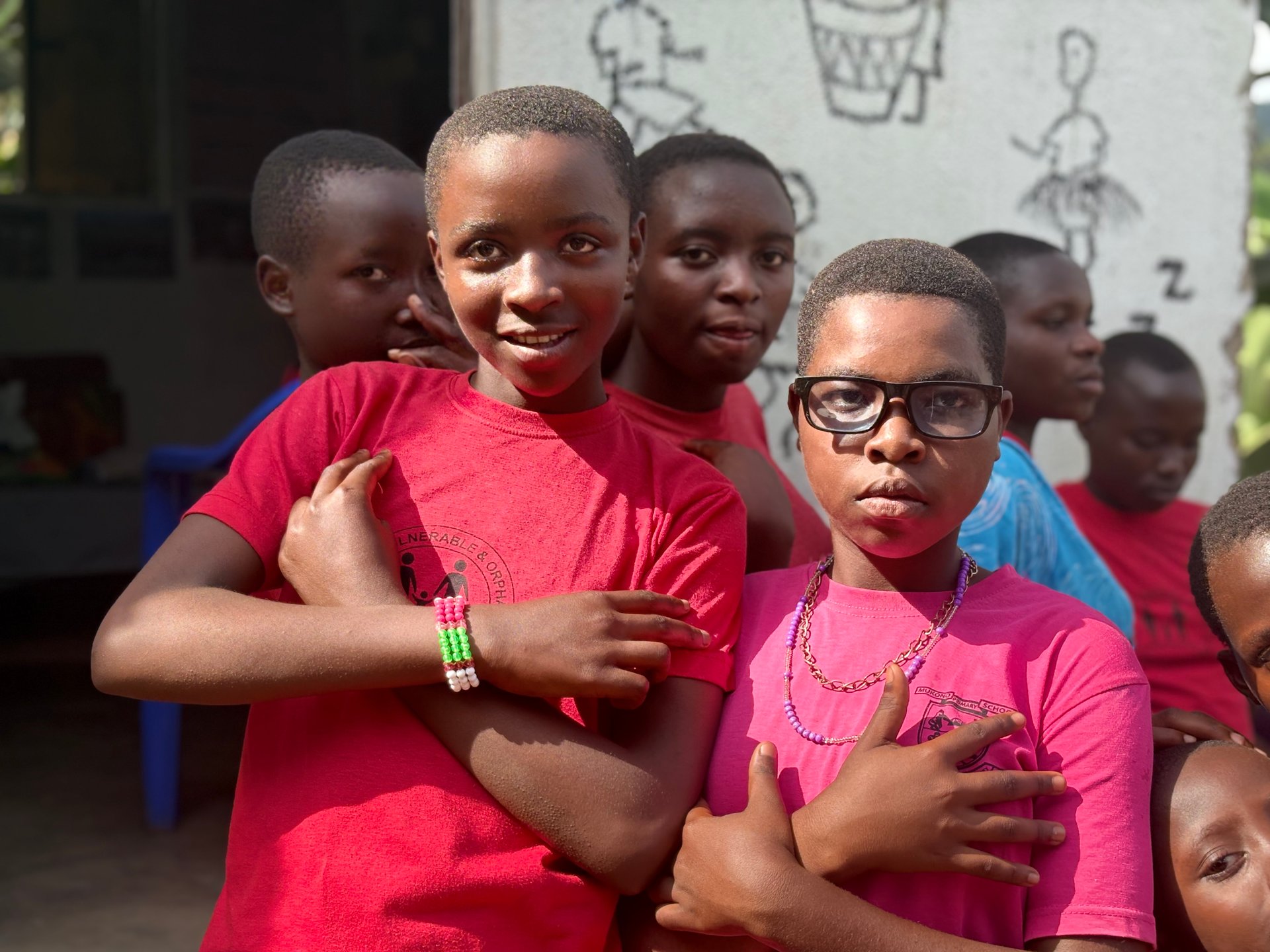
On the sandy courtyard in front of Nicholas’s orphanage in Buhoma, two teenagers in bright pink and red shirts stepped forward and struck a pose. They held their shoulders back, tilted their chins, and grinned with a confidence that felt rehearsed and genuine at the same time. Behind them, younger children pressed closer, craning to see the camera screen. In a village where almost nobody owns a smartphone — teenagers least of all — having your picture taken is an event. A small performance follows naturally: a bit of theatre, a burst of laughter, a moment of feeling seen.
I photographed that scene in January 2026, during my second visit to Buhoma. Over three trips between October 2024 and June 2026, I returned to the same compound, the same faces, the same village that sits at the northern gate of Bwindi Impenetrable National Park. Each visit revealed a layer the previous one had missed. The first time, I saw the lodges, the forest, the gorillas. The second time, I began to understand the economy. By the third visit, the children at the orphanage were no longer strangers — and the question of what happens to them when they grow up had become impossible to ignore.
This article is about that question. Not about gorilla trekking itself, but about the young people growing up in a village whose entire economy depends on it — and what self-sufficiency looks like when the tourism stops.
A Village Built on Gorilla Permits
Buhoma exists because of gorillas. Before the national park was gazetted and trekking permits were introduced, the settlement was a small farming community at the forest edge. Today, it is the primary staging point for gorilla trekking in Bwindi’s northern sector, and the entire village economy revolves around the visitors who arrive each morning and leave each afternoon. Lodges, restaurants, craft stalls, guiding services, portering, and transport — every link in the chain depends on travellers who come for a one-hour encounter with habituated mountain gorilla families.
The fragility of this arrangement has been demonstrated repeatedly. When the 2018 Ebola outbreak in eastern Democratic Republic of Congo triggered border alerts, tourist bookings in Buhoma collapsed almost overnight. The virus never reached Bwindi, but the perception of risk was enough. Lodges emptied, guides lost their income, and the craft sellers who line the road between the lodges and the UWA sector headquarters had no customers for weeks. Norman, a long-time community member, has described how the village went from full occupancy to near-silence within days. The pattern repeated during the COVID-19 lockdowns of 2020 and 2021, when international travel ceased entirely and Buhoma’s only revenue source disappeared.
[QUOTE: Norman on what happens to Buhoma when tourists stop coming]
What makes this dependency particularly acute for young people is the absence of alternatives. There is no factory, no regional hospital employing hundreds, no government office complex. The nearest city of any size is Kabale, several hours away on rough roads. For a teenager growing up at Nicholas’s orphanage, the visible career paths are: work at a lodge, become a guide or porter, sell crafts, farm — or leave. Uganda’s tourism sector generates employment and revenue across the country, and the KCCA Strategic Plan 2025 targets the training of 80 tourism professionals and guides annually to address skill gaps in the hospitality industry. But those opportunities are concentrated in Kampala and the larger parks. In Buhoma, the pipeline from youth to employment runs through a single industry.
Nicholas’s Orphanage: Where Childhood and Tourism Intersect
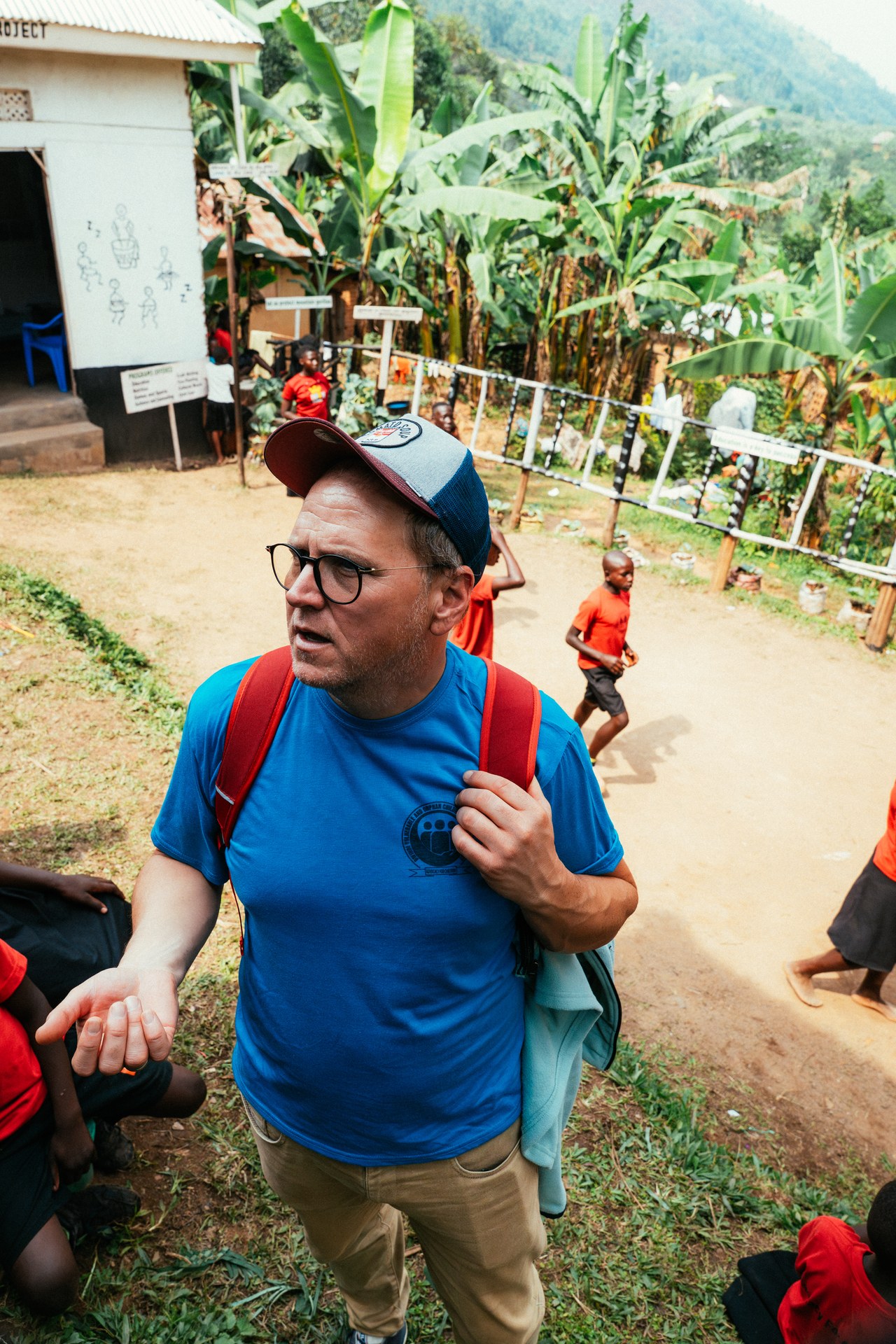
Nicholas is a pastor who, together with his wife Media, runs Buhoma’s orphanage on a sandy compound in the centre of the village. The facility houses orphaned and vulnerable children from the surrounding area, feeding and educating them without any institutional funding stream. Food reserves at the orphanage typically last about a week. Donations arrive irregularly — from local churches, from occasional international contacts, and from partnerships with organisations such as Hope on the Road.
The teenagers I photographed in January 2026 were living at this compound. Their enthusiasm for the camera was not mere vanity. In a community with almost no smartphone penetration, being photographed is one of the few moments where you become visible in a way that extends beyond the village. The children understood this intuitively. They performed for the camera because the camera was a window to a world they could see — through the tourists walking past every day — but could not yet enter.
The orphanage’s location is no coincidence. It sits within walking distance of several lodges and the gorilla trekking starting point. Visitors who arrange a community walk through Buhoma often pass through the compound, meet the children, and sometimes leave donations. This proximity to the tourism economy is both the orphanage’s greatest asset and its structural vulnerability: it receives attention and support because tourists are nearby, but that support vanishes when the tourists do.
During our visits, we observed the daily rhythm. Mornings are quiet — children at school, the compound nearly empty. By midday, the energy rises as older children return and younger ones play on the sandy ground. When visitors arrive, the atmosphere shifts: curiosity, shyness, then rapid confidence. By evening, the compound settles into the routine of preparing the next day’s meals from whatever food is available. It is a pattern shaped entirely by what the community can provide on a given day, with no buffer against shortage.
From Chicks to Self-Sufficiency: The Chicken Farm Model
In June 2026, we visited a chicken farmer in Buhoma whose small operation has become a direct link between local entrepreneurship and the orphanage’s food supply. The farmer raises chicks purchased from suppliers in Kampala — a journey of over 400 kilometres on Uganda’s unpredictable roads. He treats his animals with visible care, managing the growing process patiently and keeping the farm clean despite its modest scale.
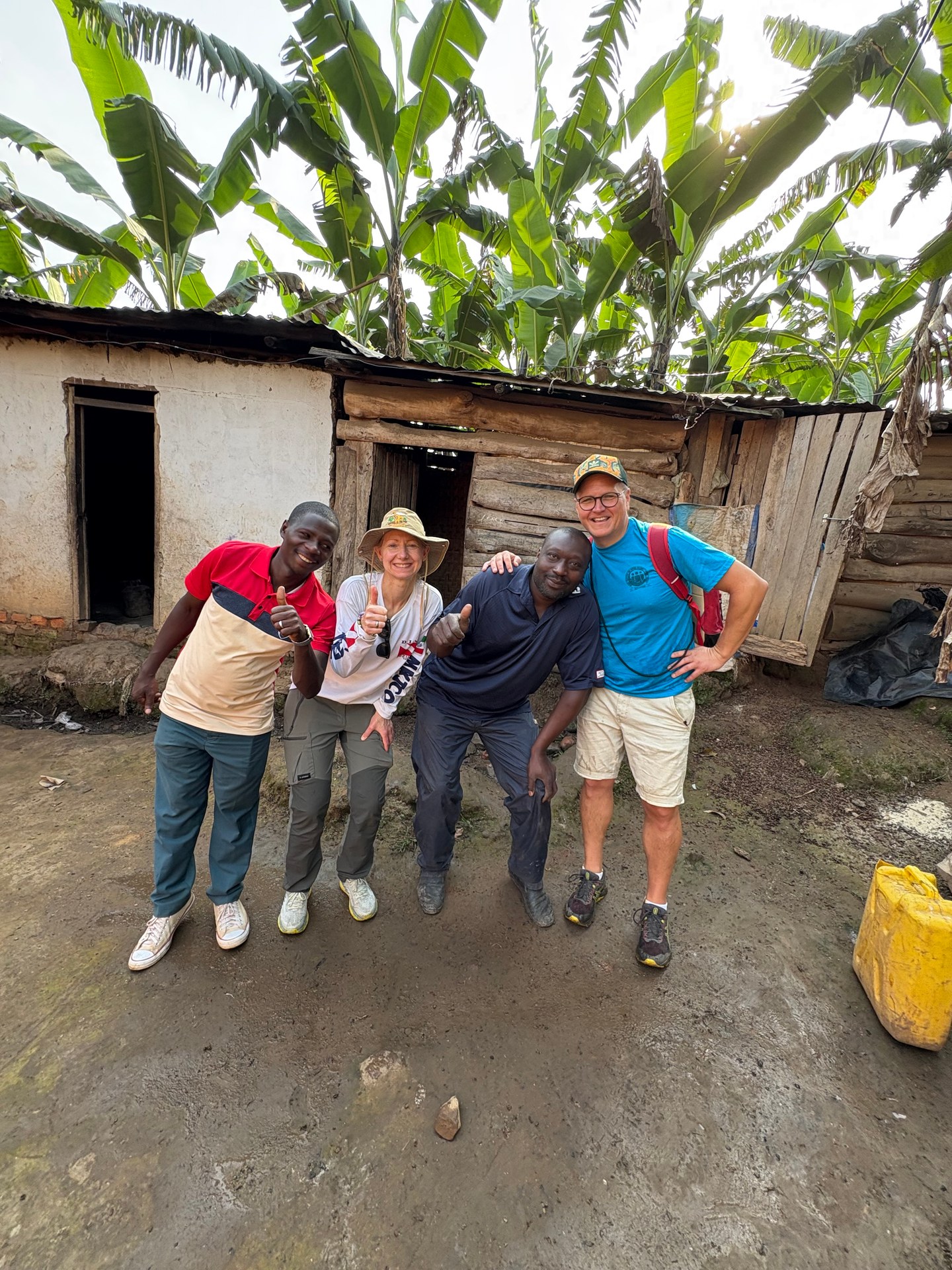
We purchased chicks from this farmer for Nicholas’s orphanage on multiple occasions. The model is straightforward: the orphanage raises the chickens, keeps some for egg production as a self-sustaining food source, and sells others when they reach maturity. A few are kept for meat — though eating chicken is rare enough to be treated as a genuine celebration at the orphanage. The farmer told us that a chick from Kampala costs about USD 2.50; once grown, a fully mature chicken sells for USD 10 to 15.
This is what self-sufficiency looks like at the village level: not a grand programme or a government initiative, but one farmer, one orphanage, and a supply chain that converts a few dollars into protein and income. The model does not eliminate dependency on external support, but it creates a buffer. When tourist donations dry up, the chickens still lay eggs. When school fees are due, a grown chicken can be sold. It is small-scale, practical, and replicable — exactly the kind of initiative that the Uganda Women Entrepreneurship Programme, which the KCCA Strategic Plan 2025 identifies as a priority intervention for economic empowerment, aims to support at a national level.
[QUOTE: chicken farmer on why he cares about the quality of his animals]
The Grauer’s Gorilla Warning: What Happens When Conservation Funding Collapses
Bwindi’s mountain gorillas are a conservation success story, but their close relative — the Grauer’s gorilla, or eastern lowland gorilla — tells a starkly different tale. Living in the lowland forests of Kahuzi-Biéga National Park in the Democratic Republic of Congo, the Grauer’s gorilla population crashed from approximately 18,000 individuals in 1998 to roughly 3,800 by 2018. Armed conflict, habitat destruction, and poaching drove the collapse. The critical difference between the two species’ trajectories is not biological but economic: Bwindi had sustained tourism revenue funding ranger patrols, habitat protection, and community programmes. Kahuzi-Biéga did not.
This comparison is not academic for the people of Buhoma. The mountain gorillas in Bwindi number around 459 individuals across habituated and unhabituated groups. Their survival depends on the continued flow of permit revenue that funds the Uganda Wildlife Authority’s operations, ranger salaries, and anti-poaching patrols. When tourism collapsed during the Ebola scare and again during COVID-19, the funding pipeline that protects these animals was severely disrupted. The Grauer’s gorilla decline shows what the end-state looks like when that disruption becomes permanent.
For the young people at Nicholas’s orphanage, the connection is direct: the gorillas bring the tourists, the tourists bring the money, and the money sustains the village. Protecting the gorillas is not an abstract environmental goal — it is an economic necessity. This is why community conservation education matters, and why the next generation’s understanding of that link will determine whether Bwindi’s success continues or follows the Grauer’s gorilla’s path.
Lodge Life Through a Visitor’s Eyes — And Through a Local’s
During our January 2026 stay at the Gorilla Bluff Lodge, the rhythm of the place revealed itself gradually. Each morning began on the private terrace of our room — a wooden deck overlooking dense vegetation, where staff brought fresh coffee and African tea before the day’s activities began. Breakfast followed: fresh mango, sweet banana, and juicy melon on a white plate, all locally sourced. The lodge is built into a steep hillside, and massive hand-cut timber steps connected our room to the main building — a physical reminder that creating comfort in this terrain requires considerable effort and craftsmanship.
From the terrace, we could hear the forest. The lodge sits at the edge of Bwindi Impenetrable National Park, close enough that wildlife sounds are a constant presence. It is an extraordinary setting for a guest. But for the staff — many of whom walk uphill from the village each morning — the lodge represents something else entirely: a stable job in a community with few alternatives. The cooks, cleaners, and maintenance workers who make the experience possible earn wages that, while modest by international standards, place them among the more reliably employed people in Buhoma.
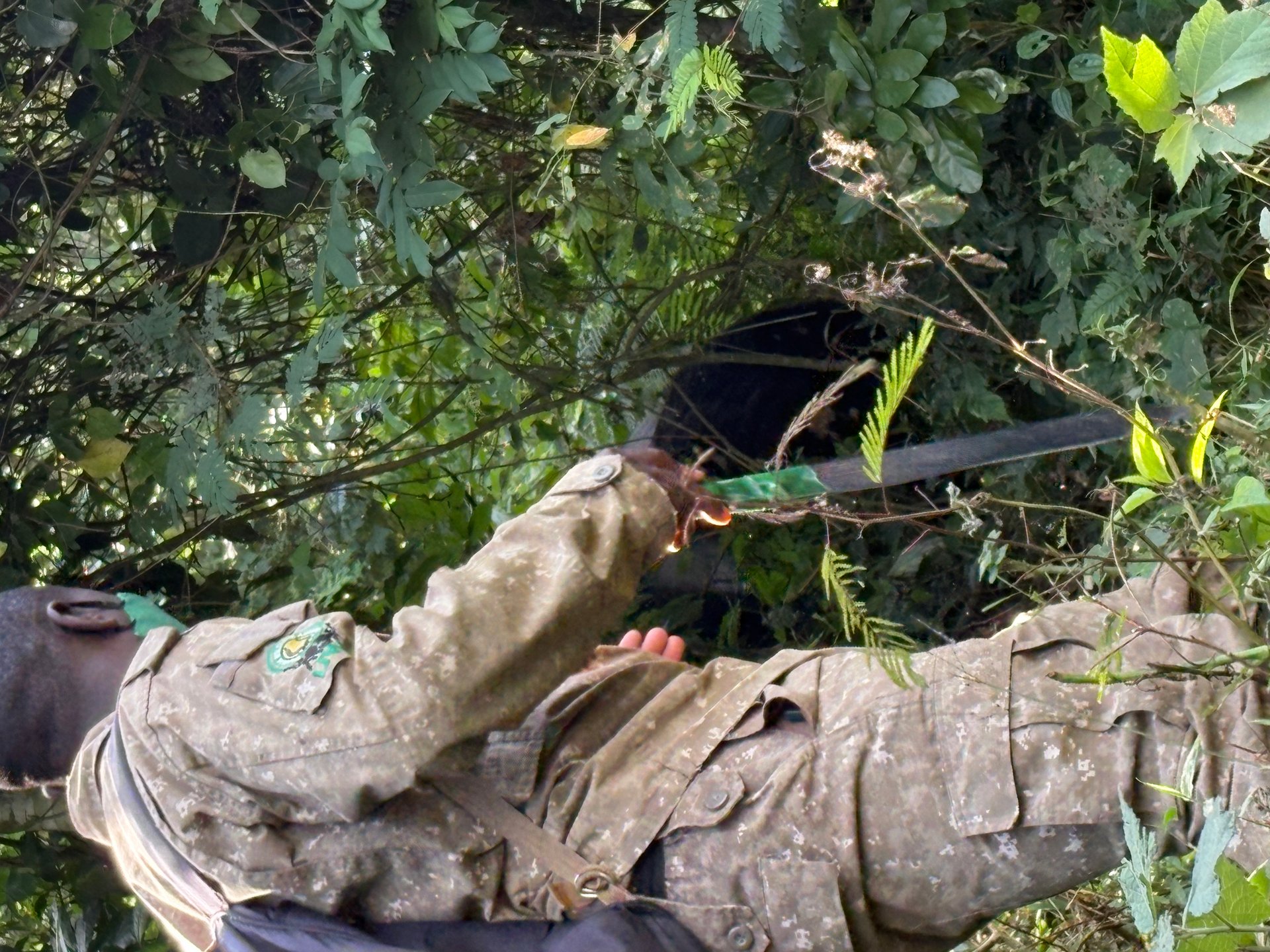
Our gorilla trekking from this lodge was accompanied by a guide and two armed rangers. The rangers’ presence felt unusual at first — seeing firearms in a forest setting is not something most European visitors expect. But it was entirely routine and reassuring. The rangers were in excellent spirits, helping with the steep ascent through dense undergrowth, pointing out features of the forest, and ensuring the group maintained a safe distance from the gorilla family once we found them. Their professionalism reflected a system that works: well-trained personnel, funded by permit revenue, protecting both wildlife and visitors.
Uganda has been investing in the professionalism of its tourism workforce. According to the KCCA Service Standards 2025, tourist guides and in-service hotel personnel in Kampala receive annual training, and tourism attractions undergo quarterly inspections. In Buhoma, the quality of guiding and ranger support is already high — the challenge is extending that standard to the broader service economy around the park, where informal businesses operate without structured training or quality oversight.
Beyond Bwindi: Uganda’s National Parks and Why Buhoma’s Story Matters Everywhere
Buhoma’s dependency on gorilla tourism is an extreme case of a pattern visible across Uganda. The country’s ten national parks — from Murchison Falls in the northwest to Kidepo Valley in the remote northeast — each anchor a local economy that depends heavily on visitor numbers. Murchison Falls, Uganda’s largest park, draws visitors for boat safaris on the Nile and savannah game drives. Queen Elizabeth National Park offers the Kazinga Channel and tree-climbing lions. Kibale Forest is the primary destination for chimpanzee trekking. Each park has its gateway village, its lodge corridor, and its community that rises and falls with the tourist seasons.
The Ugandan government recognises tourism as a strategic economic sector. KCCA’s Strategic Plan 2025 targets participation in at least two international tourism expos annually by the 2025/26 financial year, up from one previously. The Kampala Tourism Infrastructure Project plans 20 local tourism promotion campaigns and the creation of a heritage park with five monuments (KCCA Strategic Plan 2025). Five major tourism festivals are planned for Kampala to attract visitors and promote local culture. These investments aim to distribute tourism revenue more broadly, reducing the concentration that makes villages like Buhoma so vulnerable to external shocks.
For Buhoma’s young people, this broader context offers both hope and uncertainty. A more diversified tourism sector means more potential employers, more routes into the industry, and less dependence on a single permit-driven revenue stream. But diversification takes time, and the teenagers at Nicholas’s orphanage are growing up now — not in five or ten years when infrastructure programmes may have matured. The immediate reality is a village where the path from childhood to adulthood runs through a narrow corridor of tourism-adjacent employment, with self-sufficiency projects like the chicken farm providing the only alternative model that exists at ground level.
What I took away from three visits is this: Buhoma is not a development case study or a conservation poster. It is a real community where real young people are figuring out how to build lives in a place that the world visits for one hour and then leaves. The gorillas will continue to draw visitors as long as they survive. The question is what the community builds in the time between arrivals — and whether the next generation has the tools, education, and economic options to build something that lasts even when the tourists do not come.
Frequently Asked Questions
How does tourism sustain the community in Buhoma?+
Buhoma’s economy depends almost entirely on gorilla trekking. The village serves as the main entry point to Bwindi’s northern sector, and USD 800 gorilla permits fund UWA operations, ranger salaries, and a community revenue-sharing programme. Beyond formal channels, tourism supports lodge employment, guiding, portering, craft sales, and food supply. When tourism stops — as it did during the 2018 Ebola border alert and the COVID-19 lockdowns — the village has almost no economic fallback.
What is the orphanage in Buhoma?+
Nicholas’s orphanage is a community-run facility in central Buhoma that houses and feeds orphaned and vulnerable children. It operates without institutional funding, relying on donations, local church support, and partnerships with organisations like Hope on the Road. The children attend local schools and the compound typically holds food reserves for about one week at a time.
How does chicken farming help the orphanage?+
A local farmer raises chicks purchased from Kampala. Hope on the Road buys chicks for the orphanage, which raises them on-site. Some are kept for egg production as a self-sustaining food source, others are sold when mature, and a few are consumed — a rare occasion treated as a celebration. The model converts a small investment (USD 2.50 per chick) into both food security and income.
What is the Grauer’s gorilla and why does it matter for Bwindi?+
The Grauer’s gorilla (eastern lowland gorilla) lives in the DRC’s Kahuzi-Biéga National Park. Its population crashed from roughly 18,000 in 1998 to about 3,800 by 2018 due to conflict, habitat loss, and poaching. The critical difference from Bwindi’s mountain gorillas is funding: Bwindi has sustained tourism revenue protecting its gorillas, while Kahuzi-Biéga did not. The Grauer’s decline shows what happens when conservation funding collapses.
Can visitors meet young people at the orphanage?+
Yes. A community walk in Buhoma typically passes the orphanage compound. The children and teenagers are genuinely curious about visitors and enthusiastic about being photographed. Visits are informal and respectful, arranged through local guides or the Hope on the Road network. There is no entry fee, though donations of food, school supplies, or financial support go directly to the facility.