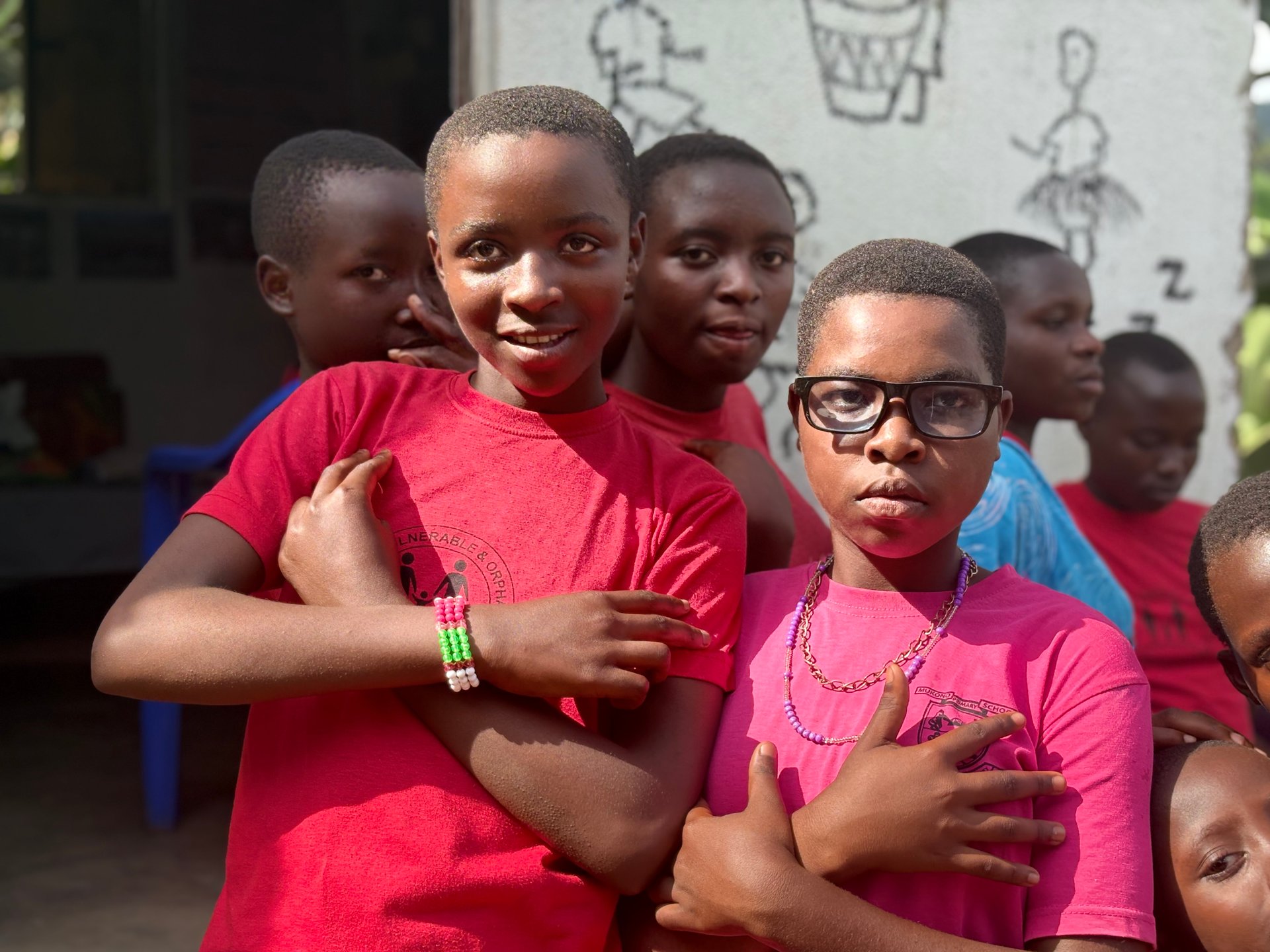
On the sandy courtyard of Nicholas's orphanage in Buhoma, two teenagers in bright pink and red T-shirts positioned themselves in front of my camera with the kind of deliberate composure that means they had been thinking about this moment. They stood straight, tilted their heads slightly, and delivered expressions that were half genuine smile, half performance — the universal language of young people who understand that a photograph is a small event. Behind them, other children gathered on the open ground in front of the building, watching. In January 2026, during my second visit to Buhoma, this was one of those interactions that tells you something about a place without anyone having to explain it: in a community where almost nobody owns a smartphone, being photographed is not routine. It is an occasion.
The teenagers were not shy. They were enthusiastic, curious, and entirely willing to perform for the lens — a quality that years of gorilla trekking traffic through the village has made common among Buhoma's younger generation. Tourists walk through Buhoma on their way to the Uganda Wildlife Authority sector headquarters, and cameras are part of the landscape. But owning one is different from being in front of one. These young people have been photographed many times. They have rarely, if ever, taken a photograph themselves. The orphanage does not have a mirror. When I showed the children their own faces on the camera screen after a group photo, the reaction was one of the most genuinely joyful things I witnessed across seven days of GPS-documented travel through this region between October 2024 and June 2026.
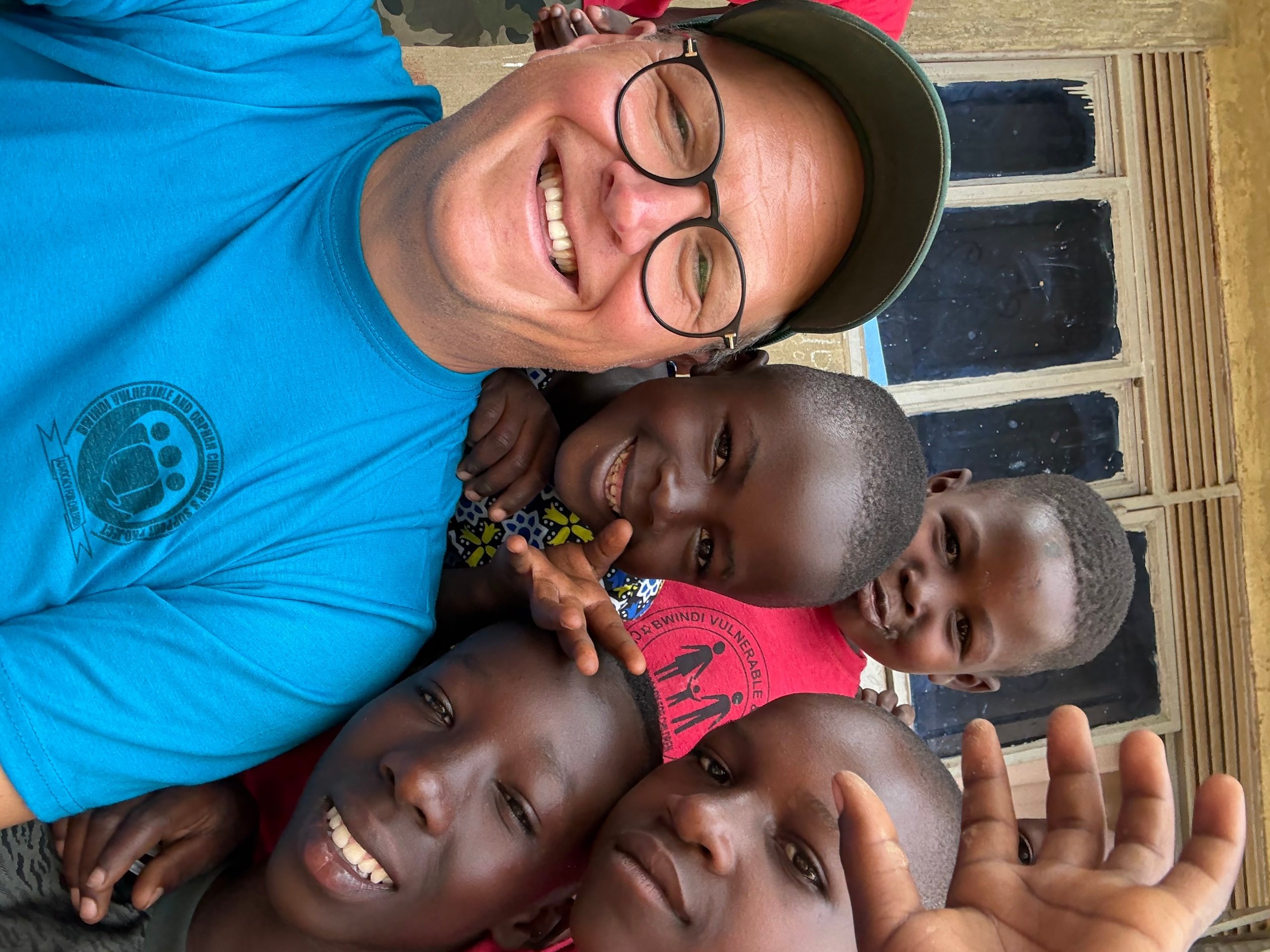
This is the texture of Buhoma that the gorilla trekking brochures do not include. The village at Bwindi's northern gate is described in tourism materials as a "gateway" — a staging point for the morning trek, a place where lodges are located and permits are checked. That description is accurate as far as it goes. It is also radically incomplete. Buhoma is a functioning community of several hundred people who live here year-round, whose economy is shaped by gorilla tourism but whose daily lives are not organised around it. The orphanage, the construction projects, the roadside commerce, the transport logistics, the youth who grow up between the trekking economy and village reality — this is the Buhoma that becomes visible when you stay longer than the morning of your trek.
The Roof Goes Up — HopeKitchen in May 2026
When I first saw the HopeKitchen site during an earlier visit, the walls were partially raised — red brick on a cleared slope above the Buhoma valley, with the banana terraces and distant mountains framing the view. By May 2026, the building had progressed substantially. The brick walls were complete. The timber roof frame — a structure of substantial wooden beams in a pattern not unlike European roof construction — was approximately 60 per cent erected. A worker stood on top of the wall, fitting roof timbers without safety equipment, in the pragmatic style of construction across rural Uganda where the work gets done with the tools and protections that are available, which is to say: skill, balance, and experience rather than harnesses and hard hats.
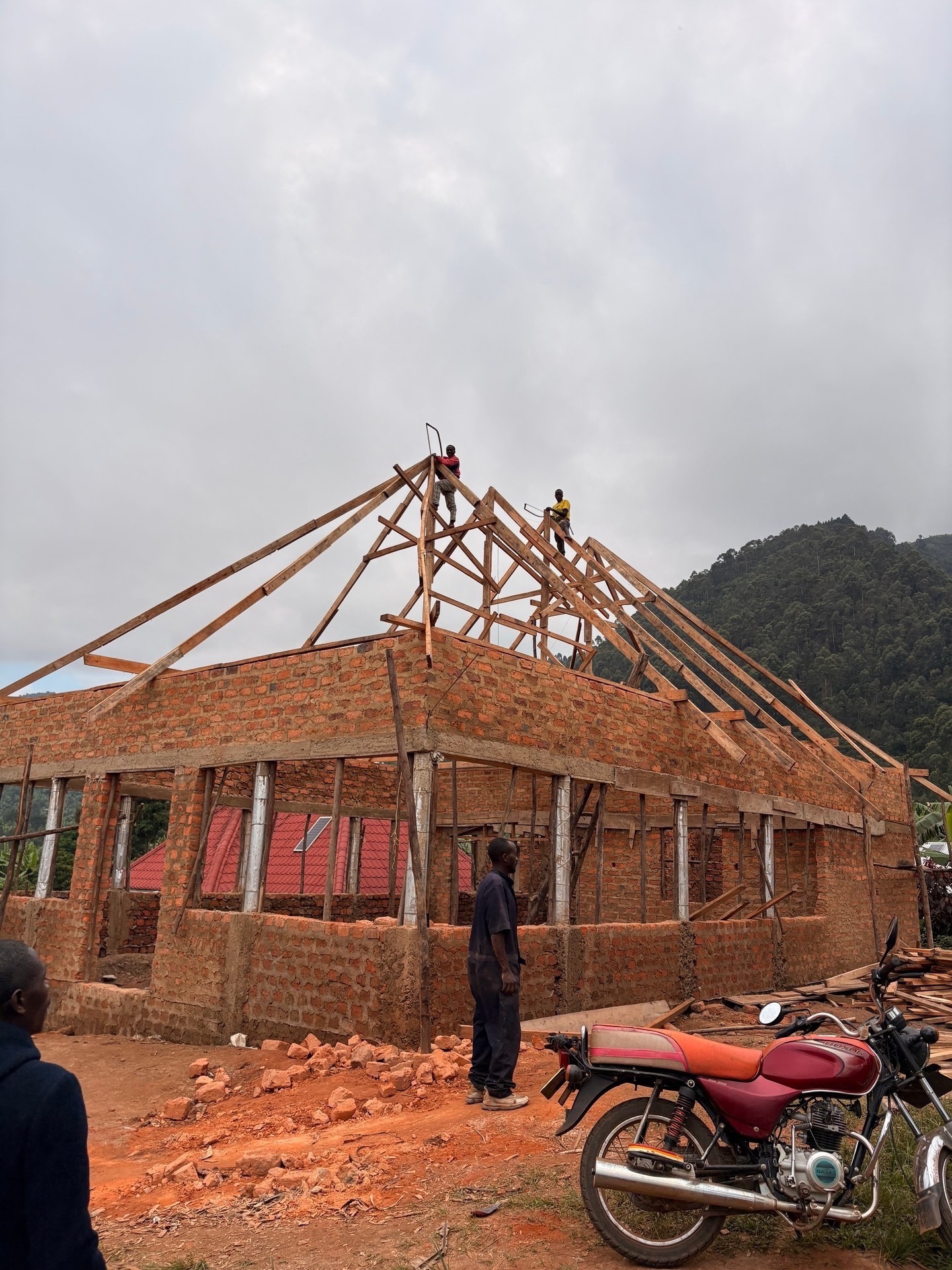
The HopeKitchen is a community project connected to the Hope on the Road initiative that has been active in Buhoma across multiple visits. When completed, the building will serve as a communal kitchen and gathering space — a functional addition to Buhoma's community infrastructure that currently consists of a primary school, a health post, a craft cooperative, and Nicholas's orphanage. The construction uses red brick made locally, timber sourced from the region, and corrugated metal roofing that is standard across south-western Uganda where rainfall in Bwindi's northern foothills is substantial during both rainy seasons.
The contrast with the lodge infrastructure visible from the same hillside is instructive. Buhoma's lodges — built with private investment and maintained by the per-night revenue of gorilla trekkers paying between $150 and $600 per room — have finished walls, proper roofing, landscaped grounds, and staff. The HopeKitchen is being built by the community, for the community, at the pace that donated funds and volunteer labour allow. Both types of building sit within the same village boundary. The distance between them, in terms of funding and finish quality, is measured in metres. The distance in terms of the economic systems that produce them is considerably wider.
Nicholas and Media — Running an Orphanage on Faith and Donations
Nicholas is a pastor, a community organiser, and the man who decided — as a practical matter of conviction — that Buhoma's orphaned children needed to be housed and fed. He runs the orphanage with his wife Media. Between them, they manage the administration, fundraising, food procurement, and daily care of children who have no other institutional support. Nicholas works from a small office adjacent to the main building, where certificates and documents are pinned to whitewashed walls — the paperwork of a functioning facility that operates entirely on the margin between enough and not enough.
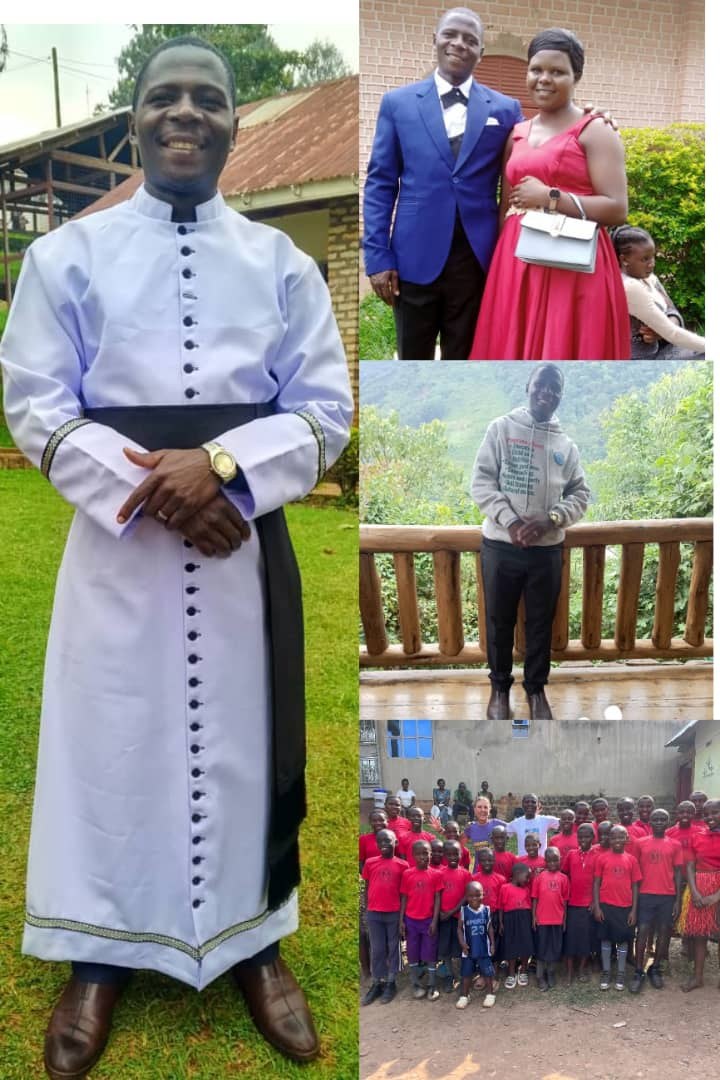
The orphanage's most acute challenge is food security. When I looked inside the storeroom in January 2026, it held several sacks of beans and grain — sufficient for approximately one week. That is the practical planning horizon: seven days. The next delivery depends on donations that have not yet been committed, from sources that are not guaranteed. Nicholas manages this uncertainty not by having a solution to it but by operating within it, week after week, for years. The children eat. The question of whether they will eat next week is perpetually open. This is not a crisis in the conventional sense — it is a steady state, and that steadiness is what makes it both functional and precarious.
The economics of this situation are worth stating plainly. A single gorilla trekking permit costs $800 (UWA, 2026). The Mubare group at Buhoma receives up to eight trekkers per day — a daily ceiling of $6,400 in permit revenue from one habituated gorilla family alone. Buhoma has three habituated families. The orphanage, less than a kilometre from the trailhead, operates on a weekly food budget that would not cover a single permit. The revenue-sharing mechanism through which UWA returns a portion of park fees to boundary communities funds schools and boreholes — real, significant public infrastructure. But it does not extend to operating costs for informal facilities like Nicholas's orphanage, which sits outside the formal grant framework and depends on the pastor's own network of supporters.
Tourism Infrastructure vs. Community Infrastructure in Buhoma
Tourism — Funded by Permits and Private Investment
Lodges ($150–$600/night), UWA sector headquarters, ranger stations, maintained trails, trailhead facilities. Well-resourced, purpose-built, professionally staffed. Funded by gorilla trekking permits ($800/person) and private lodge operators.
Community — Funded by Donations and Local Labour
The orphanage (weekly food supplies), HopeKitchen (under construction since 2026), craft cooperative, village housing, roadside commerce. Funded by individual donations, community labour, and incremental local investment. Operates at the edge of capacity.
Transport, Commerce, and Roadside Life
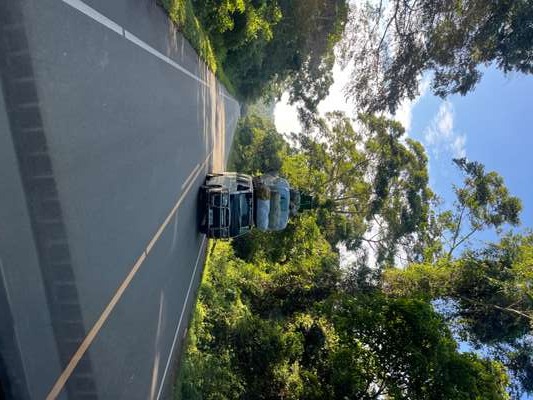
To reach Buhoma from Kampala is a journey of approximately 530 kilometres by road — seven to nine hours depending on conditions and stops. Along the way, the transport culture of Uganda is visible in forms that no brochure prepares you for. On the highway from Butiru towards Murchison Falls National Park during my October 2024 trip, I passed a minibus with a load of mattresses and household goods stacked on its roof to roughly twice the height of the vehicle itself. The image was, by European standards, extraordinary. By Ugandan standards, it was Tuesday. Long-distance minibuses in rural Uganda carry whatever needs carrying, and the definition of "full" is more flexible than any transport regulation would suggest.
Closer to Buhoma, transport becomes more localised. The boda-boda — Uganda's ubiquitous motorcycle taxi — is the primary means of moving people and goods along roads too narrow or too steep for larger vehicles. Near Buhoma, I spotted a three-wheeled variant I had not seen before: a boda-boda with a red flatbed cargo area and a protective canopy over the driver's seat. Three wheels instead of two, designed for carrying goods rather than passengers. It was parked on green ground near the road, a piece of improvised engineering that illustrated the way Ugandan transport adapts vehicle design to local need — not by importing purpose-built trucks, but by modifying motorcycles into whatever the terrain and the cargo require.
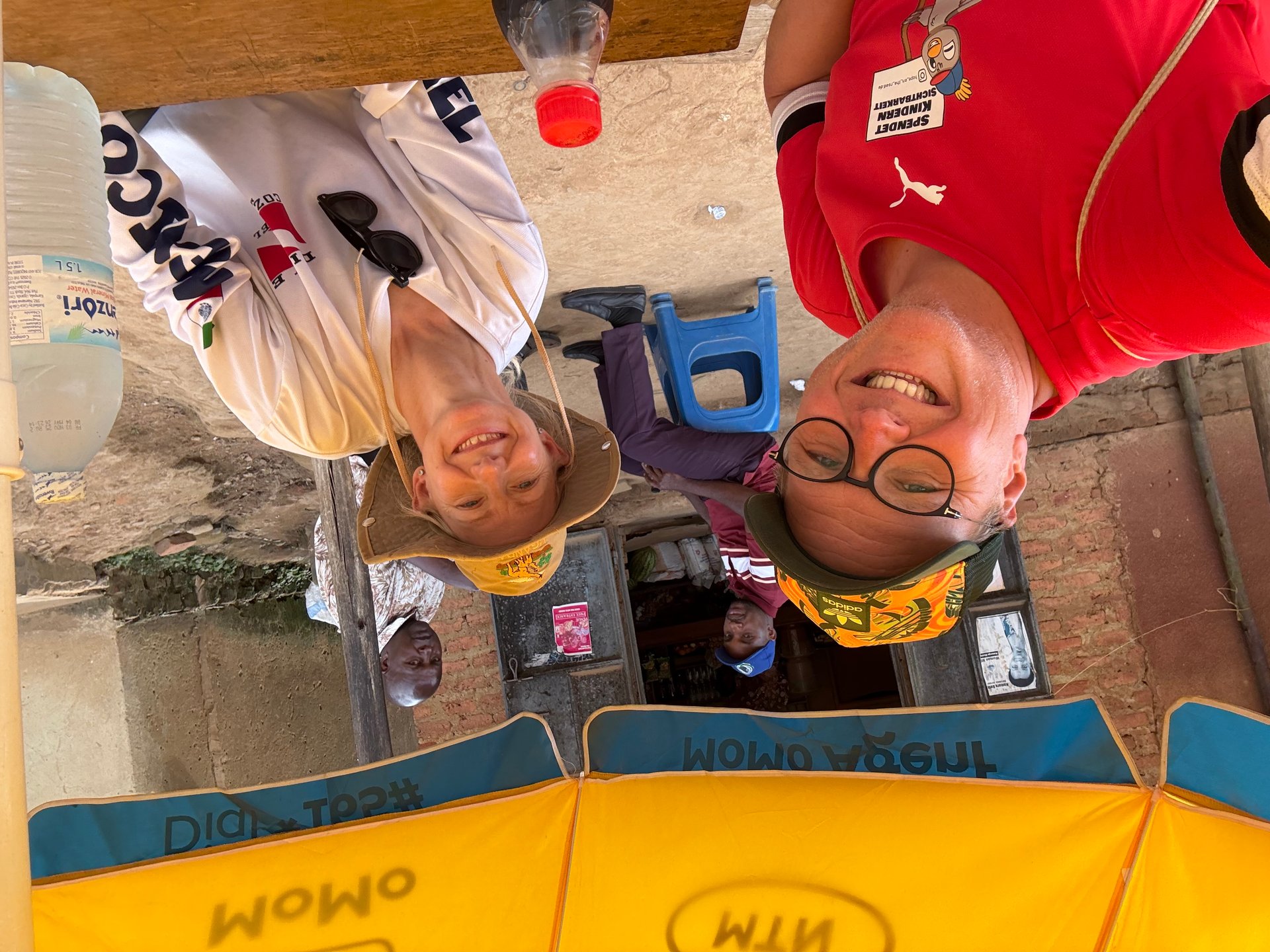
In June 2026, during my most recent visit, Susanne and I sat on a bench outside a small shop on Buhoma's main road, sharing water under a makeshift parasol. The shop was the kind of roadside enterprise that exists in every village in south-western Uganda — a few shelves of essentials, a bench for customers, a corrugated roof that extends far enough to provide shade. We had been walking the village, and the stop was unplanned. The conversation with the shopkeeper was brief, friendly, and entirely ordinary — the kind of interaction that happens when you are not on a schedule and the village is not performing for tourists. It was one of the most pleasant half-hours of the trip, and it involved nothing more than sitting on a bench and drinking water.
Wildlife Beyond Buhoma — A Crocodile on the Nile
Uganda's wildlife is not confined to the gorilla forests. During my October 2024 journey, before reaching Bwindi, I spent time in Murchison Falls National Park — the country's largest protected area, covering 3,893 square kilometres along the Victoria Nile. On a boat safari upstream from Paraa, we observed Nile crocodiles resting on the riverbanks. They were at a comfortable distance from the boat, but the impression of size and power was immediate. These are animals that can exceed five metres in length, and their stillness on the bank is deceptive — they are capable of extraordinary speed in water. Watching them from the boat, with the dense riverine forest behind and the Nile flowing wide and green, the scale of Uganda's wildlife estate became tangible in a way that reading about it does not convey.
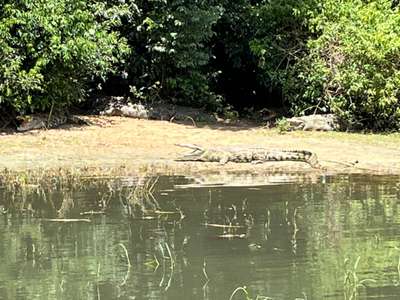
The comparison between Murchison Falls and Bwindi is instructive for understanding what Uganda offers beyond gorilla trekking. Murchison Falls is savanna and river — open landscapes, boat safaris, large mammals visible at distance, and the dramatic spectacle of the Nile forcing through a seven-metre gap in the Rift Valley escarpment. Bwindi is closed-canopy montane forest — dense, steep, intimate, and defined by the primate encounter rather than the panoramic game drive. Both are extraordinary. They are not substitutes for each other. A visitor who experiences only one of them has seen a fraction of what the country contains.
The same is true at the community level. Murchison Falls has its own boundary communities, its own revenue-sharing dynamics, and its own version of the tension between conservation infrastructure and village life. What differs is the density of the relationship. At Bwindi, and particularly at Buhoma — the oldest gorilla trekking sector, operating since 1993 — the community and the park are woven together at an unusually fine grain. Trekkers walk through the village. Lodge staff live in the village. Rangers come from nearby families. The orphanage children hear the briefings at the UWA headquarters from their courtyard. The proximity is the point: gorilla conservation at Bwindi is not a remote wilderness project. It is a village-level negotiation between wildlife value and human need, played out daily on a road you can walk in fifteen minutes.
What the Comparison Reveals
Across seven GPS-documented days of travel through Uganda between October 2024 and June 2026, the pattern that emerged most consistently was not the gap between rich and poor, or between tourists and locals. It was the gap between what is funded by the formal economy — gorilla permits, lodge investment, UWA operations — and what is funded by everything else: Nicholas's personal fundraising network, community labour on the HopeKitchen, the shopkeeper's roadside bench, the three-wheeled boda-boda that someone engineered from available parts.
The formal economy produces impressive results. Uganda's mountain gorilla population — 459 individuals in the 2018–2020 census, conducted jointly by UWA, the Greater Virunga Transboundary Collaboration, and the Max Planck Institute for Evolutionary Anthropology — has been increasing. The permit system generates substantial revenue. The lodges around Bwindi employ hundreds of people. The revenue-sharing programme has built schools and health posts in communities that would not otherwise have them. Measured by its own objectives, gorilla conservation at Bwindi is among the most successful community-wildlife programmes in Africa.
The informal economy fills the gaps that the formal system was not designed to cover. Nicholas feeds children on a week-by-week basis because no grant mechanism covers orphanage operating costs. The HopeKitchen goes up brick by brick because no lodge operator is building a communal kitchen for the village. The teenagers pose for cameras they will never own because the smartphone economy has not reached them, even though the tourists who photograph them carry devices worth more than a month's village income. None of this is a failure of the gorilla conservation model. It is an accurate description of what that model does and does not do.
For travellers considering Bwindi, the practical implication is straightforward: spend time in the village. Walk the road between the lodges and the trailhead. Stop at the roadside shops. If Nicholas is available, ask him about the orphanage. If the HopeKitchen construction is visible from the path, look at it — and look at the view from the site, which is one of the finest across the Buhoma valley. The gorilla trek is extraordinary and worth every dollar of the permit. The village is free, takes no permit, and offers a form of understanding that the forest does not provide.