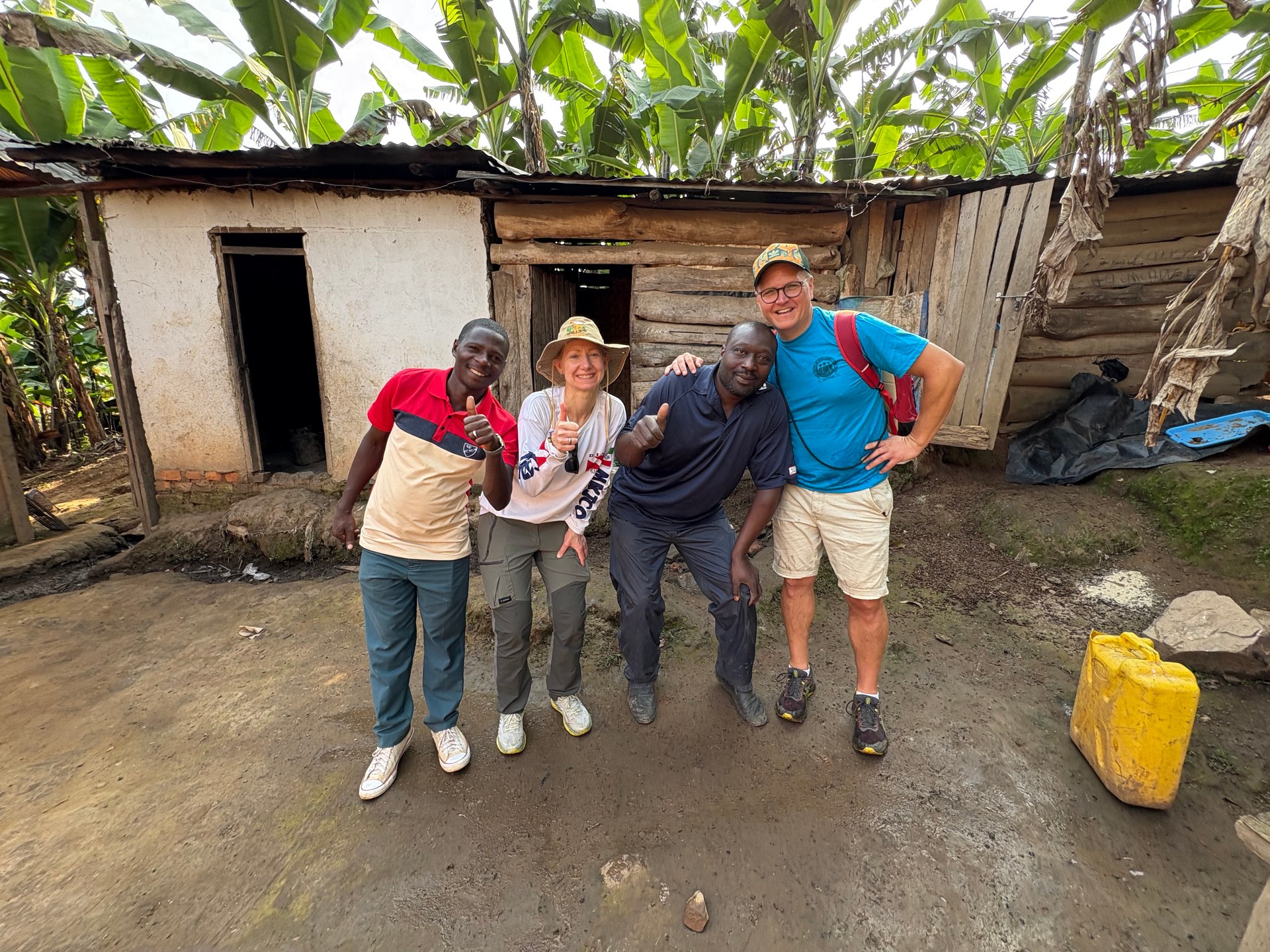
On the morning of June 21, 2026, we visited a chicken farmer in Buhoma to see how he raises his birds. His farm sits at GPS coordinates −0.9713°N, 29.6142°E — a few minutes' walk from the main road that leads to the Bwindi park gate. He keeps his flock with real care, separating the chicks by age, managing their feed and shelter in ways that reflect years of accumulated practice. We have bought chicks from him on multiple visits, and they have gone to the nearby orphanage — kept for eggs, and occasionally for meat. He talks about his birds the way someone talks about a livelihood they have genuinely invested in.
What strikes you, standing in that farmyard, is the sound. There are the chickens, obviously. But behind them — from the treeline at the edge of the property, from the canopy of the forest that begins less than a kilometre away — there is an almost continuous layering of calls that has nothing to do with any bird you have heard before. Bwindi's forest begins at the boundary of someone's farm, and the boundary is not acoustic. The birds do not stop at the fence.
Uganda records more than 1,050 recognized bird species — a number that exceeds the entire checklist of Europe. This is not a detail that appears in most travel guides. The marketing focus is on mountain gorillas, and deservedly so. But for anyone with a serious interest in birds, Uganda — and Bwindi in particular — is a destination that stands apart from anything available on the European continent or in most of the rest of the world. This article covers what that actually means in practice, built from 14 documented visits across multiple seasons.
The Numbers in Context: Uganda vs. a Continent
Europe, as a geographical and ornithological zone, has recorded approximately 700 bird species across its full extent from Portugal to the Ural Mountains — a landmass of close to 10 million square kilometres. Uganda, at 241,000 km², records more than 1,050. The disparity is not easily explained by area alone. Uganda's bird diversity reflects its position at the intersection of several major ecological zones: the East African savanna mosaic, the Albertine Rift highlands, the Congo Basin forest, and the Nile Basin wetlands. A country that touches all of these regions simultaneously will accumulate a bird list that few comparable areas can match.
The practical implication for visiting birders is that Uganda is not a destination for ticking familiar species in an unfamiliar setting. It is a destination for encountering bird families, genera, and ecological guilds that simply do not exist in Europe at all. Sunbirds, bee-eaters, rollers, hornbills, barbets, weavers, bishops, whydahs — entire groups represented by nothing comparable in a European context. A visitor arriving in Uganda for the first time with a serious bird interest should expect a list growth that is difficult to anticipate.
Uganda has twelve national parks and three active game reserves, each offering a different bird community. The northern parks — Murchison Falls, Kidepo Valley — hold species of the savanna and semi-arid zone, including shoebills in the wetlands below Murchison's falls. Queen Elizabeth National Park, in the west, offers fish eagles, flamingos during migration periods, and a large Palearctic migrant community that arrives from Europe each November. Bwindi, in the south-west, is where the forest endemic list concentrates — and it is this combination of forest specialist and Albertine Rift endemic species that makes it the most important single site on Uganda's bird map.
Bwindi's 350 Species and the Albertine Rift Endemic List
Bwindi Impenetrable National Park records more than 350 bird species within its 321 km². More than 70% of these are forest specialists — birds that depend on intact, closed-canopy forest and that disappear from degraded or fragmented landscapes. This concentration of forest-dependent species in a single park reflects Bwindi's status as a forest refugium: a patch of forest that persisted through the climatic fluctuations of the Pleistocene when much of East Africa's woodland contracted, allowing species to survive and diverge in isolation.
The 23 Albertine Rift endemic species within Bwindi are the birds that bring dedicated listers here specifically. The Albertine Rift is a geological and biological zone running from the northern end of Lake Albert down through the highlands of Rwanda, Burundi, and eastern DRC — a chain of lakes, volcanoes, and forest blocks that acted as a refuge for evolution over millions of years. The birds that evolved in this zone and are found nowhere else include some of the most visually striking and ecologically specific species in Africa.
The African green broadbill (Pseudocalyptomena graueri) is the bird most frequently cited as the primary target for visiting listers. It is a small bird with a disproportionate reputation — compact, brilliantly green, with a wide bill adapted to forest-floor foraging — found in Bwindi and a handful of sites in eastern DRC, and essentially nowhere else. Shelley's crimsonwing, a small finch of dense undergrowth, is another. Grauer's rush warbler and Grauer's swamp warbler occupy the wetland margins that appear at Bwindi's lower altitudes. Chapin's flycatcher is an unremarkable-looking bird of enormous rarity. Each of these species requires presence in a specific habitat type within Bwindi; a general gorilla trekking visit will not encounter all of them.
Beyond the endemic list, Bwindi holds a significant population of more widespread African forest species that are absent from, or uncommon in, other Ugandan parks. Great blue turacos move through the canopy in groups of four or five, their size and iridescent colouring making them the most immediately recognizable forest bird for a first-time visitor. Black-and-white-casqued hornbills produce a loud wing-beat that announces their presence before they become visible. Sunbirds — eight or more species within the park — work the flowering understorey at forest edges. The forest walks that are available alongside gorilla trekking produce, for anyone paying attention to birds, a full-day list that would represent the ornithological equivalent of several weeks birding in most European countries.
[QUOTE: local birding guide or ranger on the best time of day and location for finding Albertine Rift endemics in Ruhija]The Ruhija Sector: Bwindi's Birding Heartland
Ruhija is the eastern sector of Bwindi Impenetrable National Park, situated at 2,200 to 2,350 metres above sea level — the highest of the four trekking sectors. Its elevation produces a cooler, more open montane forest type that differs noticeably from the dense, lowland-influenced forest of the Buhoma sector in the north. This altitudinal difference is significant for birders because several Albertine Rift endemics are more reliably found in the montane zone that Ruhija represents.
Guided bird walks in Ruhija are available from the sector's community campsite and ranger post. The standard format is an early morning walk — departing before 7:00 am — through forest trails that differ entirely from the gorilla trekking routes. Birding guides in Ruhija have accumulated detailed knowledge of where specific species hold territory, which makes the early morning walk far more productive than independent exploration would be. The African green broadbill, in particular, has specific perching and foraging sites that experienced guides know well and that a visitor without local knowledge would spend a full day searching for unsuccessfully.
Ruhija also sits adjacent to a patch of wetland that holds the Grauer's swamp warbler and provides habitat for the Grauer's rush warbler in the margins between forest and water. The combination of montane forest, wetland margin, and forest edge within a single accessible area makes Ruhija the most efficient single site for working through the Albertine Rift endemic list.
The sector is less visited than Buhoma — the gorilla trekking groups assigned to Ruhija are smaller, the infrastructure more basic, and the drive from Kabale or Kisoro longer and more demanding. For birders, this lower footfall is an advantage: the trails are quieter, the forest less disturbed by passing trekking groups, and the birding atmosphere more conducive to the patient, slow movement that forest birding requires.
Birding Beyond Bwindi: Uganda's Other Key Sites
Bwindi is where Uganda's forest endemic list concentrates, but the full 1,050-species country total requires other habitats. A complete Uganda birding itinerary typically combines Bwindi with at least two or three other sites that access different ecological zones.
Murchison Falls National Park, in the north-west, is the primary site for the shoebill — a prehistoric-looking wading bird with one of the most devoted international followings of any African species. The shoebill occupies papyrus swamps along the Albert Nile delta and the wetlands south of the park. A boat trip from the park's delta sector is the standard method for locating them, and reliable sightings are more consistent here than at most other shoebill sites in East Africa.
Queen Elizabeth National Park holds a different community: the open savanna and shoreline species of the Albertine Basin. The Kazinga Channel — a natural waterway connecting Lakes Edward and George — supports large concentrations of African fish eagles, various kingfisher species, and a high diversity of waterbirds. Flamingos migrate to the channel from Kenya and Tanzania at certain times of year. The open grasslands of the park add rollers, bee-eaters, harriers, and a range of raptors that are largely absent from Bwindi's forest interior. A combined Bwindi and Queen Elizabeth itinerary covers both forest and savanna/wetland bird communities — a combination that, in under ten days, can produce a country list well above 400 species.
Budongo Forest Reserve, accessed from Murchison Falls NP, provides the chimpanzee tracking experience that many visitors combine with the shoebill search — and adds a different forest bird community, including a suite of West African forest species that extend into Uganda at this western edge of the Albertine Rift.
Practical Birding at Bwindi: What Actually Works
Based on 14 documented visits to Bwindi and surrounding areas — including extended stays in October 2024, January 2026, and multiple visits in 2026 — the most consistent observation about birding here is that early morning hours and unhurried movement produce results that afternoon walking does not. Forest birds are most active between dawn and approximately 9:30 am; by mid-morning, the forest becomes noticeably quieter and movement-based detection drops.
The combination of gorilla trekking (which typically occupies the mid-morning to early afternoon) and a dedicated birding walk (early morning or late afternoon) is practical from Buhoma. Many lodges in the Buhoma sector can arrange birding guides through the park or community guide programmes. The quality of guides varies significantly — a guide who knows the calls and territory of the Albertine Rift endemics is genuinely transformative for a serious birder, while a general nature guide will point out common species but miss most of the target birds.
For visitors in June — the month of the farm visit documented here, when photographs at GPS −0.9713°N, 29.6142°E and −0.9617°N, 29.6109°E were taken — the forest is at peak foliage density. This makes certain birds harder to see in the canopy but produces excellent conditions for understorey species. Warblers, flycatchers, and the denser-vegetation specialists are most accessible in this season. The trails themselves are manageable but occasionally muddy in the lower-elevation sections; rubber-soled waterproof footwear makes a practical difference.
Binoculars are essential; most forest birding here is detection-by-call first and visual confirmation second. A compact field guide covering Albertine Rift species specifically is more useful than a general East Africa bird guide, which tends to be too broad and too large for practical use on a trail. Several Bwindi-specific checklists are available from UWA at the Buhoma ranger station; a current list considerably improves the focus of any walk.
Birds and the Conservation Economy
The chicken farmer in Buhoma — whose farm we visit regularly, most recently in June 2026 — is not a figure in the conservation narrative the way a ranger or a gorilla family is. He is a local entrepreneur, focused on raising poultry well and selling into a community that needs reliable protein. But he lives at the edge of a forest that holds 350 bird species, 23 Albertine Rift endemics, and a bird diversity that exceeds the whole of Europe. The conservation infrastructure that protects that forest benefits his farming in ways that are largely invisible to him day-to-day: the watershed services the forest provides, the climate buffering, the soil stability at the boundaries between farmland and forest slope.
The gorilla trekking economy that funds Bwindi's protection also funds the ranger presence that keeps the forest intact for birds, elephants, pangolins, and the full community of species that makes Uganda's 1,050 bird species possible. Birding tourism in Uganda is a smaller economic line than gorilla tourism, but it is growing, and it brings a visitor demographic — typically patient, low-impact, often returning — that is well-suited to the kind of careful, high-value tourism model that Bwindi's conservation needs to sustain.
For any visitor who plans to come to Uganda for the gorillas, building in time for birding is the least complicated upgrade available. The species are there. The guides exist. The logistics are entirely compatible with a standard gorilla trekking itinerary. And the experience of standing on a forest trail at 6:30 in the morning in Ruhija, listening to an African green broadbill call from somewhere in the undergrowth while the forest starts its day — that belongs in a different category from anything a European birder will have encountered before.