Uganda holds more than 1,000 recorded bird species — a total that reflects the country's extraordinary position at the intersection of seven African biogeographic zones. Two of its national parks illustrate this diversity in sharply contrasting ways. Kibale National Park in western Uganda is one of the continent's finest examples of lowland equatorial rainforest, home to more than 360 bird species adapted to life inside and above a dense forest canopy. Lake Mburo National Park, situated some 240 kilometres to the south, presents an entirely different world: open savanna, acacia woodland, wetland margins, and the lake itself — a landscape that supports a bird community sharing almost no species with the forest to the north.
During nine documented visits to Uganda, including a ten-day stay in January 2026 and multiple field days in October 2024 and May 2026, the contrast between these two parks' bird communities has been one of the most striking features of birding across the country. A morning inside Kibale, tracking movement in the forest understory with a guide who identifies species by call alone, bears almost no resemblance to an afternoon boat trip on Lake Mburo, where kingfishers hover over open water and African Jacana walk on floating vegetation. Understanding both parks is essential for any birder planning a comprehensive Uganda itinerary.
Kibale National Park: The Forest Specialist
Kibale is defined by its forest. The park protects a large block of medium-altitude rainforest in the Albertine Rift — a region recognized as one of Africa's most important centres of bird endemism. With more than 360 recorded species, many of which are restricted to the Albertine Rift or to Uganda specifically, the park rewards serious birders with species that cannot be found anywhere else on the continent. Forest species require patience and specific technique: most are shy, many are canopy dwellers rarely visible from the ground, and a substantial number are best located and confirmed by song rather than sight.
The park's best-known birding route is the stretch of forest road known as the “Royal Mile” at the Busingiro Ecotourism Site, located roughly 14 kilometres from the main visitor centre. This forest avenue, flanked by tall trees on both sides, creates a productive corridor where light penetrates just enough to allow observation of canopy species without requiring the visitor to crane upward into impenetrable dark. Rare kingfisher species have been reliably observed here, and the combination of altitude and habitat produces a species list that differs meaningfully from Kibale's main forest block. Kibale's guides are particularly skilled: many can identify the majority of the park's bird species by ear alone, a capability that is essential given how much of the forest's avifauna remains hidden in dense cover for much of the day.
The ecological relationship between Kibale's primate and bird communities is worth understanding. The park's chimpanzee population — estimated at approximately 650 individuals, with a further 200 in the adjacent Kaniyo Pabidi Forest — disturbs fruiting trees and creates foraging activity that attracts a range of bird species. Hornbills, pigeons, and several frugivorous species follow chimpanzee troops through the canopy, exploiting the same fruit sources. Birders on chimpanzee tracking excursions frequently encounter bird species alongside their primate sightings, making the combination more productive than either pursuit undertaken in isolation.
Lake Mburo National Park: Savanna, Wetland, and Open Water
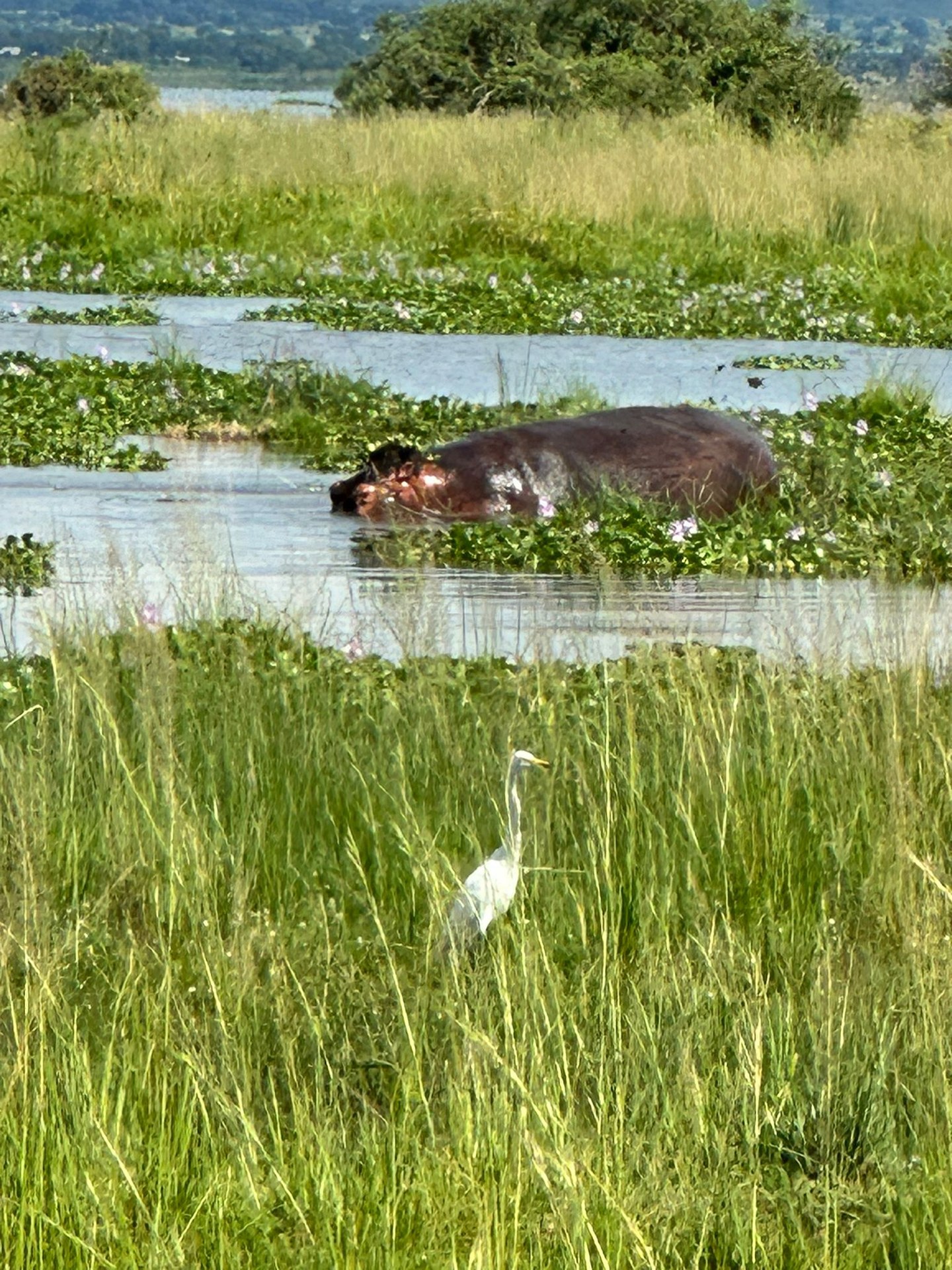
Lake Mburo presents a completely different birding environment. The park protects a mosaic of savanna grassland, acacia woodland, rocky hillsides, and a system of lakes connected by seasonally flooded channels. This habitat diversity, compressed into a relatively small protected area, supports a bird community dominated by open-country species, waterbirds, and wetland specialists that have no place in Kibale's closed forest. The Pied Kingfisher is one of Lake Mburo's most visible birds, regularly seen hovering above the lake surface before making its characteristic vertical dive. It is joined by Malachite Kingfisher along papyrus margins and Woodland Kingfisher in the surrounding acacia woodland.
The boat trip on Lake Mburo is the single most productive birding activity in the park. Departing from the Rwonyo jetty, the 1.5-hour motorized excursion runs at fixed times throughout the day and accommodates up to 14 passengers. The boat captain doubles as a trained guide, providing species identification as the trip progresses along the lake shore. Herons, cormorants, African Jacana, and various wader species concentrate along the margin vegetation, while open water species such as African Fish Eagle patrol from tall lakeside trees. The flat, calm conditions on the lake also offer a better chance of observing the African Finfoot — one of Africa's most secretive waterbirds — as it moves quietly through overhanging vegetation along the banks.
Sanga Gate serves as a formal landbird monitoring location within Lake Mburo, one of the park's designated sites for systematic bird population surveys. The data collected at Sanga Gate and comparable monitoring stations across Uganda contribute to the national-level understanding of how bird populations are responding to habitat change, climate variability, and conservation interventions. For visiting birders, the Sanga Gate entry point opens into western sections of the park where open grassland and mixed savanna produce sightings of ground-dwelling species — francolins, coursers, and various larks — that are absent from the eastern, more heavily visited part of the park.
Habitat Ecology: Why the Bird Communities Differ So Completely
The near-total difference between Kibale's and Lake Mburo's bird communities is not coincidental. It is the direct result of evolutionary specialization to radically different ecological conditions. Rainforest birds have evolved over millions of years to exploit food sources, nesting opportunities, and micro-habitats that exist only inside continuous closed-canopy forest. Their bills, feet, plumage, and behaviour are calibrated for life in low light, high humidity, and complex three-dimensional vegetation structure. Placed in open savanna, most would be unable to feed, shelter, or breed.
Savanna and wetland birds are equally specialized for their own conditions. Open country requires different flight styles, different foraging approaches, and different predator-avoidance strategies. The Pied Kingfisher's hovering technique — unique among African kingfishers in allowing sustained stationary flight above open water — evolved specifically to exploit the fish in exposed lake surfaces and rivers. This technique would be useless in a forest stream with overhanging vegetation blocking the view. The result of this deep specialization is that even parks in relatively close geographic proximity can support almost non-overlapping bird communities if their habitats differ sufficiently.
Uganda's position straddling multiple biogeographic zones amplifies this effect. Kibale sits within the Albertine Rift montane and lowland forest zone, which connects through to the Congo Basin forest system — the most extensive tropical forest outside the Amazon. Lake Mburo sits on the eastern edge of the East African savanna, with ecological connections to the Serengeti ecosystem and the open-country landscapes of Kenya and Tanzania. Both parks are geographically within Uganda, yet they represent fundamentally different African ecological realms.
Planning a Birding Itinerary Across Both Parks
A Uganda birding trip that includes both Kibale and Lake Mburo gains access to two entirely different wings of the country's avifauna. A logical routing from Kampala would visit Lake Mburo first — it lies along the main highway to the southwest and requires only a short detour from the Mbarara road — before continuing west to Kibale and then further south to Bwindi Impenetrable National Park. This west-circuit itinerary, requiring roughly ten to fourteen days to cover properly, produces species lists that no single-park visit can approach.
At Lake Mburo, morning and late afternoon are the most productive birding periods. A pre-dawn start on one of the park's walking trails captures the chorus that identifies the savanna species active during the cool hours, while the boat trip in mid-morning allows waterbird activity to be observed before the heat of the day reduces movement. Night drives, conducted with an armed UWA ranger whose spotlight scans the bush for nocturnal species, add owls and nightjars that are invisible during daylight.
At Kibale, the rhythm is different. Forest birding rewards those who move slowly and listen carefully. An early morning guided walk, starting before 07:00 when the forest dawn chorus is at its peak, is far more productive than a mid-morning session. The Royal Mile at Busingiro is a half-day walk that consistently delivers species unavailable elsewhere in the park. Guided walks are offered as three-hour outings, with the option of arranging multi-day foot excursions into more remote sections — though these require physical fitness, appropriate gear, and sufficient supplies, and are generally not viable during heavy rain when forest trails become impassable.
Together, Kibale and Lake Mburo demonstrate the core logic of Uganda birding: the country's species richness does not reside in any single location but is distributed across habitats that must be visited in combination. Forest endemics require forest. Waterbirds require water. Savanna specialists require open ground. No park contains all of these, but Uganda as a whole does — and the birder willing to move between habitat types will find that the species tally climbs faster than in almost any other country of comparable size.