Uganda holds more than 1,050 recorded bird species — a figure that places this landlocked East African country among the top five birding destinations on the continent. Much of that diversity is concentrated in two contrasting ecosystems: the dense Afromontane rainforest of bwindi forest national parkin the southwest, and the expansive savanna, woodland, and riverine corridor of Murchison Falls National Park in the northwest. Where Bwindi is prized for its Albertine Rift endemics and forest specialists, Murchison Falls offers a fundamentally different birding experience — one built around the drama of the Victoria Nile, wide open grasslands, and a landscape that changes character dramatically from sector to sector. Understanding those sectors, and what each produces for the visiting birder, is the key to planning a productive visit.
Structured bird monitoring across more than twelve sites within Murchison Falls National Park has recorded upwards of 80 species in a single survey season. Those surveys, conducted by experienced field teams using total count and point-count methods, covered both waterbird sites along the Nile and its associated wetlands and dedicated land-bird transects through the park's terrestrial habitats. The resulting dataset provides the clearest sector-by-sector picture of bird distribution within the park available to date, and it forms the backbone of this guide. During nine documented visits to Uganda — including time at Murchison Falls in October 2024, January 2026, and May 2026 — the patterns described in that monitoring data have proven reliable across different seasons and conditions.
Paraa: The South Bank Gateway and Nile Margins
The Paraa area, where the park's main lodge complex sits on the south bank of the Victoria Nile, is the gateway sector for most visitors and one of the most reliably productive for a wide range of species. The combination of Nile riverbank, acacia scrub, short grass lawns, and the open water of the ferry crossing creates a habitat mosaic that attracts waterbirds, raptors, and savanna species within a compact area. Dawn walks along the river bank from Paraa consistently produce African Fish Eagles, Goliath Herons, and multiple kingfisher species. The Malachite Kingfisher (Alcedo cristata) is a near-constant presence at any shaded overhang along the water's edge, its dark blue cap and rufous underparts making it one of the more straightforwardly identified species in the park.
The lodge grounds themselves — particularly at dusk — attract nightjars, and the acacia trees bordering the short-grass areas are reliable hunting perches for the Grey-headed Kingfisher (Halcyon leucocephala). This species, unlike its fish-hunting relatives, is a savanna bird that takes insects and small lizards, and it ranges well away from water into the drier interior of the park. The Pied Kingfisher (Ceryle rudis) — the largest black-and-white kingfisher in Africa and an unmistakable hovering fisher above the Nile — is present year-round in considerable numbers. The twice-daily game drive out from Paraa into the northern sector of the park passes through a transition from riparian woodland to open grassland that adds grassland specialists such as Black-bellied Bustard, Denham's Bustard, and multiple lark species.
Buligi and the North Bank: Open Savanna Birding in Bwindi Forest National Park's Counterpart Landscape
Cross the Nile by ferry and the landscape changes immediately. The north bank — the Buligi circuit and the tracks extending toward the Albert delta — is the park's principal savanna sector and the area most different in character from anything that bwindi forest national park and its montane forest can offer. Where Bwindi Impenetrable National Park is defined by dense, layered canopy and the difficult visibility of closed forest, the north bank of Murchison Falls is open country: wide grasslands dotted with Borassus palms, shallow seasonal ponds, and scattered termite mounds that serve as lookout posts for raptors.
This is the sector for large ground birds. Abyssinian Ground Hornbill, one of Africa's most striking species, walks deliberately through the short grass in pairs or small groups. Secretary Bird has been recorded in the more open grassland sections. The palm-dotted landscape of the Buligi circuit is particularly good for Palm-nut Vulture, a species with a strong association with Borassus palms throughout its range in Africa. Grey Crowned Cranes — Uganda's national bird — move through the wet-season grass in family groups, and wattled plovers call persistently from the edges of any seasonal water. The morning light on the north bank, with animals casting long shadows across the grass, is among the most rewarding birding environments in the country.
Falls Woodland: Riverine Forest at the Cascade
The Falls Woodland sector, covering the riverine forest that flanks the Victoria Nile between the delta rapids and the main falls, is the most structurally complex terrestrial habitat within the park and the most important for forest-dependent species. The closed canopy of Cynometra, Maesopsis, and fig trees along the gorge creates conditions that are atypical for a savanna park and that support a bird community quite unlike anything found in the open grasslands a few kilometres away. Monitoring at this site has documented species from multiple habitat guilds that converge at this vegetative edge.
The Lilac-breasted Roller (Coracias caudatus), among Uganda's most visually striking birds, is regularly encountered at the Falls Woodland margins where open ground meets the woodland edge. Its brown back, ultramarine body, and distinctive elongated outer tail feathers make it one of the most photographed birds in the park. Sunbirds, weavers, and a variety of flycatchers move through the fig trees when fruiting, and the waterfall itself creates enough mist to attract species rarely seen in drier parts of the park. The trail to the top of the falls is one of the most productive single birding walks in Uganda, particularly in the early morning when foot traffic is minimal and bird activity is at its peak.
[QUOTE: local guide on first impressions of the Falls Woodland at dawn]
Chobe Terminalia: Open Woodland and Savanna Specialists
The Chobe Terminalia sector takes its name from the dominant tree species —Terminalia— that characterise the open woodland covering large portions of the park's interior south of the Nile. This is quintessential Uganda savanna country: scattered trees over grassland, termite mounds providing perches for raptors and rollers, and a ground layer that alternates between short-grazed turf and taller patches of dry-season grass. Monitoring surveys at this site have been particularly valuable for establishing baseline counts of land-bird species that are underrepresented in waterbird-focused survey methods.
Characteristic species of Chobe Terminalia include the African Hoopoe, African Grey Hornbill, and multiple species of starling, including the striking Superb Starling and the more subtly coloured Splendid Starling. Raptors are well represented: Long-crested Eagle, African Hawk-Eagle, and Bateleur are all regular. The open ground between trees supports Yellow-throated Longclaw in wetter patches and Crested Francolin in drier areas. During survey work, the combination of point-count transects and opportunistic observation at this site reliably yields species totals higher than any other single land-bird site within the park — a reflection of the habitat's capacity to support both woodland-dependent and grassland-associated birds simultaneously.
The Victoria Nile as a Birding Sector
Uganda's bird monitoring programme applies a total-count methodology to waterbird sites, with survey teams moving by boat along defined stretches of the Nile and recording all waterbirds encountered. This method captures species that are easily missed in land-based surveys — including roosting herons, resting cormorants, and species feeding along undercut banks invisible from the road. The Nile between Paraa and the delta is one of the most consistently productive stretches for this type of survey in East Africa.
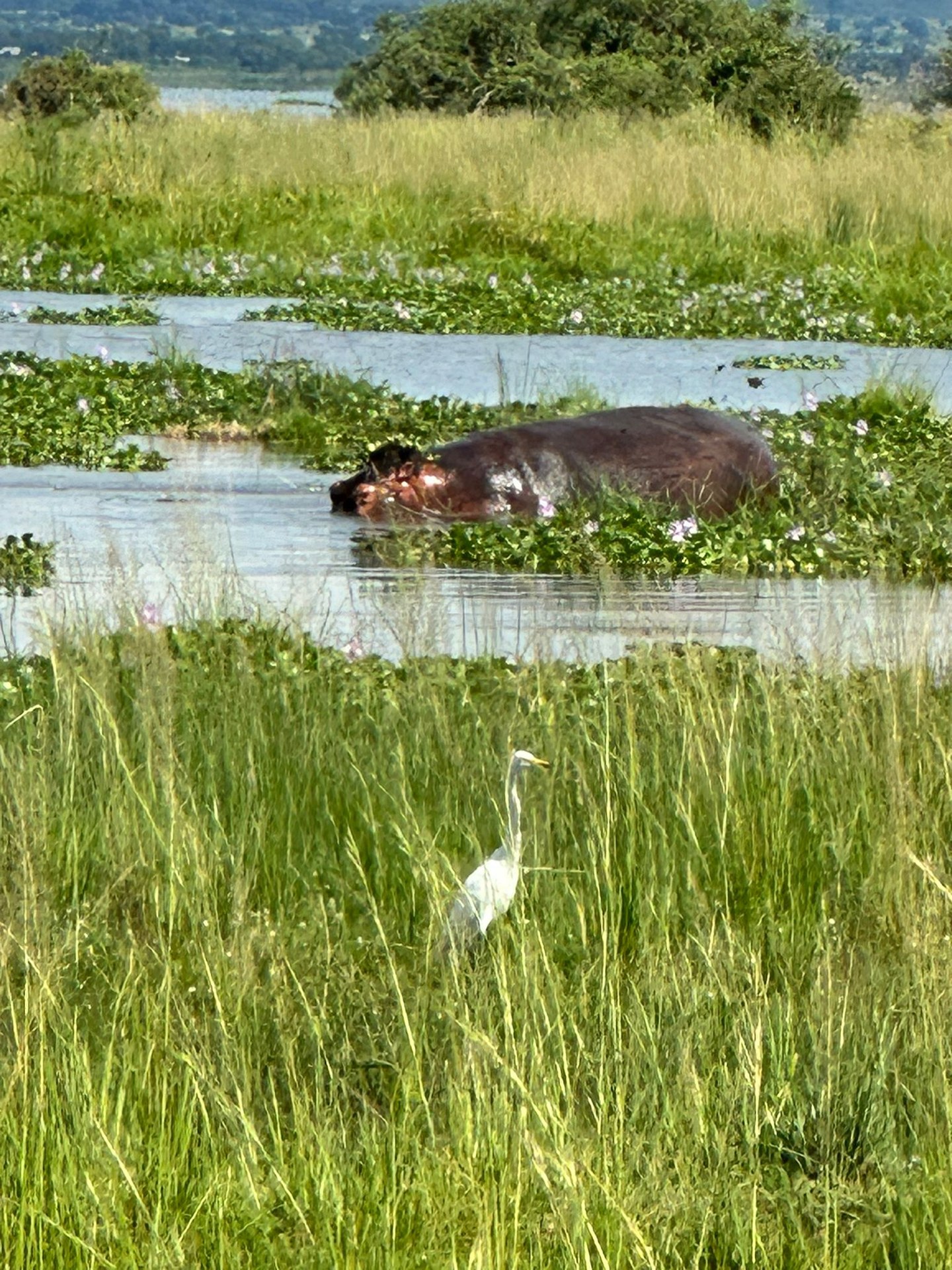
The species list from waterbird counts in this sector is dominated by herons and egrets — Great White Egret, Black-headed Heron, Striated Heron, and Purple Heron all breed along the bank — but includes significant numbers of cormorants, darters, kingfishers, and both White-winged and Whiskered Terns. The hippo pools scattered along this stretch attract Egyptian Geese, Spur-winged Geese, and in the right season, migrant waders working the exposed mud margins. The morning boat launch from Paraa, timed to coincide with first light, typically produces the highest species counts of any single two-hour birdwatching activity available to visitors in the park. Ambassadors and senior visitors to Uganda regularly include this stretch of river on their itineraries — Sasamaya Takuwa, then Ambassador of Japan to Uganda, was among those who visited Murchison Falls during this period, underscoring the park's international standing as a wildlife destination.
Uganda Birding Across the Parks: Murchison and Bwindi Forest National Park Together
For birders planning a Uganda itinerary, the choice between parks is rarely an either/or decision. Bwindi forest national park — known worldwide for mountain gorilla trekking — is also the single most important site in Uganda for Albertine Rift endemic birds. Of the 23 Albertine Rift endemic bird species recorded in Uganda, the majority can be found within Bwindi, including the African Green Broadbill, Grauer's Rush Warbler, and Shelley's Crimsonwing. These species are entirely absent from Murchison Falls, which lacks the montane forest habitat they require.
Uganda's only true endemic bird — Fox's Weaver (Ploceus spekeoides) — is found at neither Murchison nor Bwindi. Its confirmed range is restricted to the papyrus swamps and tall-grass wetlands of the Lake Kyoga and Lake Opeta basins in eastern Uganda. A complete Uganda birding itinerary therefore requires movement across the country's north-to-south axis: savanna parks such as Murchison Falls in the northwest, the Albertine Rift forests of Bwindi Impenetrable National Park in the southwest, and the eastern wetlands for the endemic weaver. Survey teams working across all these zones have used consistent methodology — experienced birders with binoculars and a field guide, supported by local site guides — to build a national monitoring picture that is now one of the most detailed in East Africa.
The lesson of sector-by-sector monitoring in Murchison Falls applies to Uganda birding generally: habitat determines species composition more reliably than any other variable, and a guide who knows where each habitat type begins and ends is worth more than any equipment. Whether that habitat is the riverine forest clinging to the Nile gorge at Falls Woodland, the open Terminaliawoodland of Chobe, the wide savanna of Buligi on the north bank, or the closed-canopy montane forest of bwindi forest national park in the southwest, the birds are there — and they reward the visitor who arrives with a plan.