The Victoria Nile is the spine of Murchison Falls National Park. From its entry point in the east to the thundering drop at Murchison Falls and onward to Lake Albert in the northwest, the river cuts through savannas, wetlands, and floodplains that together create one of East Africa's most concentrated waterbird habitats. Uganda Wildlife Authority monitoring data records more than 854 waterbird sightings within the park, a figure that reflects how thoroughly the river corridor has been surveyed and how consistently productive it remains throughout the year.
Visiting the park in October 2024 and again during an extended stay in January 2026, the sheer density of birds visible from a single boat trip between Paraa and the falls made clear why systematic monitoring produced numbers on this scale. Cormorants drying their wings on mid-river snags, Egyptian Geese in loose groups on every sandbank, and herons stationed along both banks at intervals of a few hundred metres — the Nile functions as a linear wetland that supports waterbird populations far beyond what any isolated lake or marsh of equivalent area could sustain.
Egyptian Goose: The Dominant Waterbird
With 373 recorded sightings, the Egyptian Goose is by a significant margin the most frequently encountered waterbird in Murchison Falls National Park. Alopochen aegyptiaca is a large, striking bird — broadly goose-shaped but technically a member of the shelduck subfamily — with chestnut eye patches and a bold mix of brown, grey, and white plumage that makes it unmistakable at a distance. Its calls, a rasping honk audible across open water, are among the most persistent sounds along the Nile.
Egyptian Geese are not exclusive to the water's edge. They graze on open grassland adjacent to the river and are frequently encountered during morning game drives across the savanna north of the Nile. Their dominance in the waterbird monitoring count reflects both their abundance and the ease with which observers record them: a group of twenty geese on a sandbar is impossible to overlook, while a single reed warbler in the marginal vegetation requires deliberate searching. The Egyptian Goose count of 373 is a robust baseline figure that underscores how well-suited the Nile environment is to large, open-country waterbirds.
Breeding pairs are territorial and defend riverbank nest sites vigorously against other geese and against much larger animals that approach too closely. During the dry season, when water levels fall and sandbanks extend further into the channel, non-breeding birds aggregate in larger groups that are concentrated on the sandbars for warmth and safety. These aggregations account for some of the highest single-location counts recorded during monitoring surveys.
Great Cormorant: 281 Sightings on the Nile
The Great Cormorant, Phalacrocorax carbo, is the second most frequently recorded waterbird in the park, with 281 monitoring sightings. Cormorants are visual fish hunters that pursue prey underwater, propelling themselves with their feet and steering with their wings in a manner distinctly different from surface-diving ducks. After each fishing bout, they emerge and spread their wings in the characteristic drying posture that makes them instantly recognizable perched on rocks or dead trees above the water.
On the Victoria Nile, Great Cormorants concentrate where fish are most accessible: around the turbulent water immediately below Murchison Falls, where stunned or disoriented fish are easy to catch, and in the slower pools and backwaters downstream where fish gather in the shallower margins. The species roosts colonially and is often found in groups of dozens on prominent perches — exposed rocks, bare branches extending over the water, or the edges of partially submerged snags. A boat passing a cormorant roost site typically flushes the birds in sequence as the vessel approaches, creating one of the more dramatic wildlife encounters that the Nile boat trip reliably produces.
The 281 sightings recorded in the monitoring data place the Great Cormorant as a genuinely abundant rather than merely occasional presence. Its numbers reflect the productivity of the Nile fish population and the availability of suitable roosting structures along both banks — a combination that Murchison Falls maintains year-round regardless of seasonal fluctuations in water level.
Herons, Egrets, and the Art of Standing Still
The heron family is well represented along the Victoria Nile and contributes significantly to the park's overall waterbird count. The Goliath Heron is the most imposing: standing up to 1.5 metres tall and with a wingspan approaching two metres, it is the largest heron species in the world and one of the most reliably encountered large birds on a Nile boat safari. Goliath Herons are typically solitary, maintaining individual feeding territories along the bank, and they tolerate approaching boats with patience that allows extended observation before eventually lifting off with slow, heavy wingbeats.
Grey Herons occupy similar riverbank habitats and are considerably more numerous than Goliath Herons, appearing at virtually every section of the river. Black-headed Herons are less tied to open water and are regularly encountered on the grasslands adjacent to the Nile, where they hunt rodents, insects, and frogs in the short grass. Night Herons — both Black-crowned and Rufous-bellied — roost in riverside vegetation during the day and become active at dusk, when the boat trip is typically returning to the Paraa launch site and observers can watch them moving to their feeding grounds over the river.
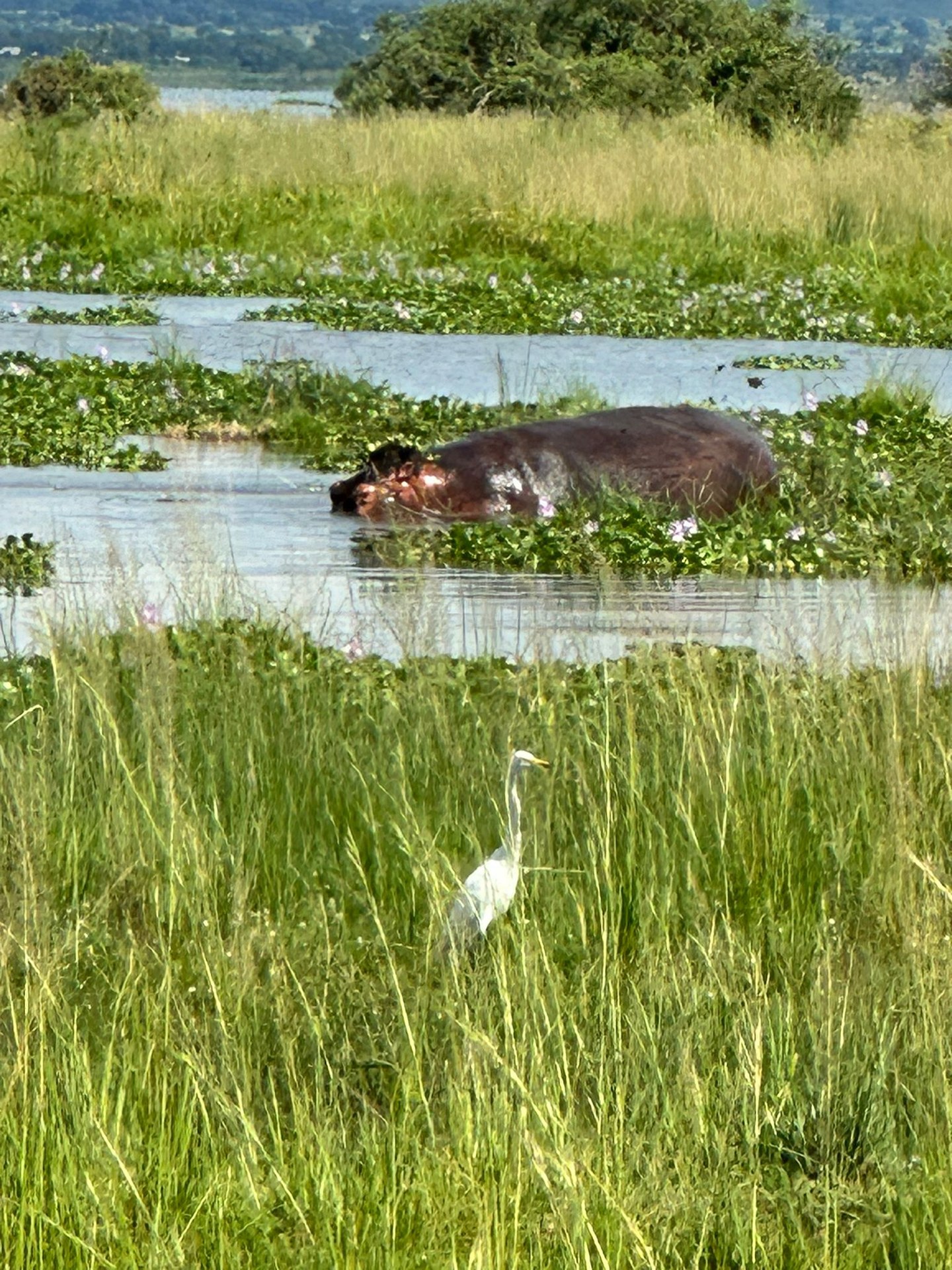
Egrets add white to the heron family's palette along the Nile. Great White Egrets stand prominently in the shallows or perch at the water's edge; Intermediate and Little Egrets occupy comparable habitats but at a smaller scale. During the wet season, egrets gather in mixed feeding aggregations with Yellow-billed Storks and Open-billed Storks at the floodplain margins where insects and fish are concentrated by rising water.
Storks along the Victoria Nile
Yellow-billed Storks are a regular presence on the Nile and are often encountered in the same slow-moving sections of the river that herons favour. They feed by a tactile method — sweeping the bill through the water with a partial gape and snapping it shut the instant they contact prey — that allows them to locate fish and invertebrates without relying on visibility in turbid water. This feeding strategy makes them effective hunters in both clear and muddy conditions, and during the rains when soil runoff colours the river, Yellow-billed Storks remain productive while purely visual hunters are less successful.
Open-billed Storks, named for the prominent gap visible when their bill is closed, specialize in molluscs and are most numerous during and after wet-season flooding when water snails become abundant in the floodplain areas. They congregate in groups that can reach several hundred birds in productive years, moving between the river edge and adjacent wetlands as conditions change. The Marabou Stork, enormous and ungainly on the ground but effortlessly soaring at altitude, is a scavenger presence along the Nile and is regularly seen roosting in riverside trees or following hippo movements on the river.
Kingfishers: Multiple Species on One River
The Victoria Nile corridor supports an exceptional diversity of kingfisher species across a range of sizes and feeding strategies. The Giant Kingfisher is the most conspicuous: large enough to be visible perched on an overhanging branch from thirty metres away, it dives for substantial fish prey and is a near-certain sighting on any full boat safari. The Pied Kingfisher, equally reliable, is the only kingfisher that hovers consistently over open water before diving, which makes it visible in areas where there are no convenient perches.
Malachite Kingfishers occupy the reed and sedge margins where the river narrows into sheltered backwaters, their vivid turquoise and orange plumage appearing briefly as they dart between perches. The Woodland Kingfisher, despite its name, often forages near water and is common in the riverside trees of the Nile corridor. Grey-headed Kingfishers and the Striped Kingfisher complete a tally that few single river systems in East Africa can match.
Encountering multiple kingfisher species in the same morning is routine on the Murchison Falls boat safari rather than exceptional. The combination of open water, reedy margins, overhanging trees, and fish-rich conditions provides each species with a distinct niche, preventing competitive exclusion and sustaining a kingfisher community that rewards any observer willing to spend time on the water.
Planning a Waterbird Safari on the Victoria Nile
The standard boat trip departs from the Paraa launch, located on the south bank of the Nile at the park's main visitor hub, and travels upriver to the base of Murchison Falls before returning. The journey covers approximately 17 kilometres in each direction and takes three to four hours at a pace that allows genuine observation rather than transit. Two boat sizes operate on this route: a larger vessel with more capacity and a smaller option that sits closer to the water and allows more flexible positioning for photography.
Morning departures, typically around 8 a.m., benefit from lower temperatures, calmer wind conditions, and peak bird activity. Cormorants are actively fishing rather than simply roosting; herons are at their feeding stations before the midday heat reduces their activity; Egyptian Geese are vocal and mobile across the sandbanks. Afternoon departures, usually around 2 p.m., offer the advantage of light falling on the northern bank, which is the more productive side for bird observation throughout much of the year, and they capture the late-afternoon movement of storks and egrets as they shift between feeding areas.
During a ten-day stay in January 2026, taking the boat trip on multiple mornings confirmed that the waterbird community is not static from day to day. Different sandbanks hold different aggregations of geese depending on water level and overnight disturbance; cormorant roosts shift between sites; heron territories are consistent but individual birds move within them. Repeated trips reward patience with a cumulative picture of the Nile waterbird community that no single outing can fully capture.
The 854+ waterbird count documented in Uganda Wildlife Authority monitoring data represents not a single dramatic event but the accumulated evidence of a river system in good ecological condition. Egyptian Geese and Great Cormorants dominate the numbers because the Nile provides exactly what they require: open water, fish, safe roosting sites, and space free from the agricultural pressure that reduces waterbird populations on rivers outside protected areas. For visitors to Uganda whose itinerary includes Murchison Falls National Park, the Nile boat safari is the most direct access to this waterbird community — and one of the most consistently rewarding wildlife experiences the country offers.