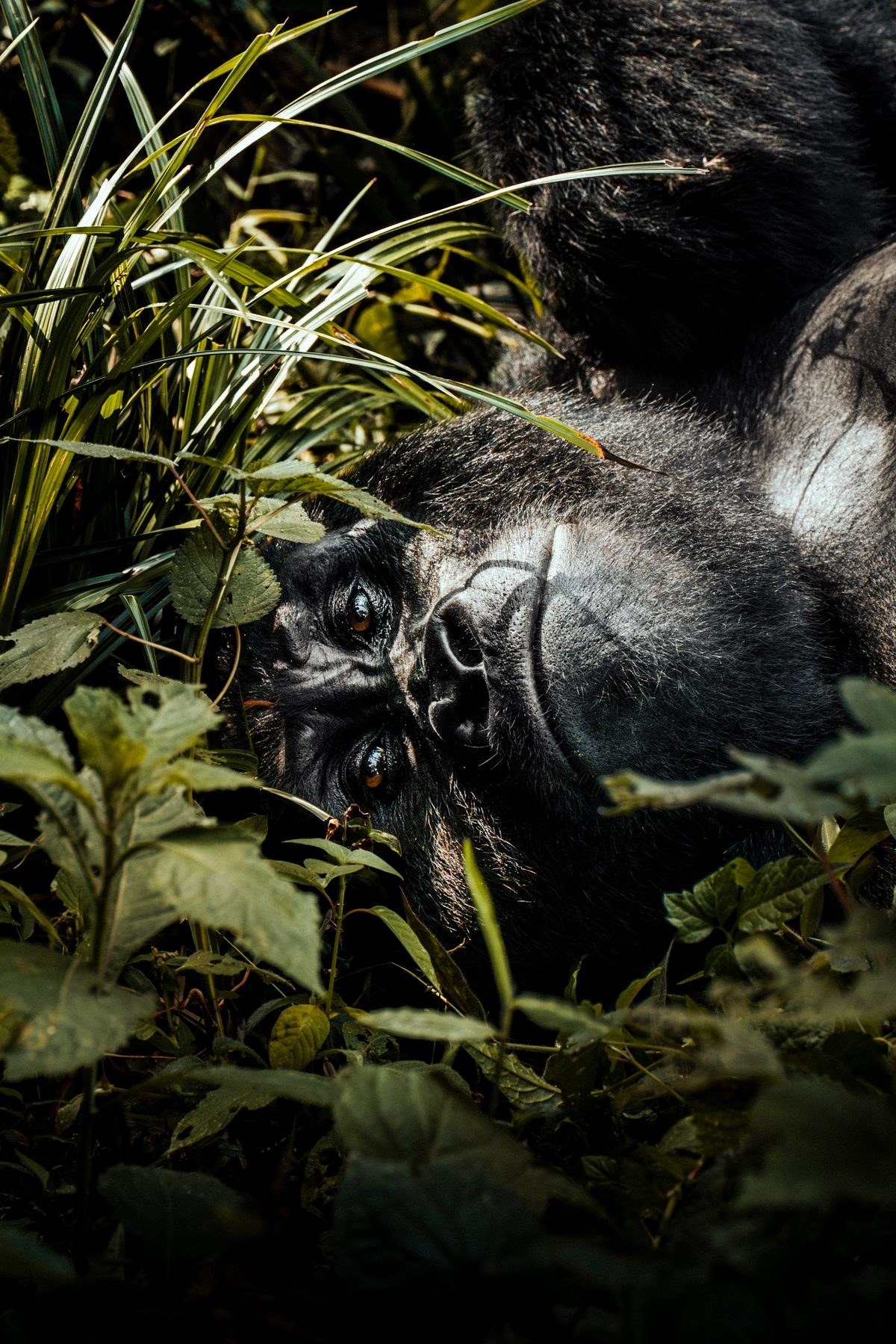
Across five visits to Bwindi Impenetrable National Park between January and June 2026, one dynamic came up in almost every conversation about community relations with the park: wildlife does not stay inside the boundary. Gorillas, baboons, elephants, and bush pigs move into farmland. Crops are destroyed. Families lose income. And the relationship between the community and the park that is supposed to benefit them becomes complicated by that loss. The Gorilla Organisation (GO), a UK-based NGO with a long operational history at Bwindi, has made this exact tension the focus of its programme work — through problem animal control on one side and enterprise development on the other.
The Human-Wildlife Conflict Problem at Bwindi
The term “human-wildlife conflict” covers a wide range of encounters, from a baboon in a maize field to an elephant demolishing a season's harvest overnight. At Bwindi, the specific profile of conflict incidents is shaped by the park's ecology and its immediate surroundings. The forest boundary is not fenced for most of its length. On one side: one of the world's most biodiverse tropical forests, home to approximately 459 mountain gorillas counted across Uganda in the 2018–2020 population census. On the other side: smallholder agricultural land, banana plantations, and vegetable gardens that represent the primary food source and income base for tens of thousands of people living in the boundary parishes.
According to the State of Wildlife Resources in Uganda 2026, between 2020 and 2025 elephants were responsible for the majority of reported human-wildlife conflict incidents nationally, followed by buffaloes, hippopotamuses, baboons, and large carnivores. At Bwindi specifically, the relevant species are somewhat different in scale: mountain gorillas and chimpanzees do move into farmland, but it is baboons and monkeys that generate the most persistent day-to-day crop-raiding complaints in boundary communities. This was confirmed in community consultations carried out in 2025, where multiple Batwa and farming communities explicitly named baboons and monkeys eating crops as a recurring livelihood problem. The response from Uganda Wildlife Authority rangers — threatening arrest if animals are chased — created a situation where communities felt unable to defend their own fields without legal risk.
This dynamic is at the core of why problem animal control matters as a conservation programme, not just as an agricultural one. When a family loses a crop to wildlife and has no legal recourse, no compensation mechanism, and no practical deterrent available to them, their attitude toward the park and the animals it protects deteriorates. In a landscape where gorilla conservation depends entirely on the goodwill and active cooperation of surrounding communities, that deterioration of trust is not a soft social concern — it is a direct threat to the long-term viability of the protected area.
What Problem Animal Control Actually Looks Like on the Ground
Problem animal control (PAC) as a structured programme involves several interlocking components. The first is early warning: community wildlife scouts or trained local monitors who identify when animals are moving toward the boundary and can alert farmers before damage occurs. The second is deterrence: physical and behavioural methods for discouraging wildlife from crossing into farmland, which at Bwindi includes noise-making, fire, chilli barriers, and in some cases beehive fences, which have proven effective against elephants in other African contexts. The third is response: when an animal does cross the boundary and cause damage, a structured process for documenting the incident, engaging UWA, and seeking either compensation or practical mitigation.
The Gorilla Organisation has contributed to all three components at Bwindi over its years of operation. Its community-facing work has included training of community wildlife scouts, support for the development of locally managed early warning systems, and the practical provision of equipment and materials for deterrence activities. This work sits alongside UWA's own operations. Uganda Wildlife Authority has implemented what the State of Wildlife Resources in Uganda 2026 describes as an integrated package of prevention, response, and community-based interventions to reduce human-wildlife conflict across its protected area network. The NGO role in this system is not to replace UWA but to extend its reach, provide resources it does not have, and maintain the community relationships that make the system function.
One concrete illustration of the scale of investment required for physical conflict prevention: at Mgahinga Gorilla National Park, located roughly 80 kilometres south-west of Bwindi, UWA maintains a 16-kilometre stone wall along the park boundary specifically to prevent crop-raiding by gorillas. That wall required significant construction investment and requires ongoing maintenance. At Bwindi, with its far longer and more complex boundary, the wall approach is not the primary solution — but it demonstrates that problem animal control is taken seriously enough to warrant major infrastructure commitment at the national wildlife authority level.
[QUOTE: local farmer or community wildlife scout on the practical experience of dealing with baboons or gorillas near the park boundary]
Enterprise Development: Building the Economic Case for Conservation
Problem animal control addresses one side of the equation: reducing the costs that communities bear as a consequence of living next to a national park. Enterprise development addresses the other side: increasing the benefits that communities derive from the park's existence. The Gorilla Organisation has worked on enterprise programming at Bwindi across a range of sectors, with a consistent underlying logic: if a household's income is substantially linked to the park being intact and the wildlife being alive, that household becomes an active defender of what it benefits from.
Beekeeping is one of the enterprise activities that has featured prominently in conservation-linked livelihood programmes at Bwindi and in comparable forest boundary contexts across Uganda. It requires modest capital investment, uses skills that can be learned relatively quickly, produces a marketable product, and has the secondary benefit of contributing to plant pollination around forest edges. When beehives are placed near forest boundaries, they also function as elephant deterrents — a dual-purpose intervention that simultaneously generates income and reduces conflict. Multiple community groups in the Bwindi area have expressed interest in beekeeping but noted a persistent barrier: lack of materials and, in some cases, suitable land for hive placement near forest edges where the benefit would be greatest.
Craft production is another enterprise domain that conservation NGOs have supported at Bwindi. Basket and mat making, pottery, and other traditional craft skills are documented among communities in the park boundary zone, particularly among Batwa communities who have the deepest traditional connection to the forest. The challenge for craft enterprise is not skill availability but market access and start-up capital. Skills exist; what is often absent is the initial investment in quality materials, the marketing channel to reach buyers, and the storage and display infrastructure to sell directly to the visitors who pass through the park's gateway communities. This is precisely the gap that enterprise development programmes, including those supported by the Gorilla Organisation, have worked to close.
The gorilla tourism economy at Bwindi provides the demand side for these enterprise activities. The park receives thousands of visitors annually, each of whom passes through gateway communities like Buhoma, Rushaga, Nkuringo, and Ruhija. A visitor who has just spent a morning in the forest with a habituated gorilla family is an emotionally engaged potential buyer of locally made crafts, a consumer of locally prepared food, and a potential client for community-guided nature walks. Connecting that demand to community supply requires enterprise infrastructure: organised groups, quality standards, reliable product availability, and visibility to lodge staff who can refer guests. Enterprise development programmes build exactly that infrastructure.
The NGO Role in the Bwindi Conservation Ecosystem
Understanding how the Gorilla Organisation fits into the broader Bwindi conservation ecosystem requires a clear picture of what each actor can and cannot do. Uganda Wildlife Authority is the statutory body responsible for managing Bwindi Impenetrable National Park. Its mandate covers law enforcement, habitat management, tourism administration, and community revenue sharing. It operates under government budget constraints, responds to government policy directions, and carries the full complexity of a national agency managing one of the world's most visited conservation sites. What UWA does at scale and with authority, NGOs complement with flexibility, community trust, and specific technical or financial resources.
The Gorilla Organisation's particular strength has been its ability to work directly with community groups at a granular level — visiting individual villages, training specific farmer groups, supporting particular women's associations or youth cooperatives — in ways that a national authority operating across dozens of protected areas cannot easily replicate at the same intensity. This is not a criticism of UWA; it is a structural reality of how large institutions and small NGOs can operate complementarily in the same landscape. The UWA-NGO relationship at Bwindi has, across several decades, been characterised by formal collaboration through memoranda of understanding, joint planning at the sector level, and information sharing that allows both parties to understand what is happening at the boundary.
Other NGOs active in the Bwindi area have operated in adjacent spaces. Empowering Vulnerable Communities (EVC), working in partnership with an Italian organisation, has focused on food security, agricultural support, seeds, and seasonal tools for vulnerable community members including Batwa households. The Bwindi Batwa Development Programme (BDP) has addressed Batwa land, education, and livelihood needs specifically. ABEG has provided training in practical craft and small-scale production skills including candle-making, shoe polish production, and beeswax oil processing. Each of these programmes occupies a different niche, and together they represent a substantial NGO presence in what is, by rural Ugandan standards, a relatively small geographic area.
The Gorilla Organisation's comparative position within this ecosystem has been its explicit gorilla-focused framing. Where other NGOs address poverty or Batwa rights broadly, GO has consistently connected its community work to the specific question of whether gorillas and people can coexist economically. This focus has shaped both its problem animal control work and its enterprise development approach: both are oriented toward reducing the practical costs of living with wildlife and increasing the practical benefits of doing so.
Corridor Disturbance and the Broader Habitat Challenge
The work of organisations like the Gorilla Organisation does not happen in isolation from larger landscape-scale threats. According to the State of Wildlife Resources in Uganda 2026, elephant and chimpanzee corridors connecting Budongo-Bugoma in the north and Kibale-Bwindi in the south have been disturbed by tourism infrastructure development, contributing to population declines. This finding places individual NGO interventions in a sobering context: the most careful crop-raiding deterrence programme cannot compensate for habitat fragmentation that prevents wildlife from moving through the landscape safely.
For the human-wildlife conflict challenge at Bwindi, corridor disturbance has a direct implication: animals that cannot move through connected forest habitat are more likely to come into contact with human settlements and agricultural land. A gorilla family confined to a forest fragment with deteriorating food availability will move further into farmland more frequently than one in a large intact forest with abundant resources. This means that the effectiveness of problem animal control measures at the park boundary is partly determined by decisions made at the landscape level — about infrastructure development, forest connectivity, and the management of buffer zones between protected areas and human settlements.
Enterprise development programmes that create economic alternatives to forest encroachment address this issue indirectly: a household with sufficient income from tourism-linked enterprise has less need to expand its agricultural footprint into forest buffer zones. But the connection between individual household economics and landscape-scale habitat connectivity is long and complex. What community-level NGO work can do is reduce the immediate human pressure at the forest edge; the broader landscape factors require policy-level intervention and sustained cooperation between UWA, district governments, infrastructure agencies, and the tourism industry that profits from the park's existence.
Across our visits to Bwindi in January and June 2026, the practical reality of this complexity was visible in the lived landscape. The forest boundary at Buhoma is metres from the first homesteads. The garden plots run right up to the park edge. The banana plants and the ancient trees of the impenetrable forest coexist in the same field of view. It is not a difficult landscape to understand intellectually — but it is an extraordinarily difficult one to manage. The organisations that have chosen to work here, including the Gorilla Organisation, are engaged with one of the most genuinely complex problems in applied conservation: making it economically rational, as well as morally correct, for people to share their land with endangered wildlife.