The Bwindi gorillas are protected by one of the most carefully constructed tourism regulatory frameworks in Africa. What looks from the outside like a straightforward wildlife experience — a permit, a walk in the forest, an hour with a gorilla family — is, from the inside, a layered system of environmental compliance, conservation funding, community economics, and legal obligation that has been refined over three decades of operation. During visits in October 2024 and January 2026, I observed that framework at close quarters: in the ranger escort that accompanied every step of the trek, in the lodges serving as tourism infrastructure at the park boundary, and in the economics of the community around it.
On our January 2026 gorilla trek from Buhoma, we were accompanied by a lead guide and two Uganda Wildlife Authority rangers, both armed. The weapons looked unusual at first — distinctly visible, these were clearly wildlife professionals operating standard UWA protocol, not a ceremonial escort. Within twenty minutes of entering the forest the weapons stopped registering as remarkable; the focus shifted to the trail, the vegetation, and the sounds of the canopy above. The rangers were calm, unhurried, and helped the group manage the steeper sections of ascent. After approximately one hour of walking, we reached the first gorilla family.
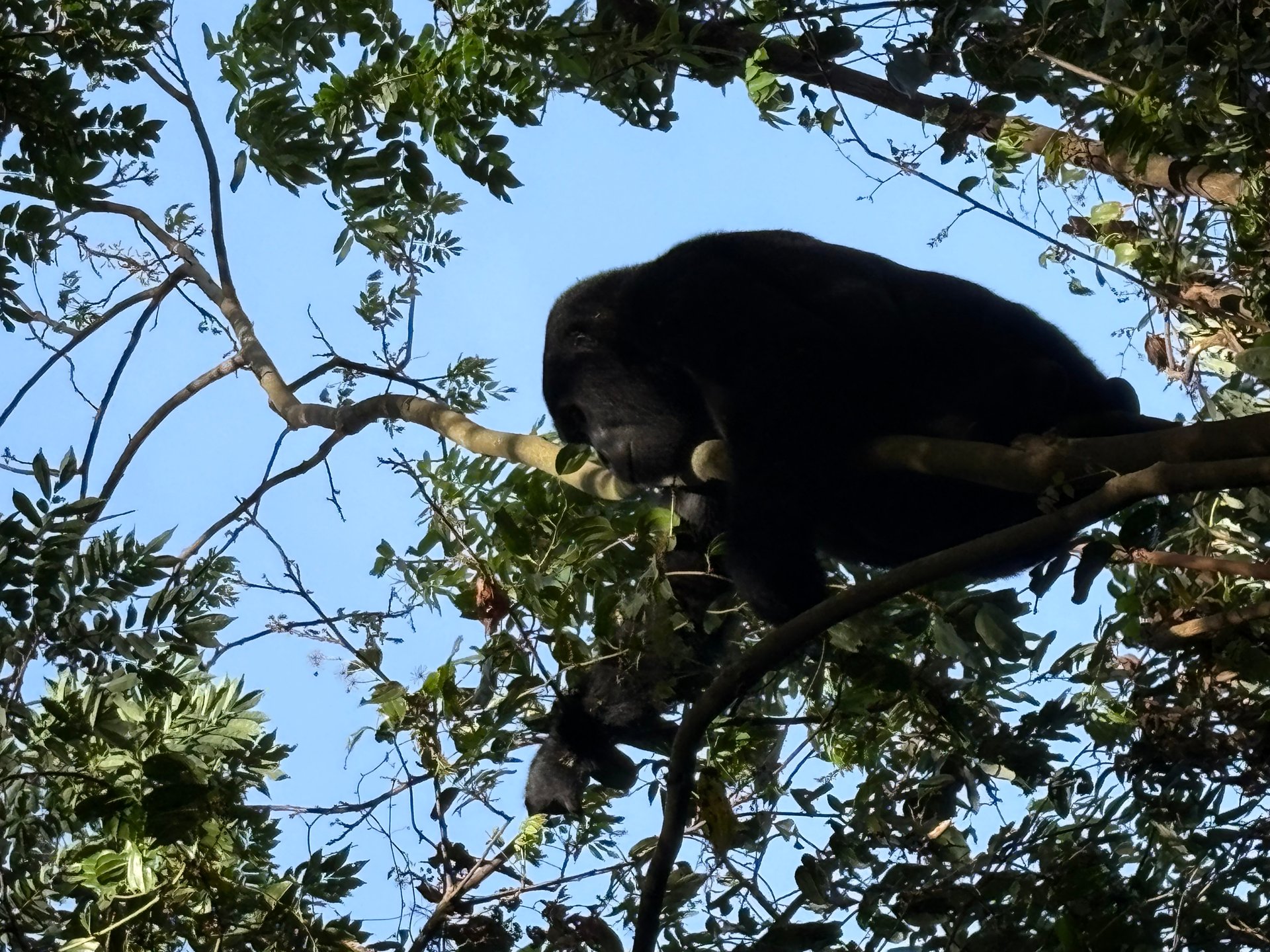
That first gorilla sat in the canopy branches of a large tree, at GPS coordinates -0.9735°N, 29.6281°E, eating leaves with complete indifference to the group below. The calmness of that moment is the product of years of habituation work, decades of conservation investment, and a functioning legal framework that extends from Uganda's national environmental legislation down to the operational compliance of every lodge within range of the forest boundary.
The Bwindi Gorilla Population: Numbers, Status, and Why Tourism Matters
The mountain gorilla population in Uganda was counted at 459 individuals during the 2018–2020 census. The majority live within Bwindi Impenetrable National Park; a smaller group inhabits Mgahinga Gorilla National Park further south. Globally, mountain gorillas number approximately 1,000 individuals across two populations: Bwindi and the Virunga Massif, which stretches across Uganda, Rwanda, and the Democratic Republic of Congo.
The species was reclassified from Critically Endangered to Endangered on the IUCN Red List in 2018 — the first time a great ape species had been downlisted in the Red List's history — largely because of the success of conservation programmes financed by tourism revenue. This is the fundamental point that separates Bwindi gorilla tourism from most wildlife tourism models: the gorillas are more numerous than they were thirty years ago, and the permit fees paid by visitors are a direct contributing cause.
The mechanism is direct: each of the gorilla trekking permits issued at Bwindi generates USD 800 in revenue to the Uganda Wildlife Authority. That income funds the permanent ranger force patrolling the park boundary, the veterinary monitoring teams that track gorilla health and intervene when animals show signs of disease or injury, and the habituation programmes that expand the number of families available for visits. Without this revenue stream, none of this infrastructure would be financially viable on Uganda's public conservation budget alone.
Bwindi's gorilla families are distributed across four trekking sectors — Buhoma, Ruhija, Rushaga, and Nkuringo — each with its own ranger station, habituation teams, and accommodation ecosystem. More than 14 families have been habituated to the point where they accept small human groups at close range without displaying defensive or flight behaviour. The Gorilla Habituation Experience (GHE), available at Rushaga, allows a maximum of four visitors to spend four hours with a family in the process of habituation — generating premium revenue while funding the multi-year habituation work itself.
Environmental Audits: Which Tourism Facilities Near Bwindi Must Comply?
Visiting a lodge near Bwindi means staying in a facility that operates under Uganda's environmental audit framework. The National Environmental (Audit) Regulations, Statutory Instrument No. 47 of 2020, specify which categories of tourism facility are legally required to conduct and report environmental audits to the National Environment Management Authority (NEMA).
The facility types explicitly named in S.I. 47/2020 as subject to mandatory audit include luxury camps, lodges, hotels, resorts, and beach facilities. Any such facility that received a development permit with attached environmental conditions — which applies to all commercial accommodation built within or immediately adjacent to a national park — is legally obligated to conduct audits at intervals specified in that original approval and submit the results to NEMA. The audit assesses actual performance against the facility's approved environmental management plan: energy consumption, water sourcing and management, waste disposal, wastewater treatment, community impacts, and compliance with all permit conditions.
The practical significance for Bwindi is considerable. The park boundary is ringed by accommodation at every price point — community rest camps, mid-range lodges, tented luxury camps — all in the zone where improperly managed waste and wastewater create direct risks to the gorillas. Organic waste near the forest edge attracts wildlife to the boundary, creates problematic habituation between gorillas and domestic animals, and risks pathogen transmission to a primate population with no evolved resistance to many human-associated bacteria and viruses. The audit framework converts this ecological risk into a legal compliance obligation. Uganda Wildlife Authority reported 500 hospitality establishments inspected under this framework in 2024/25.
The 2020 regulations substantially formalised requirements that had previously operated through less consistent ad hoc permit conditions. S.I. 47/2020 for environmental audits and the companion S.I. 49/2020 for waste management collectively define the minimum operational environmental standard for any commercial tourism facility operating in Uganda's protected area corridors — including the entire arc of accommodation surrounding Bwindi.
Lodges Serving the Bwindi Gorillas: Ruhija, Nkuringo, and the Carbon Question
The accommodation options at Bwindi range from community rest camps at the budget end — simple, community-owned, a direct income stream to village economies — to high-end tented safari camps at over USD 1,000 per night. Each operates under the same NEMA regulatory framework but with very different environmental footprints and sustainability profiles.
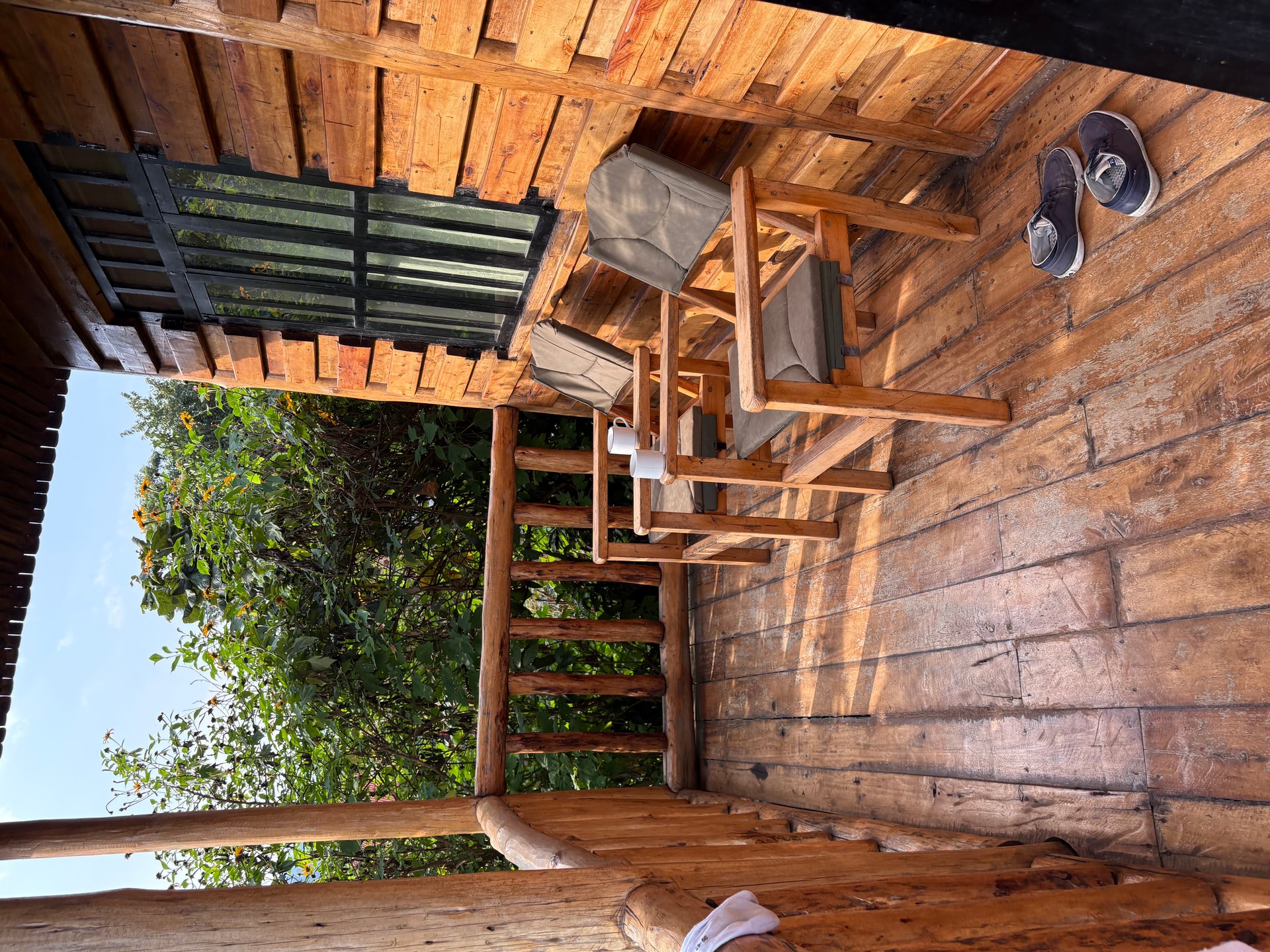
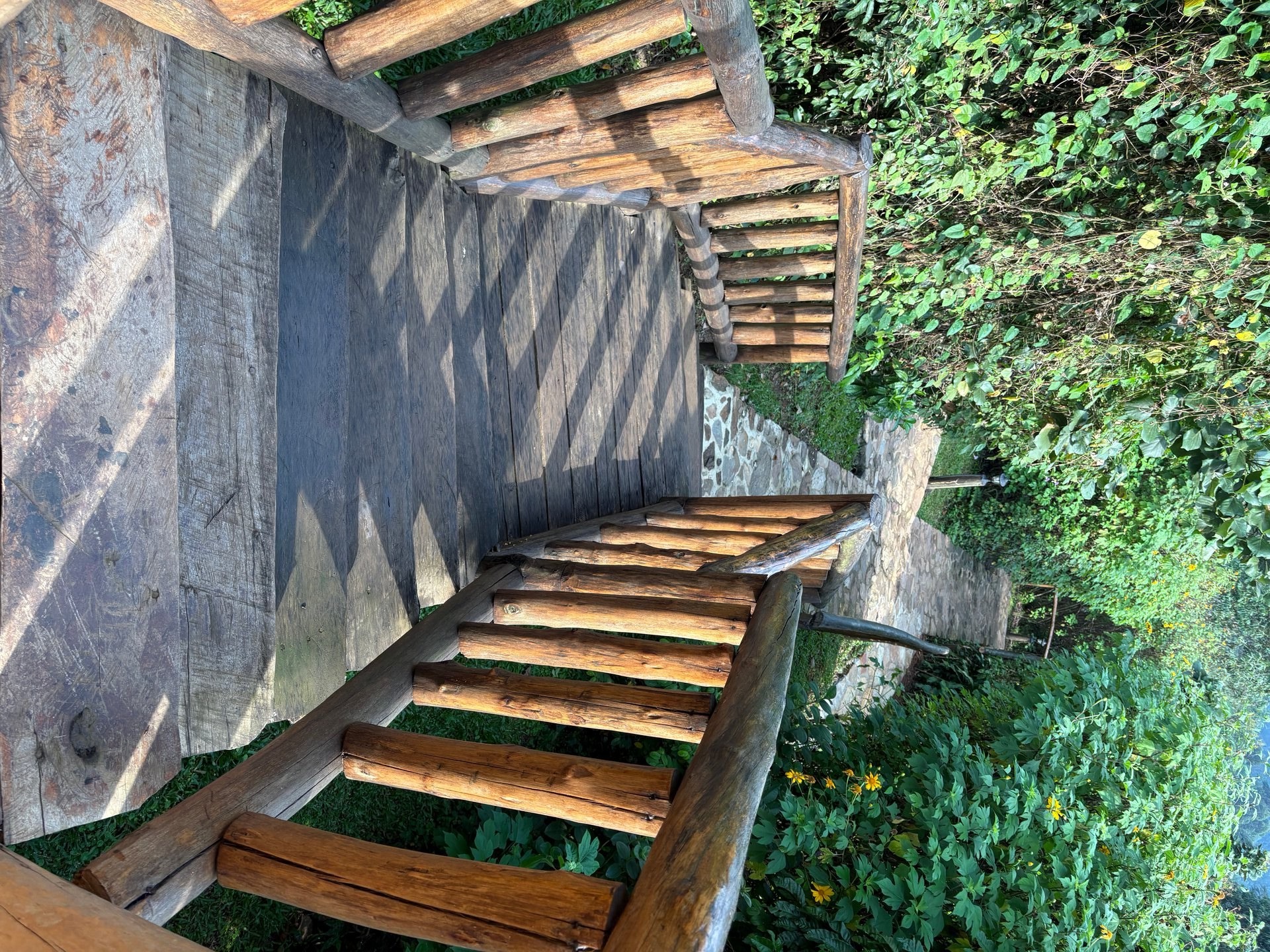
Gorilla Bluff Lodge in Buhoma, where we stayed during our January 2026 visit, is a mid-range option positioned on the steep hillside above the village. The lodge is built along the contours of the mountain — the path from guest rooms to the main house runs down a timber staircase cut into the slope, a direct response to terrain that makes flat construction impossible. Every morning during our stay, coffee and African Tea arrived on the private terrace overlooking the forest canopy. The physical structure of the lodge — the stairs, the terraces, the sightlines into the trees — is the practical reality of building accommodation in steep, heavily forested mountain terrain: resourceful, locally crafted, and negotiating constantly with the landscape around it.
Ruhija Gorilla Safari Lodge operates in the Ruhija sector at the north-eastern corner of Bwindi, at higher altitude than Buhoma. The lodge offers rustic double rooms and timber cottages near the gorilla tracking trailhead and is operated by Asyanut Safaris. The Ruhija sector sits at altitude where the forest transitions toward montane heath — the tree species mix changes, the bird community shifts toward Albertine Rift endemics, and the air is cooler. For birders visiting Bwindi primarily for the forest birds rather than the gorillas, Ruhija is frequently described as the most productive single location in East Africa for Albertine Rift endemic species.
Nkuringo Bwindi Gorilla Lodge sits at 2,090 metres above sea level in the south-western corner of the park, at the Nkuringo gorilla habituation site. The lodge has 18 rooms and is one of the most distinctively positioned of Bwindi's accommodation options — on a ridge with views into Rwanda — but its most relevant distinction for the purpose of conservation tourism is its formal partnership with the Uganda Carbon Bureau. The lodge documents and offsets its operational carbon footprint through this framework, making it one of the few facilities near Bwindi that goes beyond NEMA audit compliance to formally account for its carbon output. This is relevant to travellers researching verifiably sustainable accommodation: the Uganda Carbon Bureau partnership is a documented, third-party-verified commitment rather than an unsubstantiated marketing claim.
Uganda Tourism: Volume, Growth, and the Gorilla Premium
Uganda's tourism sector has recovered from the COVID-19 interruption and the 2022 Ebola response period, returning to growth across most visitor categories. The National Status of the Environment Report 2024 identifies tourism as a key economic driver with direct conservation implications — where tourism revenue sustains national park operations, a tourism decline immediately reduces conservation capacity. The Bwindi gorillas and the premium permit product they anchor are the clearest expression of this dependency.
The KCCA Strategic Plan FY2025/26–FY2029/30 targets a 5 per cent annual increase in international tourist arrivals to Kampala, with the city functioning as the primary staging point for Uganda's national parks circuit. KCCA plans to increase tourism information centres from 13 (baseline FY2023/24) to 44 by 2029/30, and to attend at least two international tourism trade fairs annually from FY2025/26. The construction of tourism infrastructure and facilities in the Greater Kampala Metropolitan Area has been allocated a total project budget of UGX 6 billion across the 2025/26–2029/30 period (source: KCCA Strategic Plan 2025, Infrastructure Chapter).
Gorilla trekking is the product that positions Uganda in the global wildlife tourism market. The USD 800 permit price is higher than most comparable East African wildlife experiences and signals clearly what visitor Uganda is competing for: not the budget backpacker circuit, but the high-value traveller who plans a specific trip around a specific experience. The lodge sector — the accommodation category most relevant to Bwindi — demonstrates this orientation: lodges in Uganda show the highest occupancy rates and strongest demand growth of any accommodation category, while hotels (more concentrated in urban centres) operate at more moderate utilisation levels.
Wildplaces Africa, which has managed the Semliki Safari Lodge in western Uganda since 1996, represents the longer-established model of private conservation-linked lodging in the Albertine Rift region. The Semliki ecosystem sits within the broader Albertine Rift network that connects ecologically with Bwindi's western edge. The Wildplaces Africa operation — private management, conservation mandate, environmental compliance — is the template that many of the newer Bwindi-area lodges have adopted in their own context.
International Conservation Partners: AWF and IGCP at Bwindi
Bwindi gorilla conservation is not a solo operation of the Uganda Wildlife Authority. The African Wildlife Foundation (AWF) has been a consistent international partner at Bwindi for decades, contributing funding, technical expertise, and community development support to projects in the park's buffer zone and surrounding communities. AWF's work at Bwindi has supported community income-generation projects, ranger capacity building, and conservation education for the farming communities at the forest boundary — all components of the framework that makes the tourism model sustainable over time.
The International Gorilla Conservation Programme (IGCP), a joint initiative of the African Wildlife Foundation, WWF, and Flora & Fauna International, coordinates transboundary conservation across the Virunga Conservation Area — the landscape shared between Uganda, Rwanda, and the DRC that contains both the Bwindi population and the Virunga Massif population. The IGCP framework is what makes cross-border population monitoring function as a single coherent dataset: without it, the 459 Uganda figure and the global approximately-1,000 figure could not be reliably derived or compared.
For travellers, the involvement of international conservation organisations provides independent accountability for the conservation claims made by UWA and by the lodges serving Bwindi. The AWF and IGCP publish programme reports, population monitoring data, and community impact assessments that can be independently reviewed. This transparency is part of what makes Bwindi gorilla tourism credible as a premium product: the conservation claims are not marketing copy but verifiable outcomes tracked by multiple institutions with distinct interests and standards.
[QUOTE: local UWA guide or AWF representative on the most significant conservation improvement at Bwindi over the past decade]
Beyond Bwindi: Lake Bunyonyi and the History of the Region
The landscape around Bwindi has been shaped by human activity — agricultural, medical, missionary, administrative, and conservation — for over a century. Understanding this history gives context to the gorilla conservation model that emerged here in the early 1990s, with its community revenue sharing, farmer income protection at the forest boundary, and lodge employment as an alternative to subsistence farming at the park edge.
Lake Bunyonyi, approximately 25 kilometres south-east of Bwindi, provides a direct connection to the region's deeper human history. In 1921, Leonard Sharp — a Scottish missionary and medical doctor — established a hospital on Bwama Island in Lake Bunyonyi, specifically to treat leprosy patients. The facility operated under the constraints of an era when leprosy patients were isolated from their communities and required dedicated care infrastructure; Bwama Island served as both hospital and managed settlement. Sharp's presence at Lake Bunyonyi represents the earliest documented large-scale organised health intervention in the vicinity of what would become the Bwindi protected area — a reminder that these landscapes have always carried a human history alongside their wildlife history.
Today, Lake Bunyonyi is one of the most common add-on destinations for visitors completing a gorilla trek at Bwindi. The lake's 29 islands, depth of up to 44 metres, and high-altitude calm contrast sharply with the dense forest experience at Bwindi. The combination of two to three days at the lake with the gorilla trek forms a natural south-western Uganda circuit. Nkuringo Walking Safaris, a specialised operator based near Kisoro further west, designs multi-day walking routes that connect the Bwindi area to Lake Mutanda and the Virunga foothills — a perspective on the Bwindi ecosystem from its edges and surroundings rather than solely from within the trekking sectors.
Frequently Asked Questions: Bwindi Gorilla Tourism
Related Articles
Bwindi Gorillas: Conservation and Science
Bwindi Gorillas: First-Hand Trek Guide
Gorilla Trekking Safety: Then and Now
Conservation and Ecotourism in Uganda
Sustainable Gorilla Trekking Explained
Gorilla Trekking at Bwindi: Full Guide
Ruhija: The Research Sector
Nkuringo Sector