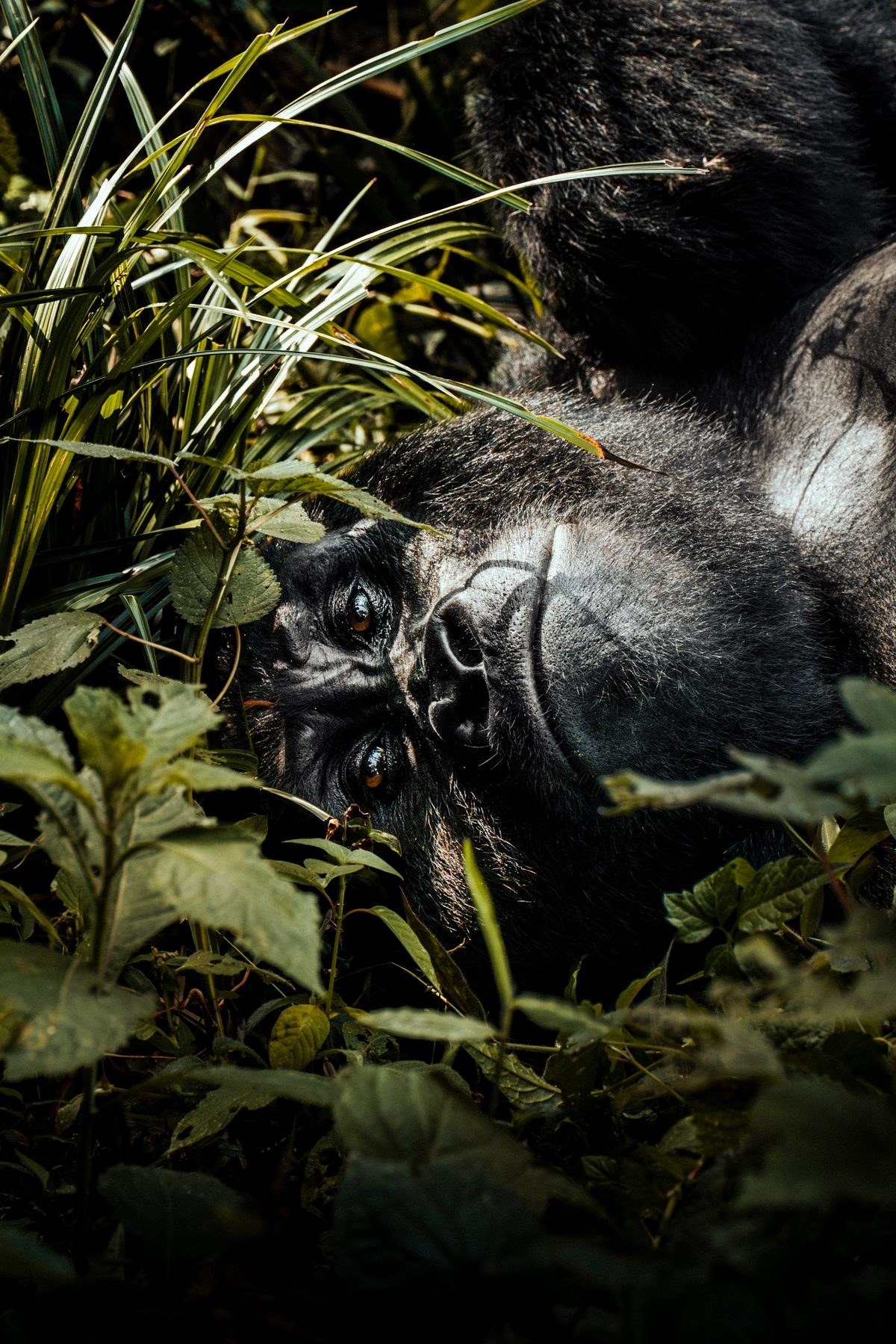
After three hours of climbing through dense undergrowth on a January morning in 2026, our small group emerged into a clearing where a gorilla family sat in complete calm, barely twenty metres away. A silverback moved slowly through the vegetation, and juveniles tumbled across each other at the base of a fig tree. The encounter lasted an hour. What struck me most — beyond the obvious privilege of proximity — was how entirely the gorillas belonged to their forest. Every movement, every food choice, every resting posture was shaped by the specific character of that patch of montane woodland: its moisture, its canopy structure, its particular mix of plant species. These animals are not simply “in” the forest. They are an expression of it.
That inseparability from habitat is precisely what makes the mountain gorilla climate change habitat impact question so urgent. Gorilla beringei beringei exists in only two isolated populations: the Virunga Massif spanning Rwanda, Uganda, and the Democratic Republic of Congo, and Bwindi Impenetrable National Park in southwestern Uganda. Together, these habitats cover less than 800 square kilometres. With approximately 1,063 individuals remaining in the wild — around 459 of them in Bwindi alone, according to the 2018–2020 census — there is no buffer. Every shift in forest ecology is felt directly.
A Changing Forest: Temperature Trends in the East African Highlands
The East African highlands have warmed measurably over the past five decades. Mean annual temperatures across the region have risen, and climate models project continued warming through the twenty-first century regardless of emissions pathway, though the magnitude depends heavily on global action. For the forests of southwestern Uganda and the Virunga volcanoes, even modest temperature increases carry significant consequences.
Bwindi spans an altitudinal range from approximately 1,160 metres at its lowest point to 2,607 metres along its upper ridges. This vertical gradient supports distinct vegetation zones, each with its own community of plant species on which gorillas feed. As temperatures rise, the boundaries between these zones shift upward. Plant species adapted to cooler conditions retreat to higher elevations, while lower-elevation species expand upslope. The net effect is a compression of the montane zone at the top of the forest, with nowhere higher to go. For gorillas that feed preferentially on species found at specific elevations, this contraction reduces the area of optimal habitat available to them.
During my visit in June 2026, I had the opportunity to watch a gorilla feeding in the upper branches of a large tree, methodically stripping leaves while the morning light filtered through the canopy. The scene looked timeless. But the composition of that canopy — which species dominate, how dense the leaf cover is, how much fruit is available at a given time of year — is not static. It is being slowly renegotiated by a changing climate.
Rainfall Shifts and the Vegetation Gorillas Depend On
Rainfall drives nearly everything in a tropical montane forest. It determines when plants flower and fruit, how quickly leaf material regenerates after browsing, and how much standing water is available across the landscape. Bwindi receives between 1,130 and 2,390 millimetres of rain annually, with two wet seasons separated by drier periods. The Virungas operate under a similar bimodal rainfall pattern shaped by the dynamics of the East African rift.
Evidence from across central Africa suggests that these patterns are becoming less reliable. Dry seasons in some areas are lengthening. Intense rainfall events are becoming more concentrated, increasing runoff and erosion rather than percolating into the soil systems that sustain vegetation. In highland forests, this translates into stress on tree root systems, increased susceptibility to fungal infection, and dieback of plant species with narrow moisture tolerances.
For gorillas, the most immediate dietary consequence is disruption to fruiting cycles. In Bwindi, where fruit plays a significantly larger role in the gorilla diet than in the Virungas — a reflection of the greater diversity of fruiting species in the lowland portions of the park — unpredictable fruiting seasons create nutritional gaps. Groups must range further to compensate, which increases energy expenditure and, in areas where the forest is bordered by agricultural land, the risk of conflict with farming communities.
The corridors that once connected forest blocks across the landscape have also suffered. According to the State of Wildlife Resources in Uganda 2026 report, elephant and chimpanzee movement corridors linking Budongo-Bugoma and Kibale-Bwindi forests have been disturbed by infrastructure development, contributing to population declines. While gorillas do not currently use these specific corridors, the broader pattern of connectivity loss driven by habitat fragmentation compounds climate-related range restrictions.
Habitat Alteration and Its Effects on Gorilla Behaviour and Diet
Mountain gorillas are generalist herbivores with considerable dietary flexibility, capable of feeding on well over 100 plant species across their range. This flexibility has historically buffered them against local fluctuations in plant availability. But flexibility has limits. When multiple food species decline simultaneously under prolonged drought, or when an invasive plant colonises a disturbed forest patch and displaces the native vegetation on which gorillas feed, the adaptive capacity of even a flexible forager is tested.
Vegetation surveys in and around Bwindi have documented gradual shifts in plant community composition at different elevations over recent decades. Some high-value gorilla food plants are showing signs of stress or contraction. At the same time, the forest edges — where the park meets farmland — are increasingly subject to encroachment as agricultural communities respond to their own climate pressures by expanding into marginal land.
The gorillas themselves appear to be responding. Research conducted in the Virungas has documented gradual shifts in home range use, with some groups spending more time at higher elevations than was typical in earlier decades. In Bwindi, the diverse topography and the altitudinal breadth of the park provide some degree of refuge, but this advantage diminishes if warming continues at the upper end of projected ranges.
[QUOTE: local ranger on observed changes in gorilla ranging patterns over recent years]
The Virungas and Bwindi: Two Populations Under Distinct Pressures
The two mountain gorilla populations face overlapping but distinct climate challenges. The Virunga Massif occupies the volcanic highlands straddling three national borders at elevations ranging from around 1,500 to over 4,500 metres on the peaks of Karisimbi, Mikeno, and Bisoke. The habitat is cooler and more exposed than Bwindi, with less dietary fruit available and a heavier reliance on herbaceous vegetation. In this environment, temperature increases shift the distribution of highland herbs and sedges that form the backbone of the gorilla diet.
Bwindi's gorillas live in a different kind of forest: lower, denser, richer in species diversity, and spanning a wider altitudinal range. The park is recognised as a UNESCO World Heritage Site for its extraordinary biodiversity, which includes significant populations of other globally threatened species. According to the State of Wildlife Resources in Uganda 2026, Bwindi and the neighbouring Echuya Forest Reserve are considered strongholds for a threatened cat species on the Uganda Red List, underscoring the broader ecological value of the habitat that climate change is now placing under pressure.
The geographic isolation of these two populations from each other means that neither can serve as a source of genetic rescue for the other if climate stress causes local decline. Any conservation response must therefore treat both populations as separately critical and develop site-specific strategies for each.
Long-Term Implications and the Path Forward
The scale of the mountain gorilla climate change habitat impact challenge requires responses at multiple levels simultaneously. At the landscape level, maintaining and restoring the forest buffers and transition zones adjacent to both Bwindi and the Virunga parks is essential. These areas provide refugia for plant species shifting under climate pressure and reduce the hard edge between protected forest and agricultural land.
Community engagement remains the single most effective tool available to conservation managers on the ground. The revenue-sharing programme that returns a portion of gorilla tourism income to communities neighbouring Bwindi has created powerful economic incentives for habitat protection. When communities benefit directly from an intact forest, they become its most effective defenders. Strengthening and expanding these arrangements, particularly as climate stress increases competition for land, is a strategic priority.
The Uganda Wildlife Authority's practical approach to human-gorilla conflict management offers one concrete example of adaptive conservation in action. The 16-kilometre stone wall maintained in Mgahinga Gorilla National Park — designed to prevent gorillas from raiding crops in adjacent farmland — represents the kind of infrastructure investment that will become increasingly relevant as gorillas ranging under climate pressure are more likely to encounter agricultural land. Similar boundary management approaches are being considered for other park edges.
Veterinary surveillance is another critical response area. Warmer, wetter conditions expand the habitat range of parasites and pathogens that can infect gorillas, and a population as small and genetically restricted as the mountain gorilla is acutely vulnerable to epidemic disease. The Gorilla Doctors programme and related veterinary monitoring efforts provide early warning and direct intervention capacity that has already saved individual animals from snare injuries and respiratory outbreaks.
What stayed with me from those hours with a gorilla family in Bwindi in January 2026 was the sense of a self-contained world, ancient and calibrated, that operates entirely according to its own logic. The forest exists on a timescale that dwarfs human history. The gorillas have been shaped by it over millions of years. The challenge we now face is that the pace of climate change compresses that adaptive timescale into decades. Whether the gorillas and their habitat can respond quickly enough — and whether we can reduce pressure on them sufficiently to give adaptation a chance — is one of the defining conservation questions of this generation.