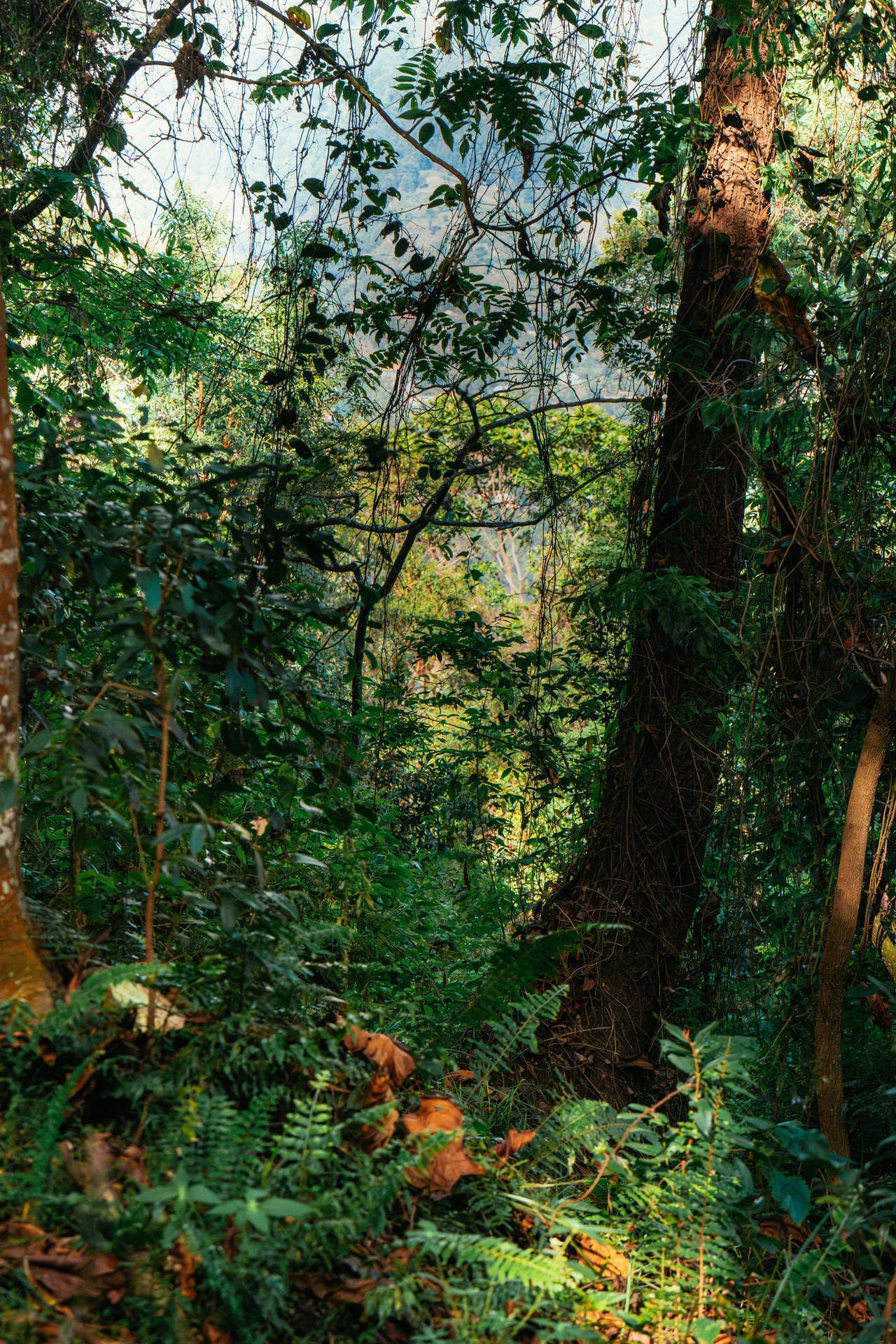
Bwindi forest national park sits at the centre of one of the most complex stakeholder landscapes in East African conservation. A single Batwa household living outside the park boundary may receive support from three different NGOs, interact with two district government offices, and participate in a UWA-managed resource access arrangement — all within the same calendar year. Coordinating those interactions without duplication, conflict, or gap is the core challenge of collaborative resource management (CRM) at Bwindi. Digital tools, from shared contact registers to field reporting applications, are now central to how that coordination works in practice.
The Organisational Ecosystem Around Bwindi
At least sixteen formal organisations are documented as working with or led by Batwa communities in the immediate surroundings of Bwindi Impenetrable National Park. They operate across the two primary districts — Kanungu and Kisoro — and across all four visitor sectors: Buhoma in the north, Ruhija in the east, and Rushaga and Nkuringo in the south. Their mandates range from land acquisition and house construction (Batwa Development Programme, active since 1991) to cultural advocacy and livelihood microfinance (Action for Batwa Empowerment Group, founded 2017 and formally registered 2021).
Other organisations in this ecosystem include Nkuringo Cultural Centre, the Bwindi Batwa Development Association, Bwindi Mgahinga Conservation Trust, Conservation Through Public Health, the International Gorilla Conservation Program, Pro-biodiversity Conservationists in Uganda (PROBICOU), and the Institute of Tropical Forest Conservation. Several of these are themselves Batwa-led, while others are external NGOs with Batwa programme components. This distinction matters for coordination: Batwa-led organisations often have direct community trust but limited administrative infrastructure, while external NGOs may have stronger systems but less community legitimacy.
The 2022 stakeholder consultation process, which held sessions at Rushaga-Rubuguri on 21 June and at the Buhoma Visitor Centre on 22 June, brought together seventeen stakeholders in a single structured meeting. That gathering illustrated both the strength and the limitation of face-to-face coordination: it produced rich feedback on conservation lessons, livelihood gaps, and land tenure challenges, but a two-day event cannot substitute for continuous information exchange across a landscape that spans hundreds of square kilometres.
What CRM Means in a Conservation Context
In commercial settings, a customer relationship management (CRM) platform organises interactions between a business and its clients. In the context of Bwindi, the concept translates into a system for managing relationships between a protection authority, implementing partners, and the communities they serve. The "customers" in this case are Batwa households and the wider communities living adjacent to the park boundary. The "relationship managers" are UWA staff, NGO field officers, and district government representatives.
What makes CRM specifically relevant to resource management at Bwindi impenetrable forest national park is the formal governance framework that underpins community access. Batwa communities cannot simply enter the park to collect medicinal plants or perform cultural activities: they must do so under negotiated access agreements, recorded permits, and monitored schedules. A CRM platform that tracks which households have active access arrangements, which permits are pending renewal, and which field officers are responsible for which geographic areas translates directly into better governance of those agreements.
During multiple visits to Bwindi between October 2024 and May 2026, including stays in Buhoma and observations of community organisation activity, the gap between the density of organisational activity and the lightness of shared information systems was consistently evident. Organisations knew about each other, but their internal records rarely fed into a shared picture of who was reaching which households and with what outcomes.
Digital Coordination in Practice: Current State
The current digital infrastructure supporting Batwa CRM at Bwindi is best described as a layered patchwork. At the formal level, the IFPA-CD Project (Inclusive Forest Protected Area — Community Development) established documentation protocols and data-sharing agreements between UWA and implementing partners. These protocols required field data to be collected in structured formats, enabling aggregation at the project level. In practice, this meant paper forms that were later digitised, a common approach in settings with unreliable connectivity.
At the organisational level, several partner bodies have received computers and capacity building in administrative systems as part of conservation training programmes. Batwa Development Programme, with its seventy-five-person staff roster (including over one hundred Batwa employed as dancers, cooks, and cleaners), maintains employment and beneficiary records that constitute a basic CRM dataset. Action for Batwa Empowerment Group tracks its more than two hundred economic empowerment beneficiaries and its microfinance portfolio through similar records.
The Human-Wildlife Guardians Organisation, a community-based initiative operating in the Bwindi-Kibale landscape, represents a more recent model: a structured early-warning and conflict-mitigation network that relies on mobile phone communication to transmit field alerts. This kind of lightweight digital architecture — a shared contact directory, a simple reporting protocol, a designated response chain — is closer to what is operationally realistic in rural southwestern Uganda than a full-featured cloud CRM platform with real-time dashboards.
Connectivity remains the binding constraint. Mobile data is available in Buhoma and parts of Rushaga, but coverage drops sharply inside the park and in more remote settlements. Any coordination system that depends on continuous internet access will exclude exactly the locations where coordination is most needed. The practical solutions being explored include offline-capable mobile apps that sync when connectivity is available, SMS-based reporting chains, and radio communication between sector headquarters and field teams.
What a Well-Designed CRM System Would Add
A purpose-built coordination platform for Batwa community management around Bwindi forest national park would need to address several specific gaps that are visible in the current landscape. First, a shared household register would allow all sixteen-plus organisations to identify where their work overlaps and where Batwa settlements remain underserved. Without this, organisations operating independently in the same geographic zone risk concentrating benefits in accessible households while missing remote ones.
Second, a resource-access tracking module would manage the permits, schedules, and recorded outcomes of Batwa access to park resources. Medicinal plant collection, cultural heritage visits, and guided experience trails each require different authorisation pathways through UWA. A system that tracks application status, approval dates, and field monitoring reports would reduce the administrative friction that currently slows access arrangements and creates frustration on both sides.
Third, a grievance and feedback channel integrated into the coordination platform would give Batwa community members a structured way to raise concerns about access decisions, benefit distribution, or individual organisation conduct. The current reliance on face-to-face complaint mechanisms — going to a district office or an NGO field officer — creates barriers for people with limited mobility, language confidence, or trust in formal institutions.
Bwindi and Echuya forests are recognised as critical habitat for at least one endangered cat species on the Uganda Red List, according to the State of Wildlife Resources in Uganda 2026 report. This positions the broader ecosystem not only as a gorilla destination but as a multi-species conservation priority. The argument for investing in robust coordination infrastructure becomes stronger when the management challenge extends beyond gorillas to a full spectrum of endangered fauna — each with its own monitoring requirements and community impact dynamics.
The People Behind the Systems
Digital tools are only as effective as the people who use and trust them. At Bwindi, the individuals doing the day-to-day coordination work include UWA sector managers, district tourism and natural resources officers from Kanungu and Kisoro, field staff from organisations like BDP and ABEG, and Batwa community representatives who carry information between settlements and offices.
Advocacy within the NGO community has increasingly emphasised that Batwa-led organisations should have a stronger voice in coordination mechanisms — including decisions about which platforms to adopt and how data about Batwa households is stored and shared. The concern is legitimate: a CRM system designed primarily to serve donor reporting requirements may capture data that is useful to funders but not to the communities themselves. A system designed with Batwa input would look different — prioritising information that communities themselves need, such as land availability, livelihood opportunity alerts, and healthcare access scheduling.
The Batwa trail at Nkuringo, co-managed by UWA and community members and launched in April 2019 with support from Nkuringo Cultural Centre, Bwindi Batwa Development Organisation, and Mbarara University of Science and Technology, provides a useful model. The tri-partite governance arrangement tested in that project — between UWA, ABEG, and BDP for a proposed Buhoma trail — requires shared scheduling and revenue-tracking tools that are accessible to all three parties. That specific need, at that specific scale, is where digital CRM coordination tools can deliver immediate and measurable value.
[QUOTE: local guide or NGO field officer on day-to-day coordination challenges]
The broader context for all of this work is a park that draws visitors from across the world for gorilla trekking and forest experiences. Tourism revenue flows through UWA and, via the revenue-sharing programme, into the surrounding communities. The question of how that revenue is tracked, allocated, and reported to community members is itself a CRM challenge — and one where digital transparency could significantly increase trust between the park authority and the communities that have given up so much in the name of conservation. The revenue-sharing programme at Bwindi distributes a proportion of gate fees to parishes adjacent to the park, but the mechanics of how those funds are calculated, disbursed, and audited involve multiple institutions whose information systems are not currently integrated.