Why No Single Institution Can Protect Biodiversity Alone
Protecting biodiversity at landscape scale requires more than a statutory authority and a park boundary. Ecosystems do not stop at fence lines. Species range across reserve edges, catchment areas span multiple administrative jurisdictions, and the pressures on wildlife — habitat loss, disease transmission, resource extraction — emerge from social and economic conditions that national park managers cannot address on their own. Uganda has responded to this reality by building a layered system of biodiversity partnerships in which government agencies, conservation NGOs, research institutions, and community organisations each play a formally recognised role.
Bwindi Impenetrable National Park sits at the centre of one of the most developed versions of this system anywhere in East Africa. The park's General Management Plan, which covers a ten-year strategic period and involves implementation by dozens of partner organisations, treats biodiversity management as a shared responsibility rather than the exclusive domain of Uganda Wildlife Authority. Understanding how this partnership model works — and why it has been built the way it has — matters both for conservation practitioners and for visitors who want to understand what actually keeps Bwindi's biodiversity intact.
The Legal and Planning Framework for Biodiversity Partnerships
Uganda's approach to biodiversity management is grounded in a national policy framework that distributes responsibilities across multiple tiers of government and civil society. Uganda Wildlife Authority holds statutory responsibility for national parks and wildlife reserves. The National Forestry Authority manages forest reserves, including those like Amurie that extend the conservation landscape beyond gazetted parks. District local governments are responsible for integrating environmental management into their development planning, addressing issues such as land administration, wetland restoration, and the sustainable use of natural resources at the community level.
This layered structure means that effective biodiversity management requires coordination across institutional boundaries that do not naturally align. A district government planning a road corridor near a forest reserve boundary, a community group seeking to access wetland resources, or an NGO designing a reforestation programme — all of these actors operate within different planning cycles and respond to different political incentives. Biodiversity partnerships are the mechanism by which these actors are brought into alignment around shared conservation goals.
The General Management Plan at Bwindi makes this explicit. The document states that NGOs, district local governments, community-based organisations, and development partners working in and around the park are expected to use the GMP as their source of annual activities. This transforms what might otherwise be an internal park management guide into a shared governance document — one that gives partner organisations a common reference point and a shared set of commitments, even when their institutional mandates differ.
Amurie Forest Reserve and the Extended Conservation Landscape
Bwindi does not exist in isolation. To its north and east, a series of forest reserves and communal lands form a broader conservation landscape that either supports or undermines the park's biodiversity goals depending on how they are managed. Amurie Forest Reserve is one such adjacent protected area, managed under Uganda's National Forestry Authority framework as a central forest reserve. Its significance for biodiversity is both direct — it harbours forest-dependent species and maintains water catchment functions — and structural, in that it extends the contiguous forested area available to wildlife that ranges beyond the national park boundary.
Forest reserves like Amurie are subject to a different management regime than national parks. They permit a wider range of human uses, including licensed timber extraction, non-timber forest product harvesting, and community access under defined conditions. This means that biodiversity management in a forest reserve requires active negotiation with user communities rather than the relatively clearer prohibition framework that applies within a national park. District governments in areas adjacent to Amurie are expected to establish biodiversity management strategies that integrate the reserve's conservation functions into their broader land and natural resource planning.
The target of establishing one operative framework and one biodiversity management strategy per year reflects an understanding that conservation planning must be iterative. Ecological conditions change. Community needs evolve. Climate patterns shift. A single framework written once and left unchanged cannot remain relevant across a decade of management. By building in an expectation of annual renewal — one strategy cycle per year — districts adjacent to reserves like Amurie are prompted to engage with current conditions rather than simply implementing a plan written when circumstances were different.

Gorilla trekking in Bwindi: the path through the rainforest
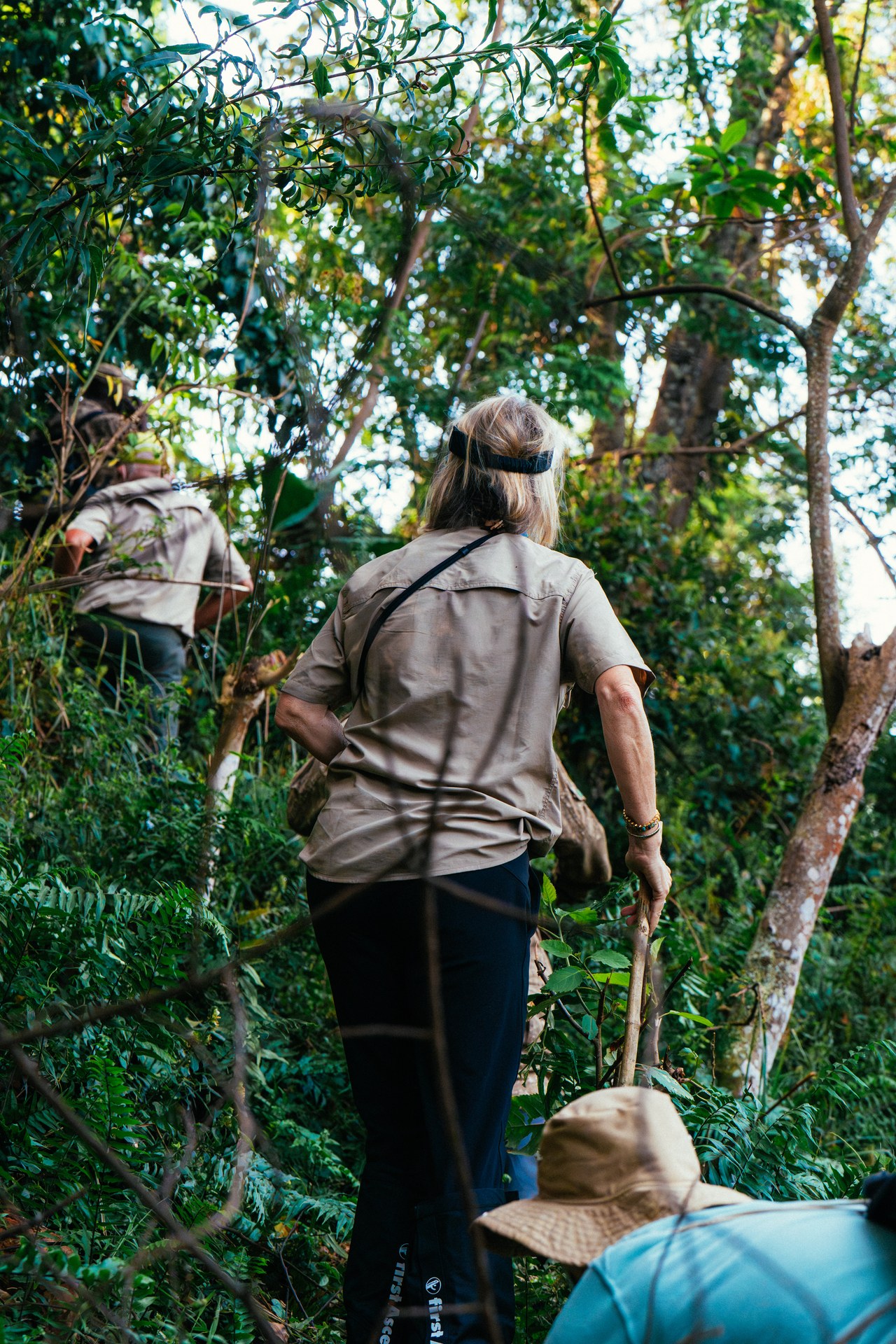
Through Bwindi forest on the trail of gorillas
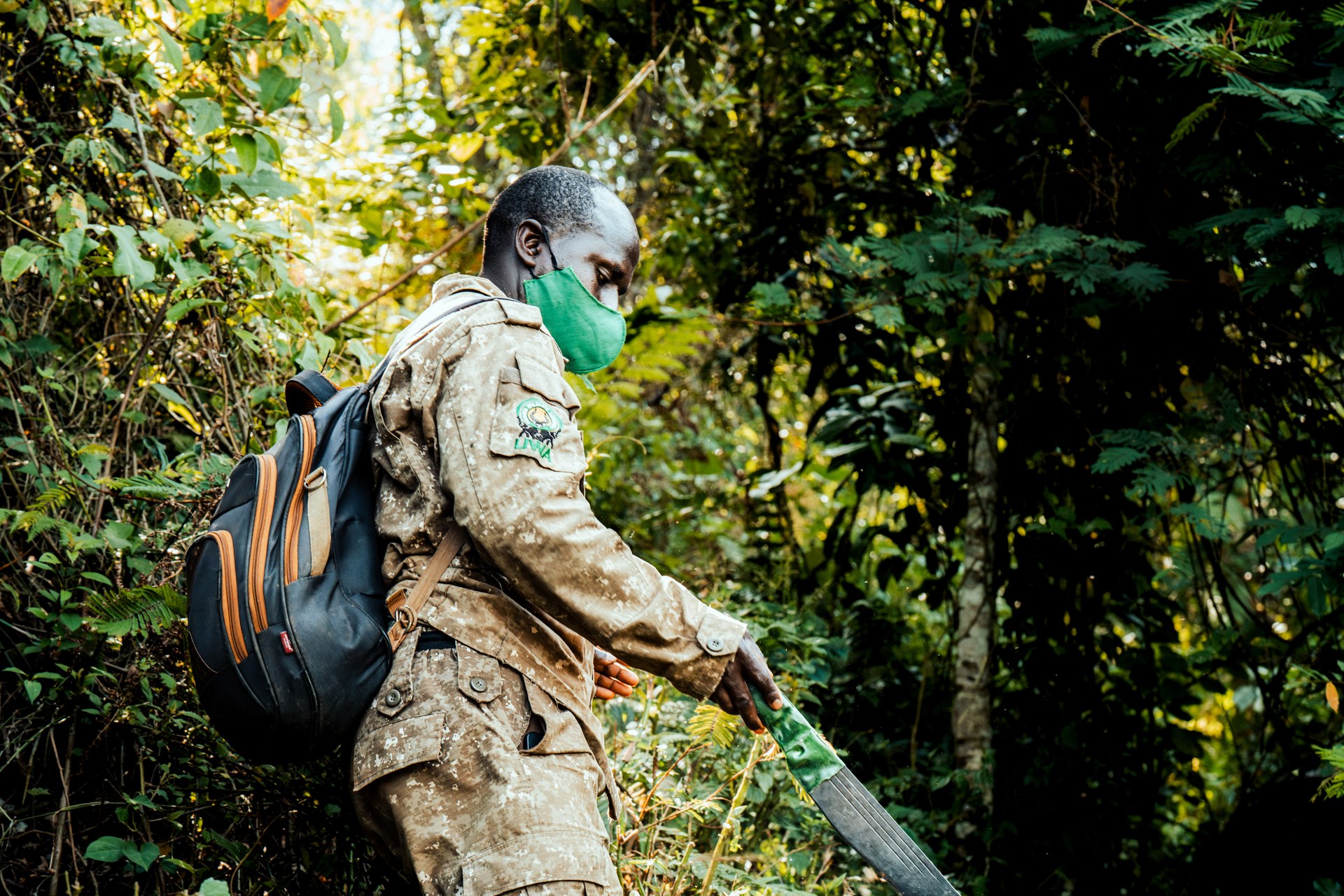
Ranger in Bwindi forest on the way to the gorillas
Government Partnerships: Districts as Conservation Actors
The four districts surrounding Bwindi — Kanungu, Rukungiri, Kabale, and Kisoro — are not merely administrative units that happen to share a boundary with a national park. They are formal partners in Bwindi's conservation, recognised as such in the GMP and bound into the park's management ecosystem through the revenue sharing programme, which directs a percentage of park entry fees into community development projects administered at district level.
This financial relationship gives district governments a concrete stake in the park's economic health. When gorilla trekking revenues are high, revenue sharing payments are larger and districts can fund more community projects. When park performance declines — through disease outbreaks, security disruptions, or reputation damage — the consequences flow directly into district budgets. This alignment of financial interests with conservation outcomes is one of the more durable incentive structures in the Bwindi partnership model.
Beyond revenue sharing, district governments contribute to biodiversity management through their development planning processes. Land and water management programmes at district level address issues that directly affect the park: soil erosion from agricultural land entering watercourses that flow into the forest, wetland drainage for cultivation, and uncontrolled settlement near the park boundary. Districts that integrate conservation considerations into their development plans — setting aside buffer zones, regulating land use transitions, and enforcing environmental regulations — materially reduce the pressure on adjacent protected areas.
The GMP identifies harmonisation of the park management plan with district development plans as a priority challenge. The annual stakeholders forum, which brings together UWA, district officials, NGOs, and community representatives, is the primary mechanism for pursuing this harmonisation. By providing a regular space for joint planning and information sharing, the forum creates opportunities to catch misalignments before they become management crises.
NGO and Research Partnerships: Specialised Capacity at Scale
National park authorities are generalist institutions. They manage law enforcement, visitor services, community relations, and biodiversity monitoring simultaneously, with staff whose expertise and bandwidth are necessarily spread across all of these functions. NGO and research partnerships fill the gaps that this generalism creates, bringing specialised capacity in areas that UWA could not develop or sustain independently.
The Institute of Tropical Forest Conservation, based at Bwindi's Ruhija sector, provides the scientific infrastructure for long-term biodiversity monitoring. Its management of the Kyaguriro gorilla research group — a group habituated exclusively for scientific study rather than tourism — generates behavioural and demographic data that informs UWA's decisions on habituation policy, ranging behaviour, and population trends. Without ITFC, Bwindi's management decisions would rest on far thinner evidential foundations.
Conservation Through Public Health (CTPH) addresses a dimension of biodiversity management that sits at the intersection of human and wildlife health. The organisation operates under a Memorandum of Understanding with UWA and applies a One Health framework that treats the health of mountain gorillas, surrounding human communities, and the broader ecosystem as inseparable. With roughly half a million people living in parishes adjacent to Bwindi, the risk of disease transmission between humans and great apes is a persistent management challenge. CTPH's community health programmes reduce this risk by addressing the health vulnerabilities of communities that live closest to the park — communities whose proximity makes them both the primary vector of disease transmission risk and the primary constituency for conservation support.
[QUOTE: local guide on first impressions of how partnerships operate in the field]
International conservation NGOs — including WWF, the Wildlife Conservation Society, and the African Wildlife Foundation — contribute expertise and funding across a range of programme areas: law enforcement support, landscape connectivity analysis, community livelihoods programming, and geographic information system capacity. Their presence at Bwindi also brings external accountability and international networking that supports both fundraising and the adoption of conservation best practices developed in other landscapes.
Community Partnerships: Conservation That Works With People, Not Around Them
The history of conservation in Uganda includes painful episodes in which protecting biodiversity meant removing people from land they had inhabited and depended on for generations. The Batwa — the indigenous forest-dwelling community displaced from Bwindi at the time of its gazettal as a national park — are the most visible example of this tension. Their exclusion from the forest without adequate compensation or alternative livelihoods created an enduring grievance that continues to shape community relations around the park.
Contemporary biodiversity partnerships at Bwindi have been built in part as a response to this history. The inclusion of community-based organisations as formally recognised partners in the GMP, the revenue sharing programme, and the stakeholders forum reflects a deliberate effort to build conservation arrangements that communities have a stake in sustaining rather than incentives to undermine. Organisations such as the United Organisation for Batwa Development in Uganda (UOBDU) and the Kellermann Foundation advocate specifically for the rights and livelihoods of the Batwa, ensuring that the partnership model does not simply replicate the exclusions of an earlier era.
Community-based organisations deliver programmes at the local level that neither government agencies nor international NGOs are well positioned to run. Conservation education in schools around the park, craft cooperatives that provide income alternatives to forest resource extraction, and cultural tourism services that allow communities to participate in the park's economic success on their own terms — these activities depend on local knowledge, local relationships, and local trust that outside organisations cannot substitute for. The GMP's resource use chapter explicitly calls for capacity building support for CBOs operating in the buffer zone, recognising that their effectiveness depends on sustained institutional investment.
The Annual Strategy Cycle: Keeping Biodiversity Management Current
One of the most important structural features of Uganda's biodiversity partnership model is the expectation of annual strategy renewal. The target of establishing one operative framework and one biodiversity management strategy per year at district and reserve level is not an administrative formality. It reflects a recognition that effective biodiversity management requires ongoing adaptation to changing conditions rather than the implementation of a static plan.
Each annual cycle begins with an assessment of current ecological and social conditions: what has changed since the last strategy was developed, which interventions have produced results and which have not, and what new pressures or opportunities have emerged. This assessment draws on monitoring data from multiple partners — ITFC's biodiversity surveys, CTPH's health reports, district government land use assessments, and community feedback gathered through local organisations. The resulting strategy is therefore a synthesis of evidence from across the partnership rather than a plan produced in isolation by any single institution.
The annual stakeholders forum serves as the accountability mechanism for this cycle. By bringing together all major partners in a regular joint planning and reporting session, the forum creates a moment at which each organisation must account for what it has done in the previous year and commit to what it will do in the next. This accountability structure is what transforms a set of individual institutional plans into something that can reasonably be called a partnership: a set of coordinated commitments that different organisations have made to one another, not just to their own mandates.
For visitors to Bwindi, the practical significance of this system is that the park they encounter is the product of decades of accumulated partnership investment. The gorilla population they have come to see has been monitored, protected from disease, and managed through decisions made by institutions from half a dozen sectors. The communities they meet in surrounding villages have been integrated into the conservation economy through programmes designed and delivered by a network of local and international partners. Biodiversity at this scale does not maintain itself — it is the result of sustained, coordinated, and regularly renewed institutional effort.
Frequently Asked Questions
Related Articles
Conservation Overview
Stakeholder Collaboration at Bwindi
Community Conservation
Ecotourism in Uganda
Revenue Sharing with Local Communities
Endangered Species in Uganda
Protected Areas of Uganda
Human-Wildlife Conflict